How to Choose a Backyard Greenhouse: Size, Shape, Glazing and Base
A backyard greenhouse is mostly three decisions: footprint, glazing and how permanent it should be. Settle those and the style narrows itself.
By DecoraMintPublished 6-minute readMore in Greenhouses
In this guide
We may earn a commission from links on this page, at no extra cost to you. Affiliate disclosure
A greenhouse stays in view through every month of the year, including the ones when it holds only a few pots, so its shape and frame have to look right in February as well as suit tomatoes in June. Footprint, glazing and how permanent the structure should be settle most of the decision; style narrows itself afterward.
Where it stands decides the type
The greenhouses and garden houses hubs show the range, and the outdoor living hub covers the patio around it. Three layouts sort the choice quickly.
- Freestanding greenhouses get light from every side and can go wherever the sun is best. They take the most space and need a level base all the way round.
- Lean-to greenhouses share one wall with the house, a garage or a garden wall. The wall stores daytime heat and the back door is a few steps away, but light arrives from three sides only, so a wall facing south or southeast works best, then east; a west wall catches hot afternoon sun in summer.
- Mini wall greenhouses are shallow enough to sit along a fence or patio wall. They hold seedlings, herbs and pots, and you do not walk into them.
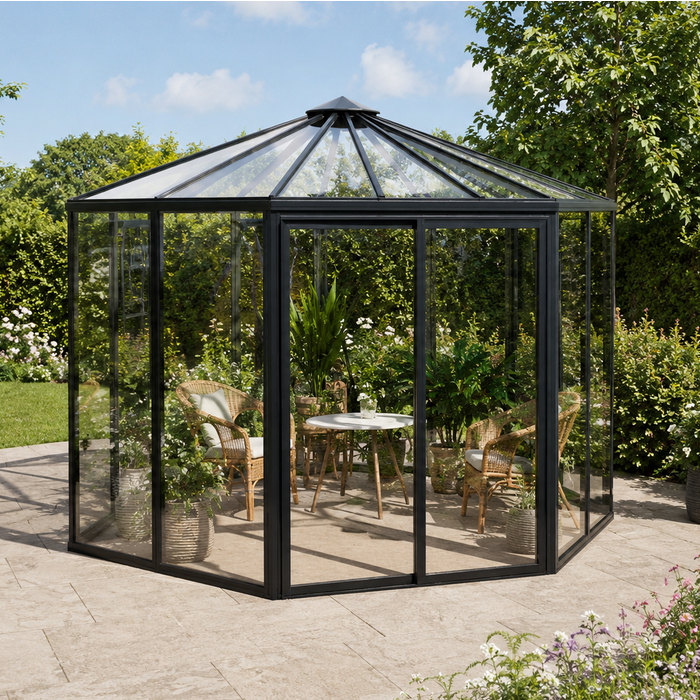
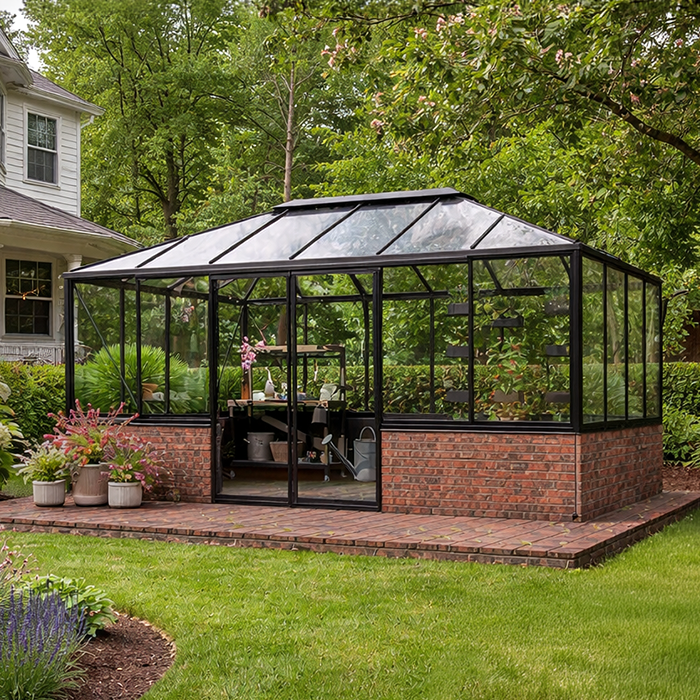
How the frame sits against its surroundings changes how large it feels. A lean-to finished in a color matched to the house trim reads as part of the building, much like a conservatory, and the listing for the lean-to model we feature offers 37 RAL frame colors, built-in rainwater drainage and heights of 98 or 106 inches. A six-sided greenhouse has no long side, so it looks smaller than a rectangle of the same floor area and finished from every angle, which suits a spot that is seen from all round and has no boundary wall to lean on. Bloomcabin’s Hexagon Greenhouse is that pavilion shape, and its page names the same kinds of spot: near a patio, at the end of a garden path or as a focal point on an open lawn. The footprint is compact, listed at 107.4 by 62.0 inches with a 102.1-inch ridge, so it fits a smaller yard as long as you can walk round it. It has a sliding door, a roof vent that takes an automatic opener and a choice of 4 mm tempered, self-cleaning or solar-control glass. A pyramid roof set on a low brick or stone wall that you build ties the glass to paving and garden walls, and the masonry grounds a pale frame.
Size and what happens inside
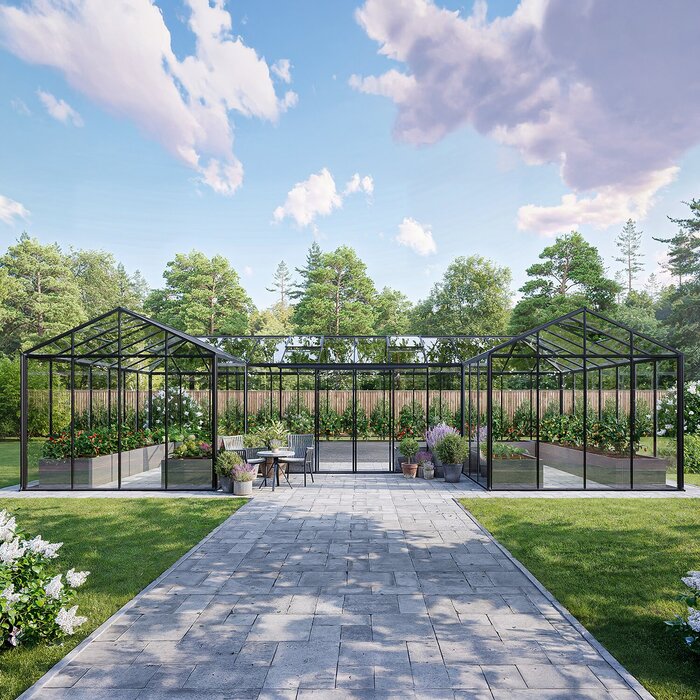
Measure the spot, then decide what happens inside. Seed trays and a few tomato plants fit a compact greenhouse. If herbs and seedlings are all you grow and the only free space is a fence or patio wall, a walk-in model is more than you need: the Aluminum Mini Wall Greenhouse installs flush against the wall, with roof vents and a sliding door, and keeps the patio usable in front of it. Its page gives 14 sizes in the description and 3 in the specification, so check which sizes the configurator actually offers for your wall. A chair, a potting bench or a small table needs more floor and more headroom, and a model sold as a garden room is meant for sitting as much as growing. The Orangerie is Bloomcabin’s version: 4 mm tempered safety glass, roof vents and a gutter as standard, and a chimney outlet as an option if you want to heat it for winter evenings. Spend at that level only if the structure will be used as a room; for growing alone, the freestanding models below are the simpler route. Between two sizes, the larger one is usually easier to live with, as long as you can still walk round it to clean the glass and open the vents.
Many towns and HOAs limit accessory structures by footprint or height, and some require a permit above a certain size, so settle that before ordering.
Glass or polycarbonate
- Tempered glass is clear, looks like a classic greenhouse and does not yellow. It is heavier and needs a solid, level base.
- Polycarbonate is lighter, harder to break and diffuses light, which some plants prefer. It is less transparent and looks more utilitarian.
- Specialty glass (self-cleaning, solar-control or frosted) is worth the money in a greenhouse that doubles as a sitting room, or where privacy matters.
Many models let you mix materials, for example glass walls under a polycarbonate roof.
Ventilation
Vents control both temperature and humidity, and humidity is what botrytis (gray mold) feeds on: UConn Extension says the disease can only be managed with a combination of methods that includes reducing humidity and leaf wetness, and that moving air helps cut moisture on plant surfaces. Greenhouses overheat faster than most people expect, even in April, so look for roof vents plus a door on two sides if you can. Automatic openers, offered as an option on some of the models below, open and close with the temperature, so the plants survive a sunny afternoon when nobody is home.
The base
Every greenhouse needs a flat, stable base: a supplied aluminum base frame, a concrete pad, paving or a low wall, depending on the model. Wall-base designs raise the greenhouse and tie it into the garden, but the wall is a separate building project with its own cost. Ask what is included before comparing prices.
Assembly and delivery
Large glass greenhouses are building projects. Some brands supply detailed manuals for self-assembly and still recommend professional installation, as the retailer does for the lean-to. Allow time or an installer, and confirm that a delivery truck can reach your yard.
The models we picked
All the models are from Bloomcabin and are configurable, so size, glazing, color and doors change the price. Prices start from a base configuration, so confirm your own configuration, delivery and installation costs on the retailer’s site. We have not tested these greenhouses, and the details come from the retailer’s product information. For most yards the decision comes down to the two starting points below.
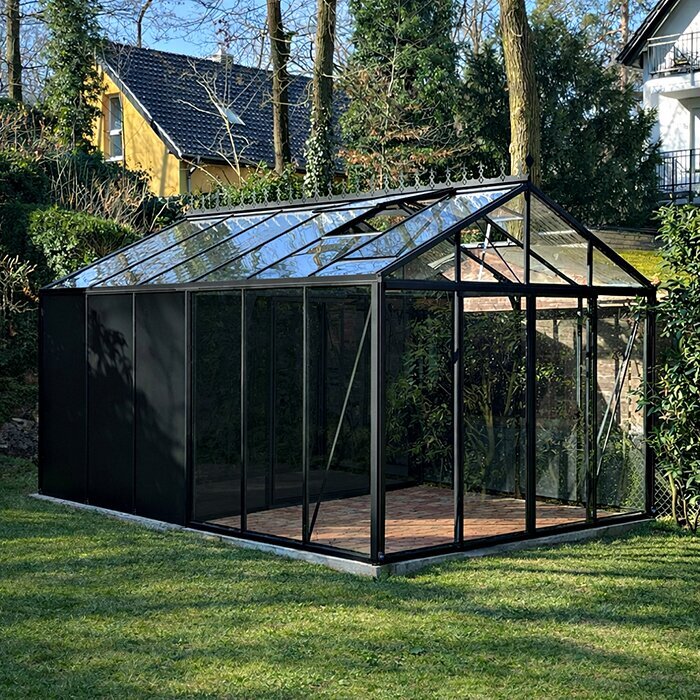
Is the sunniest spot away from the house, or do you need more than 154 sq ft, the lean-to’s largest listed size? Then the freestanding model is the one, with light from every side. If the right wall faces south or southeast and you want the greenhouse a few steps from the kitchen door, finished in the trim color so it reads as part of the house, the lean-to fits; budget for the installer the retailer recommends. Take the storage version only if you have no shed, since its storage room uses floor you would otherwise plant. The pyramid model makes sense only if you already plan a brick or stone wall base, which is a separate building project.
The picks
Prices and availability update from the retailer feed.
Freestanding with the widest size range
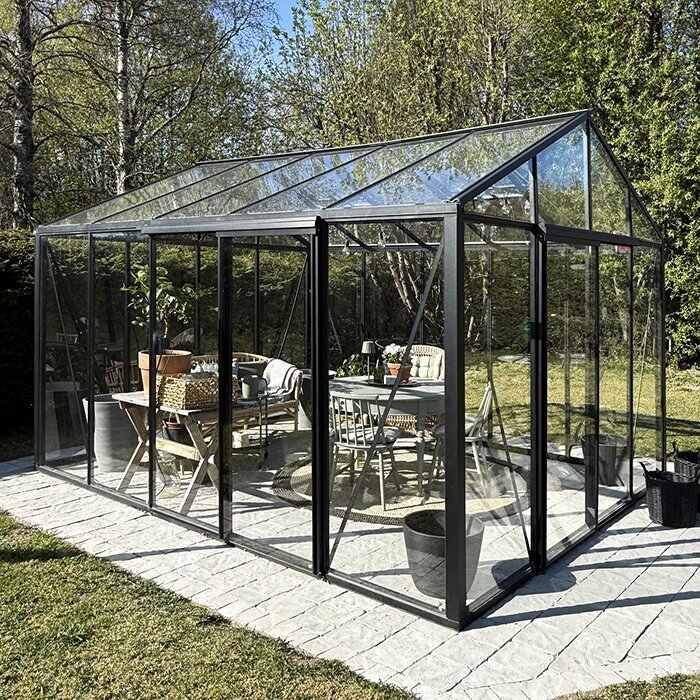
Aluminum Greenhouse
Offered in 22 size configurations from about 41 to 302 sq ft, in Classic, Modern, Master and Victorian styles, with a range of RAL frame colors. Glazing runs from polycarbonate to several tempered glass types, and roof windows have manual openers, with automatic openers as an upgrade.
Price as of
Six-sided pavilion seen from every side
Hexagon Greenhouse
A compact six-sided aluminum greenhouse, listed at 107.4 by 62.0 inches with a 102.1-inch ridge. Bloomcabin places it near a patio, at the end of a garden path or on an open lawn, where its pavilion shape is seen from every side. It has a sliding door and a roof vent that opens manually or with an automatic opener, with 4 mm tempered, self-cleaning or solar-control glass.
Price as of
Against a house wall
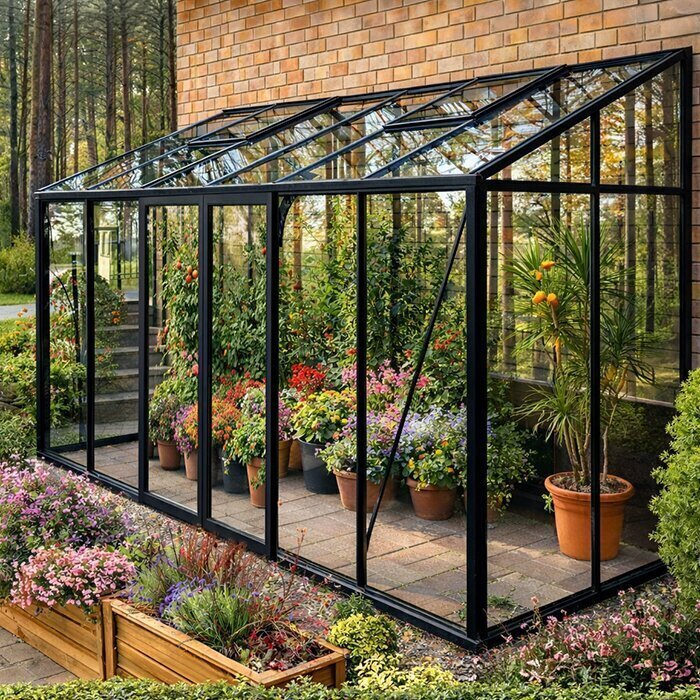
Aluminum Lean-To Greenhouse
Built to stand against an existing wall, in 12 sizes from 40 to 154 sq ft and heights of 98 or 106 inches, with built-in rainwater drainage and 37 RAL colors to match the house. The retailer recommends professional installation.
Price as of

For a patio or side yard
Aluminum Mini Wall Greenhouse
A shallow model that fits flush against a wall or fence, for herbs, seedlings and small plants where a walk-in greenhouse will not fit. Roof vents and a sliding door are listed. The page gives 14 sizes in its description and 3 in its specification, so confirm the size range in the configurator.
Price as of
With a storage room
Aluminum Greenhouse with Built-In Storage
A freestanding greenhouse with a storage room behind tinted glazing, so tools stay out of sight. It comes in 12 sizes from about 59 to 302 sq ft at 91.3 inches tall, with 4 mm tempered glass on the growing side.
Price as of
On a brick or stone base
Pyramid Greenhouse for Wall Bases
A pyramid-roof greenhouse made to sit on a wall base or other solid foundation that you build, in brick, concrete or natural stone, so the base can match the garden. The page lists 6 sizes from roughly 60 to 153 sq ft.
Price as of
As a garden room
Orangerie Large Backyard Greenhouse
A large aluminum structure with 4 mm tempered safety glass, meant for sitting and gathering as much as growing. Roof vents and a gutter are standard, a chimney outlet is an option for heating, and it ships as a kit with an assembly manual.
Price as of