Indoor Outdoor Rugs: Compare Exposure, Backing and Everyday Care
A synthetic fiber or a photo on a patio does not make a rug outdoor-ready. Define the exposure, check the backing and floor, and compare the cleaning you can actually do.
By DecoraMintPublished 7-minute readMore in Decor
In this guide
We may earn a commission from links on this page, at no extra cost to you. Affiliate disclosure
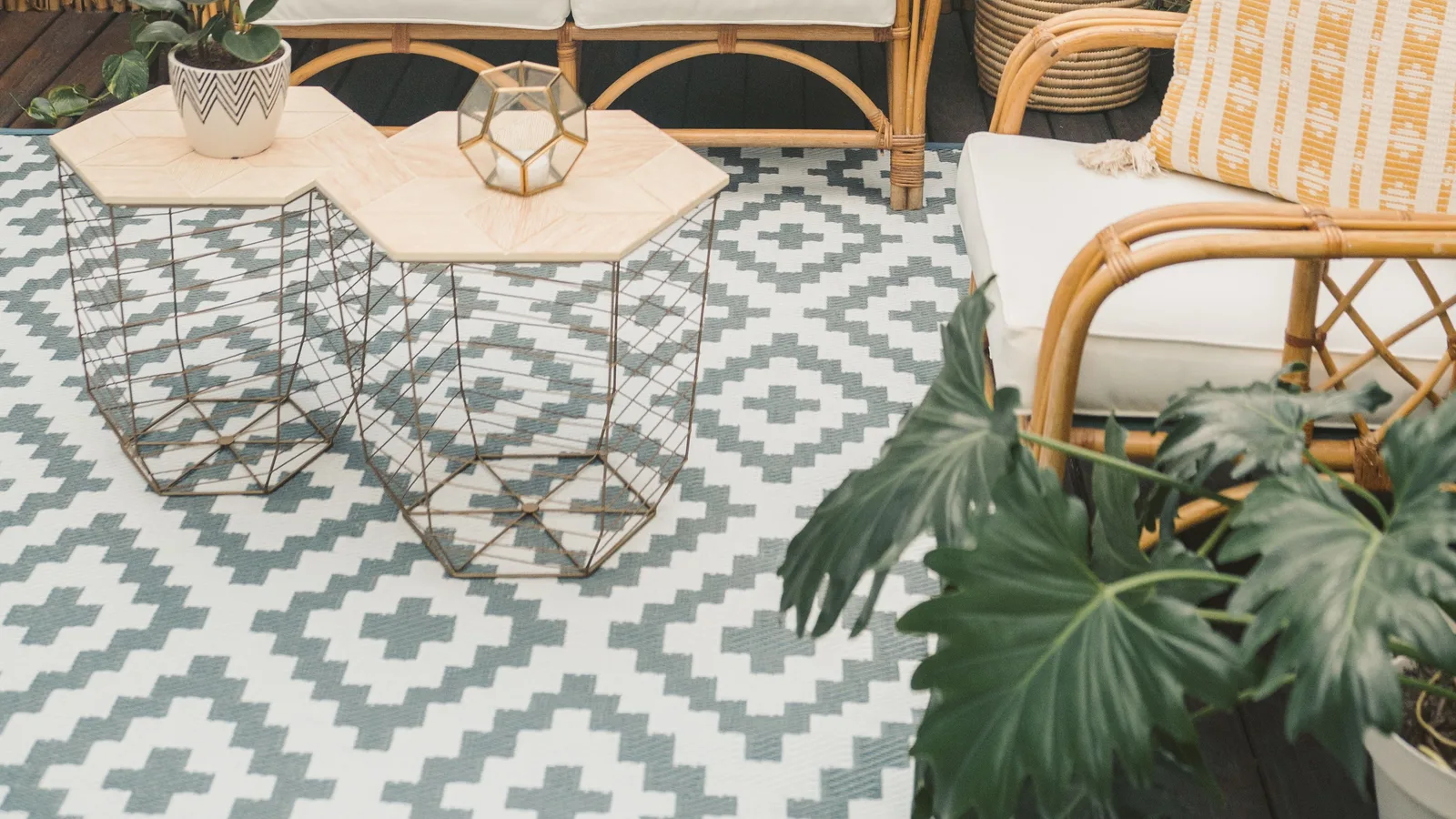
The morning after a storm tells you more about an outdoor rug than any listing: is it flat and nearly dry, or is there a dark, heavy patch where water pooled underneath and the corner in the shade still smells of damp? Rain is the easy test. The puddle that sits for three days is the hard one. An indoor outdoor rug is one the maker says can live in those conditions, so read what the maker says about exposure, backing and drying, not just the fiber. The patio photo above shows a rug in a seating area; it does not identify fiber or weather performance.
Fiber and backing
Polypropylene appears in rugs sold for both uses, and sellers describe it as non-absorbent and mildew resistant. Retailers are the source for that, and the phrase indoor outdoor does not promise a waterproof rug, so go to the listing for a stated outdoor approval, UV or lightfastness language and care and storage instructions. Backing matters as much as the face, and it is the part the tag leaves out: the FTC says backings and pads are exempt from the fiber-content label on rugs, so the listing has to describe the back, and if it does not, ask. The FTC guidance covers the label rules. Two rugs in the same fiber can have different backs, edges and care.
IKEA’s MORUM dark-gray rug, article 40203557 lists a polypropylene surface and synthetic-rubber backing, and IKEA describes its outdoor approval as being for moderate-to-warm climates with rain. That is far more useful than an unlimited all-weather promise. Super Area Rugs’ Zarina Woven Blocks Tan is a machine-woven polypropylene rug for indoor and outdoor use; its jute-look refers to appearance, not fiber, and the listing allows hosing or spot cleaning with mild soap and water, then air drying. They show what to compare, and a similar pattern elsewhere does not mean the same backing or instructions.
The two listings also point at different spots on the same house. MORUM’s approval is written for weather: rain, in moderate-to-warm climates. Zarina’s description says indoor and outdoor use but names living rooms, dining rooms, entries and covered patios as its settings and gives no climate or rain note, which points to a roofed porch or a rug that moves between kitchen and terrace; for an exposed deck through a wet autumn, ask the retailer first. For the open patio, a stated rain approval like MORUM’s is the thing to find; for the covered porch, Zarina’s hose-off care is the relevant detail, and its backing is the question to put to the retailer before it goes on soft wood.
Both product links are cited for their specifications. To compare other polypropylene patterns, the Super Area Rugs store opens on its homepage, not on a preselected rug. Its Indoor / Outdoor category, under All Rugs, holds the rest of the Zarina line next to Tortuga, a polypropylene rug with a textured multi-level weave that throws small shadows a flat Zarina face does not. Both come in the same six listed sizes as the Zarina above, including a 1-foot-10 by 7-foot-6 runner. Confirm the exact product and its care instructions there, and note that we may earn a commission if you buy through it.
Exposure, mildew and drainage
Walk the site. If a listing says only outdoor, find out whether that covers occasional rain, constant exposure or year-round use; a care label with storage instructions says more than a weatherproof slogan. A covered porch, an open patio and a deck are different settings even at the same house. Note where rain reaches, where furniture shades the rug and where water collects. A rug that stays wet is a mildew risk, and EPA’s mold guidance says that drying wet or damp items within 24 to 48 hours of a leak or spill will, in most cases, stop mold from growing. A rug laid flat on a solid surface that drains slowly will take longer to dry than the same rug on spaced boards. Lift it periodically and check what is underneath, such as trapped debris, moisture or discoloration, and do not use a rug to hide a damaged surface or a drainage problem.
IKEA’s MORUM listing warns that structured rugs or hard edges can mark soft wood even with an anti-slip underlay. Pads are not a guarantee, and the deck or floor maker’s guidance counts as much as the rug’s. Outdoor-rated rugs are not compatible with every painted, stained, composite or wood surface.
Cleaning and storage
Hose-cleanable and machine-washable are different instructions. IKEA’s MORUM directions are mild detergent, a soft brush, thorough rinsing and complete drying before use, with no tumble drying. That does not permit a pressure washer, and neither does an instruction to hose a rug. Use pressure washing only if the maker says it is allowed for that exact rug.
Ruggable’s outdoor-care article describes a different construction, a washable outdoor cover on a pad, and separates cover care from pad care. It advises against leaving the rug wet for long, and recommends storing it during prolonged harsh weather. Whether a rug can stay out all winter is a question for the maker’s climate and storage guidance and your own conditions. If you cannot wash and dry a large rug at home, a smaller one you can handle is a better choice.
Plan the off-season. Where will it go, and can one person move it without dragging the backing across rough edges? A tight improvised fold is a poor plan.
Size, shape and scale
Place the furniture first and tape the outline. Include chairs pulled back from the table and the route from the house to the seating. A rug that seems generous under an empty table can end under the chair feet when people sit down. Use the listed inches, not the size category.
An 8-by-10 rectangle is 80 square feet and a 9-by-12 is 108, a difference of 28 square feet. The bigger label does not add an equal border all around. In a 7-by-9 foot furniture group, an 8-by-10 leaves 1 foot of rug on each axis in total, or 6 inches per side if centered, while a 9-by-12 leaves 2 and 3 feet. Those are hypothetical numbers to show the arithmetic, not recommended clearances. Real listings shrink them further: Zarina’s sizes run 7 feet 10 inches by 10 feet and 9 feet 10 inches by 12 feet 10 inches where a size filter says 8x10 and 9x12, so on that same 7-by-9 group the smaller one leaves 10 inches across in total, 5 per side.
A round rug suits a circular seating group but gives no corner space: an 8-foot circle is about 50.3 square feet against 80 for an 8x10. Draw the chair feet against it first. A doormat or entry rug has a different job, so check its exposure, height and backing against the door and floor. Installed outdoor carpet is a separate project, where substrate, attachment and drainage need the system’s own instructions, so do not glue a loose rug to a deck. Pattern scale changes under furniture, with a center motif lost under a table while a border stays visible.
Using one indoors
If the maker permits indoor use, an indoor outdoor rug can suit a dining area or entry where you want a flat, simple surface instead of deep pile. But a porch rug may feel wrong beside a bed, so ask about samples or returns if the touch matters. Check the combined height of rug and pad against the door, and follow the chair rules for a dining room. Edges, backing and cleaning still need attention.
The indoor case is also where the trade-off becomes a real choice. If the rug will sit under a dining table and takes spills most nights, the hose-off polypropylene is the practical surface. If the spot is a living room and the reason you looked at an outdoor rug was its flat, low profile, a wool flatweave also lies flat under chair legs, in wool instead of plastic fiber. BENI’s Clary, for example, is 100% wool in the Zahara flatweave, which BENI puts at roughly 0.4 inch thick; the link opens its product page. What you give up is the hose: BENI’s care guide asks you to blot a spill without pressing or rubbing and recommends a professional rug cleaner when one soaks through, and it warns that strong direct sun can fade the colors. It is also woven to order, with 14 to 18 weeks quoted for 9 by 12 and smaller. Keep it indoors, away from the patio door that lets the rain in. For related textile guides, see the decor collection.
Retailers to browse
Compare colors, sizes, materials and return details on the retailer’s current listings.
- Go to Super Area Rugs
Super Area Rugs
Opens Super Area Rugs’s store (area rugs).