Dining Room Rugs: Choose for Chair Movement, Meals and Cleaning
A dining rug has to take chairs sliding out and a spill after dinner. Measure the meal, not just the table, then check construction at chair-leg level and a cleaning plan you will follow.
By DecoraMintPublished 6-minute readMore in Decor
In this guide
We may earn a commission from links on this page, at no extra cost to you. Affiliate disclosure
Slide a dining chair back the way you do at the end of a meal. If its rear legs drop off the rug onto bare floor, the rug is too small or sits in the wrong place, and the pattern matters little by comparison. Chair legs are the test a dining rug has to pass, and the second test comes after dinner, when something lands on it.
A bare floor is a fair answer too. A room with frequent messy meals, or a layout where a rug would crowd a door or a path from the kitchen, may be easier to live with uncovered. Add a rug when it gives you something you want, and the table, chairs and walkways still work on top of it.
What the rug is for
In an open plan, the rug marks the dining area as its own zone beside the sofa. In a separate dining room it adds color and breaks up a wide stretch of hard floor. Settle on the main job first so you do not trade daily convenience for an effect you stop noticing.
Then think about how much of the rug will show. A table and a set of chairs cover most of the middle, so a large central medallion can vanish while a border or a repeating allover pattern keeps reading around the furniture. A glass top reveals more than a solid one. Judge the design in the furnished view.
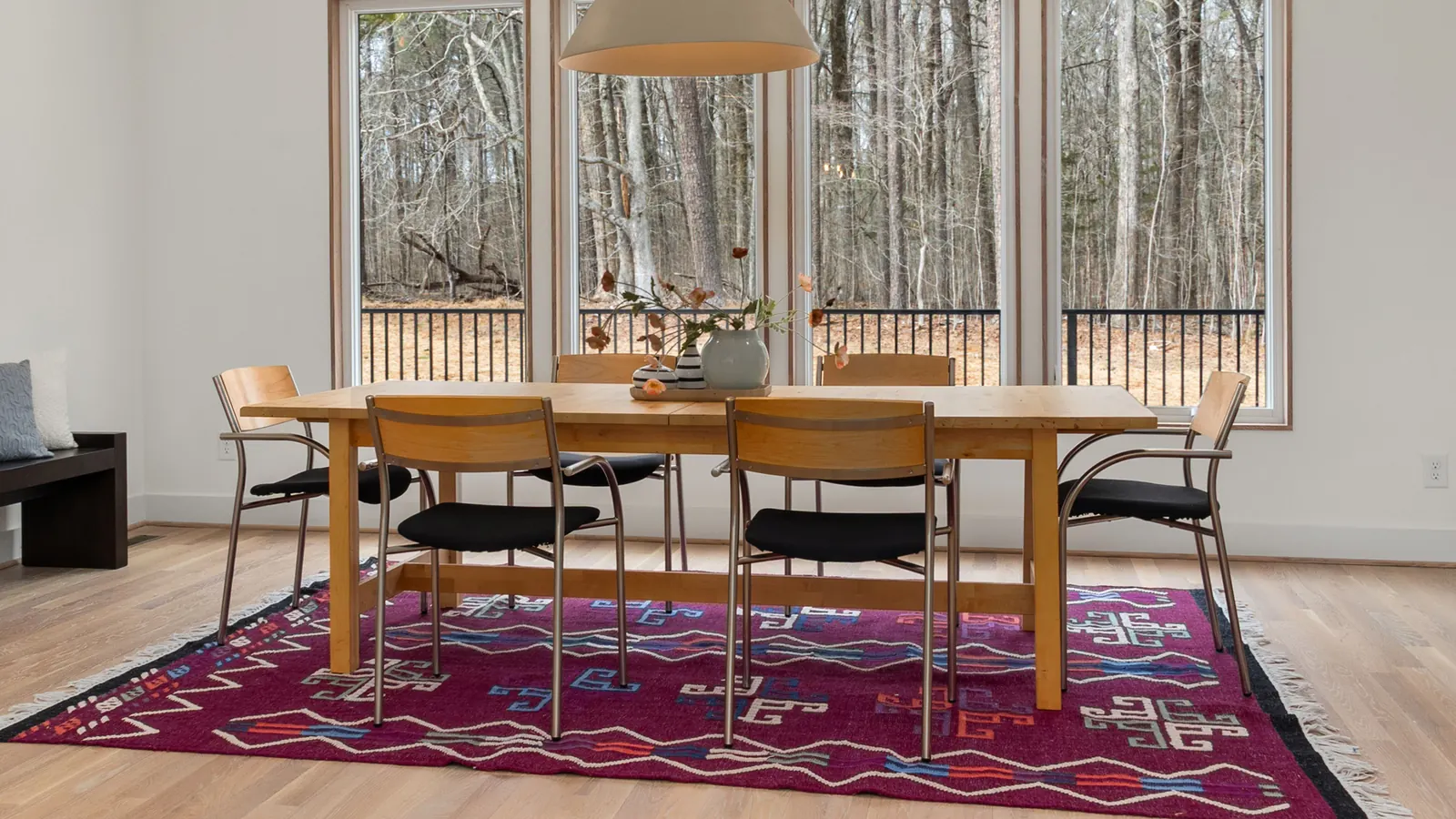
Take a narrow dining room with a long oak table, white walls and a single window at one end. A bold magenta or deep blue rug turns the floor into the room’s anchor: the dark table legs stand out against it, the pale walls feel taller by contrast, and the window light pools along the rug’s near edge in the afternoon. A coarse flatweave in the same color gives a matte surface that keeps the room casual, while a smooth low pile reads more formal and shows chair tracks. The flatweave suits this room better, with a border wide enough to stay visible around the chairs.
Now take an open plan where the dining table sits ten steps from a gray sofa and a patterned curtain runs along the wall. A quieter wool-look weave in cream and tan lets the curtain lead, and a tight geometric repeat at small scale keeps the table zone from competing with the living area. Because place settings change with the season and the rug stays all year, pick colors you like with the table bare, then repeat one small color from the rug in table linens instead of buying a matched set.
Measure the meal
Set the table where it normally stands, pull each chair out far enough for someone to sit down and get up, and measure the area that arrangement covers. Check the ends separately from the sides, because armchairs and end chairs are usually bulkier than side chairs. Room & Board’s dining-rug guidance recommends sizing for chairs in their pulled-out position, and a general allowance can shortlist sizes. The overall dimension rules for each room are in choosing the right rug size, which is the better starting point if you have not yet settled on a table.
Mark the outline on the floor with painter’s tape or a sketch on paper, sit in each chair, and walk around the edge with the seats occupied. Open the cabinet doors nearby and trace the path from the kitchen. A rug can fit the table perfectly and still be wrong for the room.
A table with leaves needs two plans. If it extends by 24 inches, centering it moves each end chair by half that, which can put the end seats off the edge of a rug sized for everyday use. Decide whether the rug covers the largest arrangement or whether holiday dinners will simply run over the edge.
Shape comes from the whole layout. A round rug suits a round table when every chair stays on it around the full circle. An oval table does not need an oval rug, and a square or rectangular rug often fits the room better. A bench on one side changes the movement, since it slides back and people enter from the ends, and a banquette against the wall leaves only the freestanding chairs to account for. If the dining area adjoins the living room, leave the path between the two clear of the rug edges.
What chair legs and spills ask of the weave
A flat room photo hides thickness and flexibility, so look for a close-up of pile, backing and binding; a good listing shows all three and states the pile height. Loops and deep pile can catch chair feet and make a chair hard to slide. Fringe in the zone where chairs and people cross gets stepped on. Edges beside a walkway need to lie flat. And the rug and any pad together add height, so a dense low-profile surface and a deep textured one handle chairs very differently even when the label shows the same fiber.
Cleaning is the other half of the choice. Decide in the shop where a spilled glass of red wine would be treated, whether the furniture has to move first, and what a large spill would involve. If that sounds unrealistic for your household, choose a different construction or leave the dining floor bare.
One rug maker’s advice cuts against the instinct to buy plain and flat. BENI weaves both kinds in wool, and its craft page credits its Zahara flatweave with letting chairs move freely and cleaning up easily. Yet the same page quotes co-founder Tiberio Lavo-Navia saying that a patterned low-pile Atlas rug fares better under a dining table in the long run, because stains come out of it more easily than out of a neutral, low-profile rug that may hold the memory of a spill. BENI’s Dining Room collection shows both approaches, though most of it is knotted Atlas, a pile averaging about 1.25 inches, which is the depth this section warns can catch chair feet. For chairs that slide, the pieces to compare there are the Zahara flatweaves, Terry and Cerise, about 0.4 inch thick, and Freunde, listed in Atlas Low Pile, which its page puts at about 0.75 inch. Under a long oak table, Terry’s brown and apricot stripes keep the chair legs reading as planted on one level plane, while a patterned low pile blurs crumbs and small marks into the design. Each piece is woven to order, with Zahara sizes up to 9 by 12 quoted at 14 to 18 weeks, and BENI’s FAQ treats orders as final 24 hours after purchase, so the taped outline has to be right first.
Room & Board’s polyester-rug instructions separate indoor from outdoor care: indoors it calls for prompt blotting and testing an approved detergent on a hidden spot, while outdoor care is different. Even within one fiber, the care instructions travel with the specific rug.
“Washable” needs a precise reading. Find out whether the whole rug, a removable cover or only the smaller sizes can go in a machine. A good answer names the size you want and fits your washer drum, with a drying method you can actually use. A pattern with several colors hides small marks better than a solid field, though it still needs cleaning. A table used for homework, crafts and daily meals wants a plainer routine than one set mostly for occasional dinners.
Floor, pad and table
Rug, pad and floor work as one stack. Use a pad cut to the rug maker’s recommended dimensions, since one that pokes out past the edge is both ugly and a tripping point, and match the pad to the floor finish and any underfloor heating. A rug that creeps on a hard floor is a slip hazard under pulled-out chairs, so a rug that no suitable pad or backing can pin in place should stay out from under a dining table. After placing everything, make sure the table is steady and the chairs roll or lift as intended. If the table rocks, follow the furniture maker’s leveling instructions before blaming the rug.
When the setup can be moved safely, lift the edges now and then and look underneath for curling, shifting or trapped moisture, and fix what you find instead of covering it with the table.