Choosing the Right Rug Size for Every Room
The right rug size depends on the furniture group, not a rule. Common sizes in inches, layouts for living rooms, bedrooms and dining tables, and a quick floor mock-up to check.
By DecoraMintPublished 9-minute readMore in Decor
In this guide
We may earn a commission from links on this page, at no extra cost to you. Affiliate disclosure
A rug that stops an inch short of the sofa’s front feet looks like a mistake. One that reaches them looks planned. Most sizing trouble comes down to that edge, which is why the useful first question is where the legs of your seating will land, not how big the room is. Once you know that, the size usually follows from the table of inches below. For the wider room around the rug, our decor guides carry on from here.
Living room: pick the placement, then the size
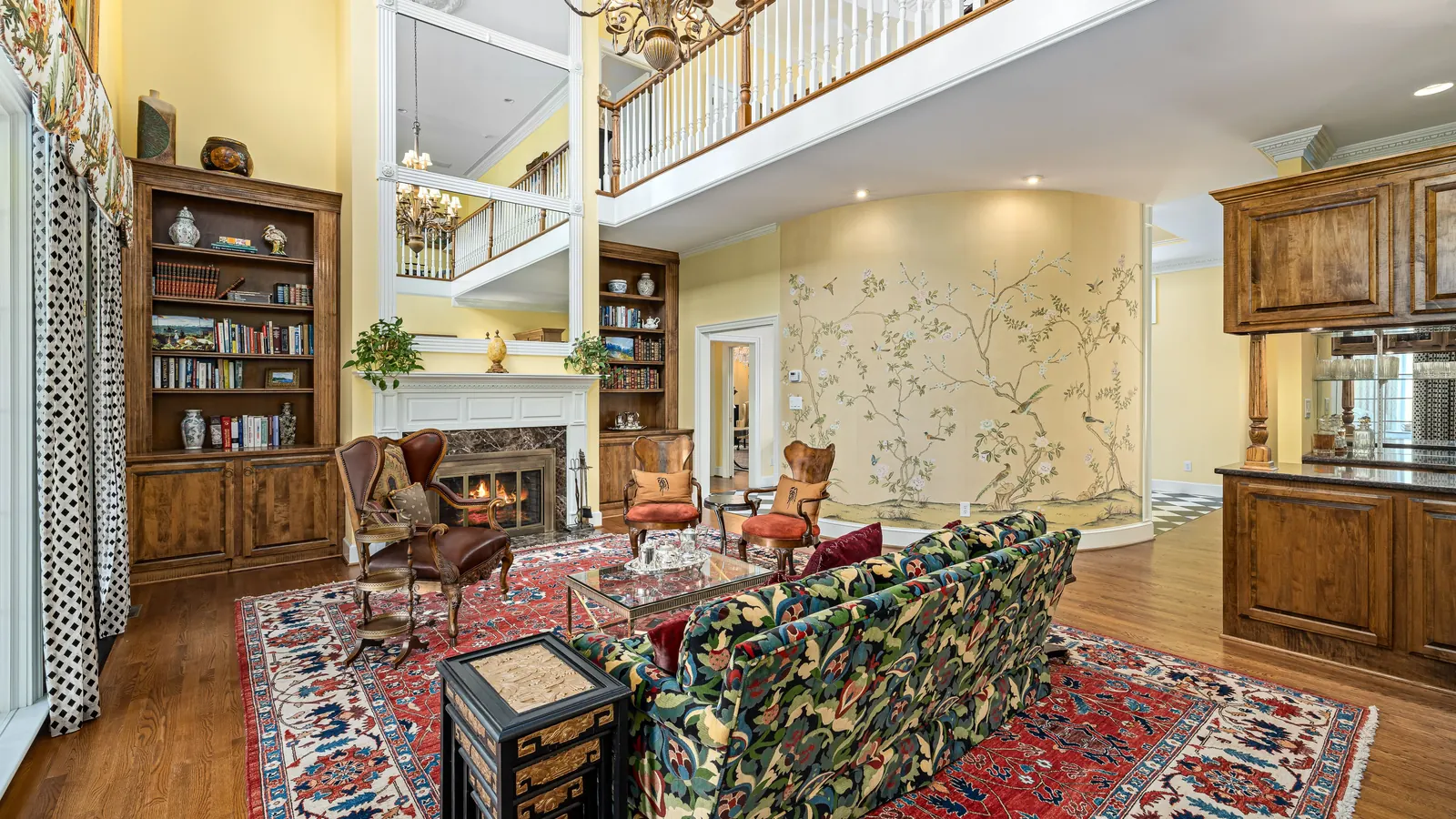
There are three placements. All legs on gives the group one shared surface. Front legs on, with the back legs off, ties the seats to the rug while leaving the rug tucked under the sofa edge. Legs off, with only the coffee table on a smaller rug, makes a deliberate island. Ruggable’s size guide describes the front-legs-on and no-legs-on options and pairs rugs with room sizes: a 9 by 12 for about 12 by 18 feet or larger, an 8 by 10 for roughly 11 by 13 feet or a little more (with a 12 to 18 inch border of bare floor), a 6 by 9 for rooms about 11 by 13 or smaller, a 5 by 7 for a small living room and a 4 by 6 for a small apartment-size space. That is one retailer’s pairing, and your furniture group overrules it.
Front legs on is the usual compromise, but the front feet must sit fully on the rug, not half on a thick edge that rocks the chair. For the island look, show enough rug around the coffee table to read as a rug; a table that swallows it makes the rug pointless.
Center the rug on the seating group, which may not be the middle of the room. In an open plan, a sofa and two chairs can form their own island while the path to the kitchen runs outside it.
Sofa and facing chairs
Tape the sofa, coffee table and chairs as one group. Then compare the rug with its long edge along the sofa and turned the other way. The turned layout often reaches the chairs better even though it ignores the longest wall. Test where chair feet land with a person in the seat, since chairs pushed in for a photo sit differently. A swivel or recliner needs its full operating space on the floor, and the rug must never interfere with the mechanism.
Sectional with a chaise
Use the full outside footprint, chaise included. The rectangle between the seats is where the coffee table goes, but the rug has to reach the seat edges as well. Check both the long sofa and the chaise end: a rug that reaches the sofa and stops short of the chaise foot leaves an edge that looks accidental. If that is the problem, extra length along the sofa will not fix it; you need more depth. Leave the route around the open end of the chaise clear, and do not feel obliged to match the bare strip on every side.
A small zone
A reading corner needs the chair, a side table and the place your feet rest, and a 4 by 6 or 5 by 7 can do exactly that. It cannot pass as a base for the whole living room, so use it only for the corner it is meant for.
What the rug does to the room
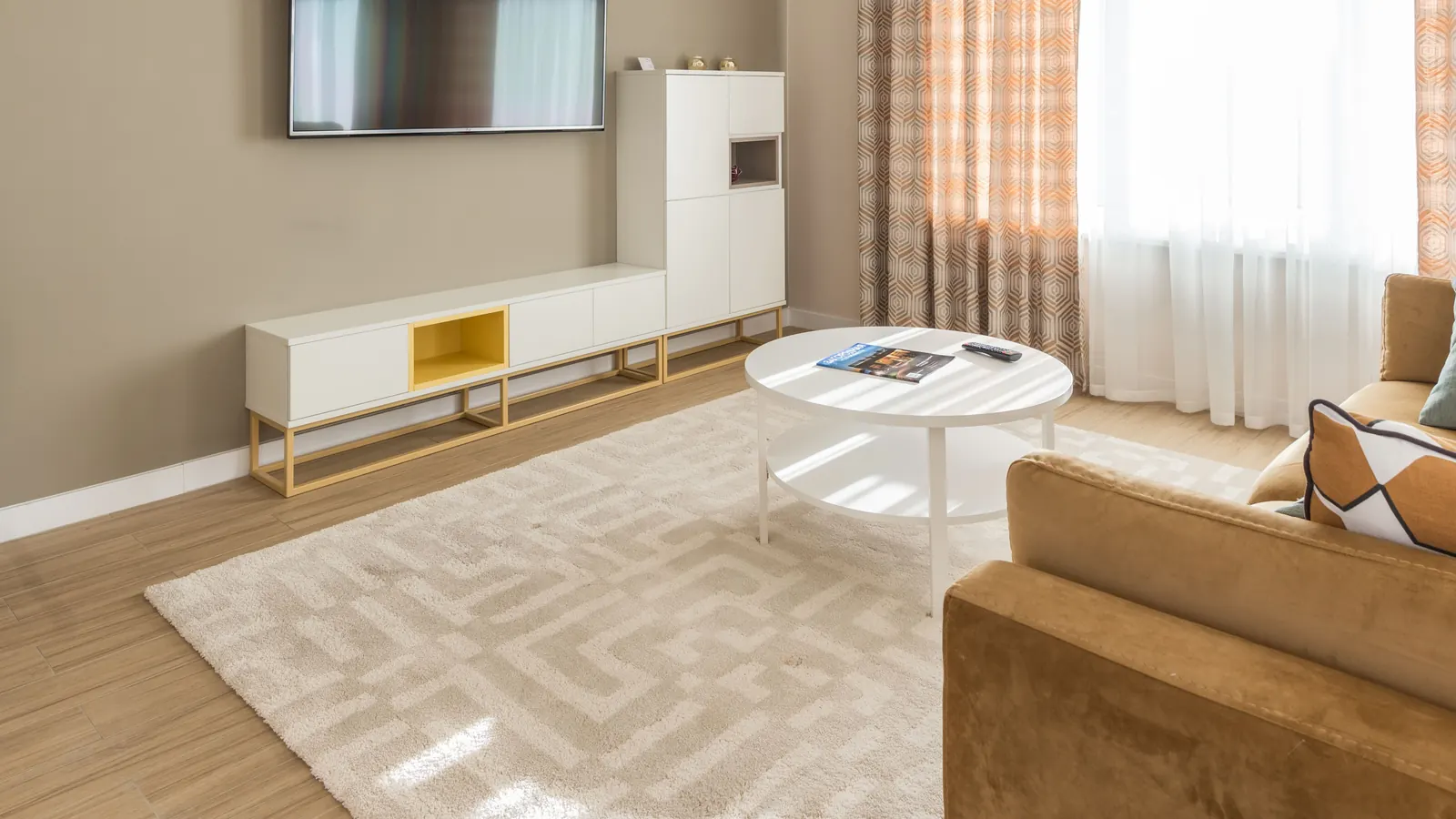
A rug is the largest color field on the floor, so its tone against the sofa matters more than its pattern. A wool flatweave striped in stone and slate under a deep green sofa lets the oak legs show at the edge and keeps the group from sinking into the boards. A thick cream shag under a low sofa adds a heavier, softer texture that suits bare feet and a darker floor.
Pattern scale tracks room scale. A large geometric under a 9 by 12 gives a big living room one clear anchor, while a fine pattern or plain weave under a 5 by 7 keeps a small room from feeling busy. A main color one step lighter or darker than the sofa keeps the two from merging; let the coffee table’s material, glass or wood, decide how much of the rug shows through.
Sizes in inches
These are conversions of nominal sizes in feet, so confirm the listing’s exact dimensions and tolerance.
| Nominal size | Inches | Compared with the one above |
|---|---|---|
| 4 × 6 feet | 48 × 72 | A bedside landing or small entry |
| 5 × 7 feet | 60 × 84 | A foot wider and longer |
| 5 × 8 feet | 60 × 96 | Same width as 5 × 7, a foot longer |
| 6 × 9 feet | 72 × 108 | A foot more each way |
| 8 × 10 feet | 96 × 120 | A full seating or underbed arrangement |
| 9 × 12 feet | 108 × 144 | More coverage in both directions |
| 10 × 10 feet | 120 × 120 | A square footprint for a squarish group |
| 10 × 12 feet | 120 × 144 | Two feet more in one direction |
Handmade rugs turn that tolerance into inches, and one rug shows both the problem and the ways around it. BENI’s Clary is a flat, hand-woven wool rug in stripes of sage and soil, from BENI’s collaboration with the designer Colin King, and the link opens its product page. Two things make it worth a look for the layouts above. It is a flatweave that BENI gives as roughly 0.4 inch thick, which matters for the front-legs-on placement, where a thick edge can rock a chair. And its size list covers the awkward cases: 3 by 5 to 12 by 15, including 8 by 8 and 10 by 10 squares for facing seats, a 10 by 14 for a group that outgrows a 10 by 12, and a runner from 2 1/2 by 5 to 3 by 10, with custom sizes handled by its designers. The same page says final sizes can vary by up to 5% from what is ordered. On an 8 by 10 that is up to about 5 inches across the 96-inch width and 6 inches along the 120-inch length, enough, at the extreme, to move a sofa foot from the rug to the floor beside it. If your taped outline only just reaches a furniture foot, a handmade rug in that nominal size is not a safe fit: step up a size, or ask for a custom size with the margin built in.
Read the step between sizes as a change in one dimension. From 5 by 7 to 5 by 8 only the length grows, so a group that is too wide for 60 inches stays too wide. From 5 by 8 to 6 by 9 each edge gains six inches with the centers aligned, which can be enough to pull an edge off a furniture foot.
Orientation can matter as much as size. An 84-inch sofa centered on the 120-inch edge of an 8 by 10 leaves 18 inches of rug past each end. Turn the rug so the 96-inch edge runs along the sofa and the overhang drops to 6 inches, while the rug reaches 24 inches farther toward the coffee table and the chairs opposite. The first layout favors a side chair along the sofa line, the second a chair across the table. Mark both and see which feet and walking routes meet an edge. If neither joins the group, find the short dimension before moving up a size. A 6 by 9 or a 9 by 12 behaves the same way, and a 10-foot square suits facing seats around a central table. A centered 10 by 12 in a clear 12 by 14 foot room leaves 12 inches on each side, though a hearth, built-ins or door swings can make that tidy fit impractical. Large rugs are heavy, so plan how one gets under settled furniture and how it can be cleaned.
Bedrooms
Measure the bed frame, not the mattress, including any bench, projecting legs and drawers. Then decide whether the nightstands should sit on the rug and where your feet land in the morning. A rug under the lower part of the bed concentrates coverage at the sides and foot, and one extending toward the headboard takes in the nightstands. A queen mattress is 60 inches wide, so centered on the 60-inch width of a 5 by 8 it leaves no rug showing at the sides, before allowing for a wider frame. Rotating or shifting the rug changes what is covered while the frame stays put. Two bedside rugs or runners put coverage where you step without sliding a big textile under heavy furniture. Each should lie flat and let doors and drawers open.
Dining table
Set the table where it normally stands and pull each chair out far enough to sit and stand. IKEA’s dining-rug guide says the rug should preferably extend 24 to 28 inches beyond the table on both sides so the chairs stay on it. Against that range, centered tabletops give these margins:
| Table and rug | Margin beyond the tabletop |
|---|---|
| 36-inch-wide table on a 4-foot-wide rug | 6 inches each side |
| 36-inch-wide table on a 5-foot-wide rug | 12 inches each side |
| 36 × 60-inch table on a 6 × 9-foot rug | 18 inches at the sides, 24 at the ends |
| 42 × 84-inch table on a 9 × 12-foot rug | 33 inches at the sides, 30 at the ends |
| 42 × 84-inch table on a 10 × 12-foot rug | 39 inches at the sides, 30 at the ends |
The first three fall short of IKEA’s range at the sides, and the last two clear it. An extendable table needs the same check with its leaf in.
Square, round and oval
A square rug suits a nearly square group, but its corners can poke into routes that a round rug leaves open. A 60-inch round table centered on a 10-foot square leaves 30 inches between the tabletop and the rug edge along each straight centerline. A square also narrows the choice of pattern, since not every design is woven at that size. BENI’s 10’ x 10’ collection gathers the designs it makes at that size, in both its flatwoven and knotted constructions. On a square, a centered medallion or a border frames the table evenly from every chair, while a stripe sets a direction that the room’s longest wall or window will either echo or cross, so decide which way the lines should run before ordering. An oval narrows toward its ends, so its listed maximum length and width cover less corner than a rectangle with the same numbers. Use the real outline for corner chairs or a rectangular table, and request an overhead view from the seller if the curve is unclear.
The floor mock-up
Outline the shortlisted sizes with removable markers that are safe for your floor finish. Walk the usual routes, sit in the chairs, and open doors and drawers. Count the rug and pad together wherever clearance matters, since a low-pile label alone does not promise that a door will clear them. A published thickness helps: add the pad to a figure such as Clary’s roughly 0.4 inch and compare the total with the gap under the door. Follow the rug and flooring makers’ guidance on compatible backing and pads, and size a pad as its instructions say instead of improvising with adhesive.
Compare the final dimensions and return terms before furniture goes on a delivered rug; BENI’s page, for one, says in-stock orders are final and cannot be returned, so the mock-up has to settle the size before ordering. When the smaller outline serves the zone cleanly, it is the better buy, because a larger rug only adds weight and cost.
Retailers to browse
Compare colors, sizes, materials and return details on the retailer’s current listings.
- Go to Super Area Rugs
Super Area Rugs
Opens Super Area Rugs’s store (area rugs).
- Go to BENI Rugs
BENI Rugs
Opens BENI Rugs’s store (made-to-order rugs).