Green Rugs: Sage, Olive and Dark Green Room Combinations
A green rug can be a quiet base or the loudest color in the room. Sage, olive and dark green behave differently with wood floors and pale sofas, shown in four room combinations.
By DecoraMintPublished 8-minute readMore in Decor
In this guide
We may earn a commission from links on this page, at no extra cost to you. Affiliate disclosure
Lay a sage rug across pale oak and it fades into the floor like moss on a pale stone; put the same rug on dark walnut and its edge suddenly shows. Green is a more moveable color than it looks in a product photo. Which shade you want depends on what the floor is doing, what color the sofa is and how much of the rug will actually be visible once the furniture is down. The color opinions below are ours, offered as starting points to test in your own room.
Decide the job first. A green rug can be a quiet colored alternative to beige, a dark frame under pale seating, or the strongest color in the room. Each leads to a different shade, and our decor guides cover the rest of the room.
Three greens, three behaviors
Sage and other muted greens carry a grayish cast and sit comfortably among soft colors. Against a pale floor they make a gentle transition, and against dark wood they create a visible boundary. A room that already has several soft tones can take a muted green without every cushion repeating it. Keep enough difference between rug and surroundings that you can pick out the rug’s edge from the doorway.
Olive and yellow-leaning greens relate to warm wood, cream and brown. Warmth that close can be an advantage or a near-miss: on orange-toned flooring, a yellow-leaning green may amplify the glow, while a grayer green separates from it. Do not judge the shade against a houseplant. Leaves vary a great deal, and a small plant occupies a tiny part of your field of vision compared with a rug. Hold the sample next to the largest finishes that will stay.
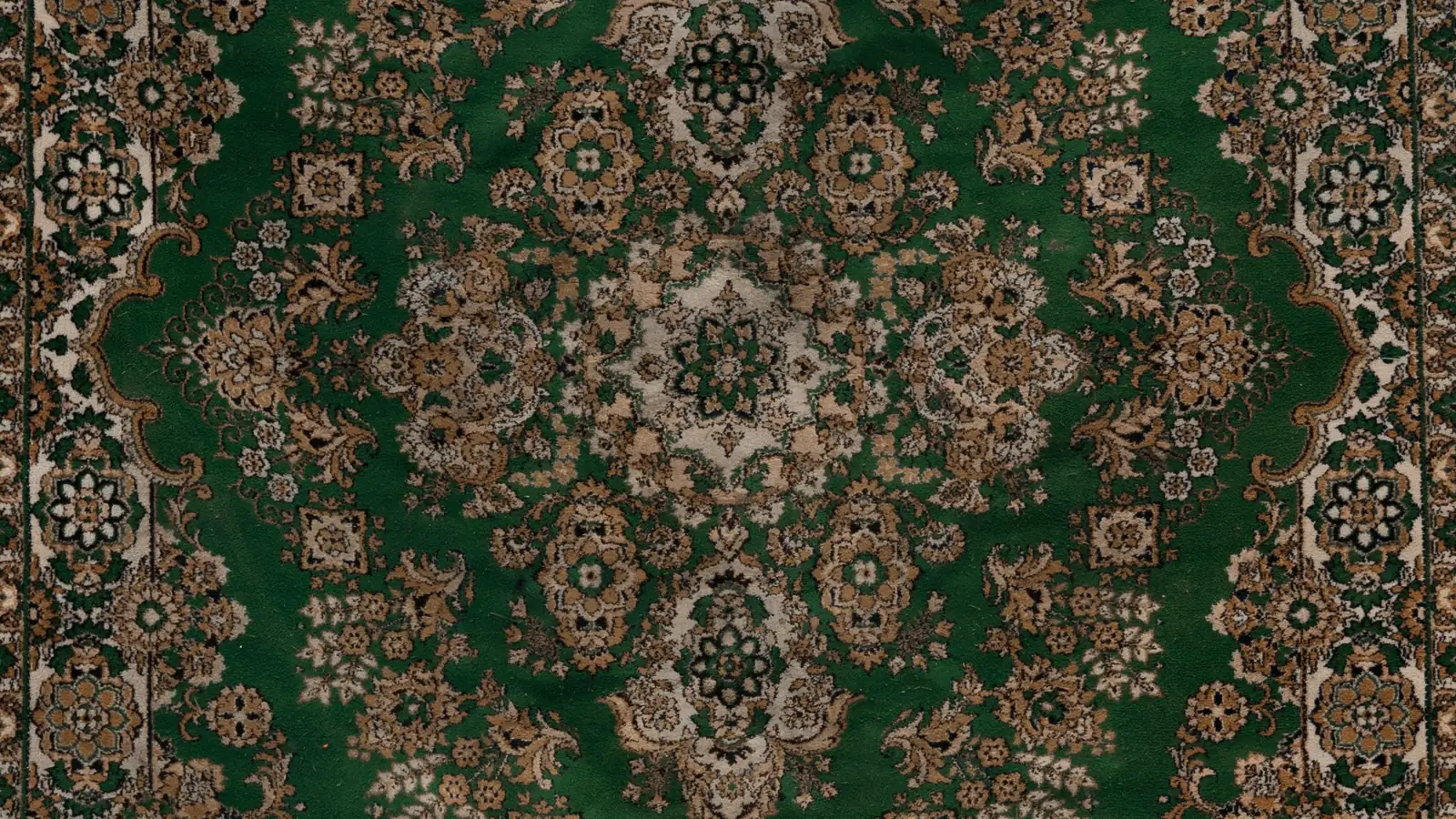
Forest and other deep greens make pale upholstery stand out, much as a dark mat frames a pale print. They also swallow dark table legs and dark sofa bases, so decide which outlines you want visible before going darkest. If you love deep green but want furniture to stay distinct, look for cream or tan in the pattern or a lighter border.
Retailers use these names loosely, and an olive from one collection can look more like another brand’s sage. Treat the names as search terms and judge the sample.
Four rooms, four starting points
Cream sofa on warm wood. In a room with a honey-oak floor, a cream bouclé sofa and a south window, a muted olive keeps the palette close and makes the room feel like one warm tone, while a cooler sage opens a visible gap between floor and rug. The sofa belongs in the comparison, because a pale green that flatters the wood can push cream upholstery toward yellow or pink. A rug pattern containing both cream and green can bridge the two, though the cream in the rug has to match the actual sofa. We would try the sage first: it keeps the rug distinct from the floor and lets the sofa’s texture stay in front.
Gray sofa on a medium floor. Start with light against dark: a pale quiet green or a deeper one. A dark rug defines the seating area strongly, and a light one leaves the sofa as the darker shape. Then look at whether the gray leans warm or cool, and avoid a gray-green that is nearly but not quite the same.
Brown leather on dark wood. With a walnut floor, a worn cognac leather sofa and a big square coffee table in the middle, a lighter green lifts the seating area into view, and a deep green can work if cream or tan in the pattern keeps the sofa’s outline readable. The coffee table covers the center, so the exposed field and the border do most of the talking, and the sofa legs at the rug’s edge are the spot to watch. We would take a mid-green with a pale border here and skip a central medallion that the table will hide.
Green upholstery or patterned curtains. A rug that is visibly lighter or darker, or that repeats only part of the textile’s palette, often looks more deliberate than a near-match that seems like a mistake. Scale matters as much as shade: a large curtain motif beside a small repeat creates balance, while two equally big patterns compete. Decide which surface carries the main pattern.
Field, border or allover pattern
A solid green field makes the color itself the feature. A border draws a frame. An allover pattern spreads green among other colors, so the rug can look much quieter from across the room than it does in a close-up. Because a larger rug shows more of the field and a smaller one more of the border, the footprint changes how the design reads, and the rug-size guide works through footprint around furniture and routes. Lay the furniture over the design in your mind: under a bed, the sides and foot are what show, a glass table reveals more of the center than an opaque one, and on a small rug a wide border may be most of what you see. In a multicolored design, name every repeated color; one you would not choose alone will be on the floor in quantity. Small pink, gold or blue details add up across a large area.
A solid field puts all the weight on the exact shade and on the surface that carries it. BENI’s greens collection opens a page of wool rugs grouped by green, from olive and sage to forest, and it includes plain solids such as Sage Green, Olive Leaf and Forest Green. Each of those solids is offered in three constructions: Atlas Standard, which BENI averages at 1.25 inches of pile, Atlas Low at 0.75 inch, and the flatwoven Zahara at roughly 0.4 inch. In our reading, that choice changes how the color sits in the room: a long pile breaks the light into shadow and usually looks a shade deeper and softer, while a flat weave shows the dye more evenly and lets a chair or sofa leg stand level. For the cream-sofa room above, we would look at Atlas Low, which keeps a soft surface while sinking the sofa’s feet less than the standard pile. The solids come in sizes from 3 by 5 to 12 by 15 feet plus runners, are woven by hand to order, and their pages state that all orders are final, so the swatch step below comes before the rug, not after.
What the listings say
Color does not tell you the fiber or how to clean it. These examples come from the retailers’ own pages, and we have not handled any of them. Super Area Rugs’ Ridgewood Forest Green is braided 100% polypropylene, about 0.33 inch thick, and the listing describes layered forest, moss and muted green tones: on the floor that reads as a mixed green, quieter from the doorway than one flat field of forest. Its care guidance depends on size. The listing allows a home washing machine up to 4 by 6 feet and asks for a commercial-capacity washer from 5 by 7, with line drying, and the label on the rug has the final word. Its shapes are ovals, rounds and runners, so it belongs by a back door or under a round breakfast table more than under a rectangular sofa group. Plymouth Green has cotton in its name, but the detailed specifications list a cotton and polyester mix, so read the composition instead of the headline. BENI’s Clary is wool in a flatwoven Zahara construction with sage and earth-toned stripes, and the page notes natural variation in finished pieces. It is the opposite brief to the braid: a striped surface instead of one green, roughly 0.4 inch thick by BENI’s figure. Nothing is woven until you order, so plan in months rather than days (BENI’s current estimate for 9 by 12 and smaller is 14 to 18 weeks), and the finished size can land up to 5% off. Cleanup changes too: in BENI’s care guide a wool spill is lifted with a towel laid on top, never scrubbed, and goes to a professional cleaner once it reaches the back. In the cream-sofa room above, the sage stripes can carry the color while the soil tones meet the wood; at a back door, where spills are daily, the washable braid is the more practical green.
Sizes change, so read the finished dimensions and return terms on the listing before ordering; a clear listing states both.
Swatches, variation and the last decisions
Order two or three clearly different greens, say muted sage, warm olive and deep green, and tape each one at the spot where a sofa leg will stand. Green shifts more than most colors between a north window and a warm lamp, so give each swatch both. BENI’s sample program separates colored poms from construction squares, a useful reminder that a yarn color shows the palette alone, without the finished surface or pattern scale. Where the maker states variation between pieces, allow for it before expecting a perfect match to a screen.
Layering is another option, and a matter of taste: a green rug over a larger plain one gives you a border of the base color and lets the green work as an accent. It asks for the edges to lie flat and the top rug to stay put, so it suits low-traffic corners better than a path to the door.
Dark green hides some marks and shows others. Pick the care route before the shade: the instructions should name a cleaning method for your size, and the backing should call for a pad whose dimensions the maker gives, so the rug cannot slide underfoot. Start from the room cases above, sage beside cream upholstery on warm wood and a mid-green with a pale border on dark wood, then let the care instructions break any tie.
Retailers to browse
Compare colors, sizes, materials and return details on the retailer’s current listings.
- Go to Super Area Rugs
Super Area Rugs
Opens Super Area Rugs’s store (area rugs).
- Go to BENI Rugs
BENI Rugs
Opens BENI Rugs’s store (made-to-order rugs).