Area Rug Buying Guide: Construction, Backing and Everyday Use
A rug under dining chairs, beside a bed and in a busy seating area does three different jobs. Start with what happens on top of it, then judge construction, pile, backing and care.
By DecoraMintPublished 11-minute readMore in Decor
In this guide
We may earn a commission from links on this page, at no extra cost to you. Affiliate disclosure
What will happen on top of this rug every day? Bare feet stepping out of bed, chairs scraping back from a dinner table, a dog circling before a nap, a toddler’s juice cup tipping over: each asks for a different surface. A deep shag that feels like a cloud beside the bed will snag every dining chair. A tight flatweave that shrugs off chair legs can feel thin under a reading chair in January. Answer that question first, and the choices about construction, pile, backing and care mostly make themselves.
Match the rug to the activity
“Living room” can mean a quiet reading corner, the main route to the patio or the family’s snack-and-movie headquarters. Describe the room by what people do in it.
| Where it goes | What matters most | The question to ask |
|---|---|---|
| Main seating area | Underfoot feel, how furniture sits on it, routine cleaning | Can you clean the exposed rug without moving the sofa? |
| Dining area | Chair movement, edge position, spills | Do chairs pulled back stay fully on the rug? |
| Bedroom | Barefoot feel where your feet land | How much rug will actually show around the bed? |
| Doorway or hall | Total height, edge stability, door swing | Does the door clear the rug and its pad together? |
| Desk area | Chair casters | Does the rug maker allow a rolling chair on it, or does it need a mat? |
Size it to the furniture
The classic sizing mistake is a rug that is too small: a 5-by-7 floating in front of a sofa like a bath mat. Choose the footprint from the furniture layout, then choose the material and pattern. These rules of thumb are a starting point, and our rug size guide walks through them in detail.
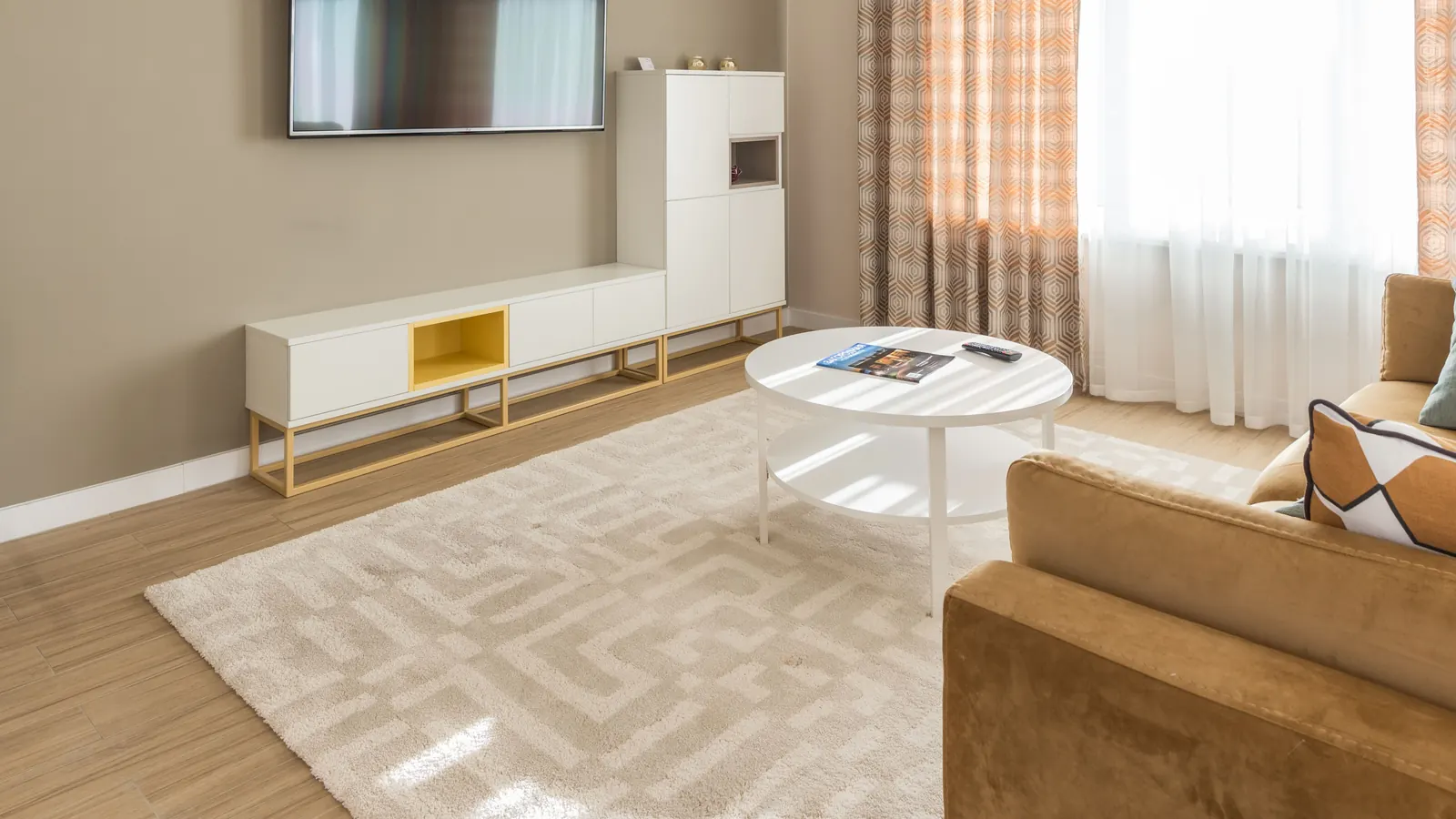
- Living room. At minimum, the front legs of the sofa and chairs sit on the rug so the grouping reads as one island. A larger rug that holds every piece fully looks calm and generous in an open plan.
- Dining room. A common rule is at least 24 inches of rug beyond the table on every side so chairs stay on it when pulled out. Ruggable’s dining guide, for example, pairs a 60-inch rectangular table seating four with an 8-by-10 and a 72- to 84-inch table seating six with a 9-by-12.
- Bedroom. Aim for rug showing on both sides of the bed and at the foot, roughly 18 to 24 inches by common rule of thumb, so your feet land on something soft. For a queen, that points to an 8-by-10 slid partway under the bed, with a 9-by-12 for a king or a roomier look.
- Walls. Leaving a band of bare floor between rug and wall, about 12 inches by a common guide, keeps the room from looking wall-to-wall carpeted.
Before ordering, lay out old sheets or flattened boxes at the planned size and walk the room around them for a day; you will feel quickly whether chairs and doors clear the edges.
Construction and fiber are different questions
Construction is how the rug is made. Fiber is what the yarn is. “Wool” or “cotton” on a label answers only the second.
A flatwoven rug is woven on a loom with no upright pile, so it lies thin and flat and chairs glide across it. A tufted rug has yarn punched through a backing and usually held with adhesive and a secondary backing. A hand-knotted rug ties individual knots to form the pile and tends to be the slowest and most expensive to make. Lowe’s rug construction guide illustrates these differences; they explain how a rug is built, not which one is best for you.
Turn the rug over, in person or in photos. Look for a backing, adhesive or a woven reverse, and whether the maker calls it reversible. Do not flip a rug just because its underside looks tidy. Ask for close-ups of the surface and edge too: a room photo taken from across the space hides loops, raised motifs, fringe and pile height, all of which change how a rug feels and how furniture sits on it.
Wool
Wool is springy, warm underfoot and recovers well from furniture dents, and it comes in many constructions. A braided wool rug and a flatwoven wool rug of the same color and size have different profiles, edges and care.
Super Area Rugs’ Tribeca Blue listing is a 100% wool braided rug offered in 8-by-10-foot oval and 9-by-12-foot oval sizes. The oval matters: its curved ends cover far less corner than a rectangle with the same maximum dimensions, so an oval suits a round table or a softened seating group better than a square-cornered sofa layout. Ask each maker about shedding, and which vacuum settings and cleaners suit its construction, before you buy.
Flatwoven wool sits at the other end. BENI’s Clary is 100% wool in the studio’s Zahara flatweave, which the page puts at roughly 0.4 inch thick, striped in sage and soil tones. Under a dining table, that level face is what lets chairs slide back without snagging, and BENI describes the construction as suited to high-traffic areas; beside a bed it feels light underfoot rather than cushioned, so if barefoot softness is the point, a thicker construction suits that spot better. Two details change the plan. Each rug is woven by hand to order, with a quoted lead time of 14 to 18 weeks for 9-by-12 and smaller, and the page warns that finished sizes can vary by up to 5% from the order. On a 12-foot length that is about 7 inches; if the rug comes up short, the chair margins at both ends shrink by that much between them, so leave slack in the plan rather than sizing to the exact inch. The page also states that in-stock orders are final, and BENI’s FAQ treats every order as final once its 24-hour cancellation window closes, so settle the size and colors before paying.
Cotton and blends
Cotton rugs are often flat, light and casual, the kind you can shake out on the porch. Read the full composition, though. Super Area Rugs’ Plymouth Green listing carries cotton in its name but specifies a cotton/polyester mix, with care limited to vacuuming without a rotating bar and spot treatment. Nothing there says machine washable.
IKEA’s TIPHEDE listing, by contrast, is 100% cotton flatweave with specific washing and drying instructions. That applies to that rug; a larger cotton rug may simply not fit your machine.
For a bedside or entry rug you will move often, the edge, weight and slip resistance matter as much as washability. Under a dining table, chair movement still comes first. If the space is tight, ask whether the rug changes size after permitted cleaning.
Two more directions
Super Area Rugs’ Ridgewood Blue is braided polypropylene in oval, round and runner shapes, with care guidance that separates smaller sizes from ones that need commercial cleaning equipment. Read the instructions for the size you pick.
BENI’s Chroma I collection takes the opposite approach: flatwoven stripes with a crisp, graphic look. Set it against a braided rug and you can see the choice clearly, a low, linear surface versus a textured, rounded one. Compare the actual dimensions, backing and care for both.
These are examples drawn from the makers’ own listings, not products we have handled. The Super Area Rugs pages are cited for their published specifications; the BENI links open its own store, the Chroma I link as a collection. Availability of a given size can change, so check the current listing before relying on any of these details.
Specifics beat adjectives
“Handmade,” “premium” and “luxury” tell you little. Fiber composition, construction, backing, finished dimensions and care instructions tell you a lot. A listing with only a room photo and a color name may describe a well-made rug, but it leaves you unable to compare it fairly against one that gives the details.
Pile height and edges
Pile height is only part of the total. Add the foundation and the pad, and that combined height is what a door has to clear. A thin rug can still catch a low door once a cushioned pad goes under it.
Edges take as much wear as the middle. Binding, fringe and raised borders sit exactly where shoes, chair legs and vacuums cross. In a busy route, keep the edge away from where people turn or step through a doorway. And save the thick pile for spots where feet will actually touch it: under a bed, most of a plush rug’s luxury is hidden.
Published pile figures turn the door check into arithmetic. BENI publishes a height for each of its constructions: its craft page puts the knotted Atlas pile at about 1.25 inches, its Atlas Low product pages give about 0.75 inch, and the Zahara flatweave behind Clary is about 0.4 inch thick. BENI’s Atlas Knotted collection is the thicker construction the Clary paragraph points to for a bedside. Next to a bed, that depth shows as a matte, shadowed surface where the yarn reads a shade deeper than the same color woven flat, and it is where bare feet land first. In a doorway, the same 1.25 inches still has the foundation and a pad added beneath it, so measure the gap under the door before letting an Atlas rug run into its swing. Lead times are listed per design: for sizes up to 9 by 12, BENI’s Après page quotes 12 to 16 weeks and its Fado page 18 to 20, and the same 5% size tolerance applies.
The pad: grip, cushion and the floor beneath
A pad does two jobs, and they can pull in different directions. A thin gripping pad keeps a small rug from sliding, which is what prevents slips on hard floors and at hallway transitions. A thick felt pad adds softness and some sound absorption under a big living-room rug that is not going anywhere. Choose for the job, and size the pad slightly smaller than the rug so its edge never shows or becomes a trip line.
Make sure the pad suits both the rug and the floor finish. Some rubber, latex and PVC pads can discolor or stick to vinyl plank and certain wood finishes, so read the flooring maker’s guidance on rug pads; felt, or felt with a non-PVC grip layer, is the usual cautious choice. Keep the floor underneath clean and dry. If you see discoloration, trapped moisture or a sticky residue, lift everything and find out why before laying it down again. Never stack improvised layers to stop slipping or fix clearance.
What “washable” really covers
A washable cover, a washable one-piece rug and a spot-clean-only rug are three different products, and the brand name will not tell you which you have.
Ruggable’s current care guide, for example, separates its two-piece covers, all-in-one rugs and other constructions. Its pad has its own rules and should not be machine washed, tumble dried or submerged, and some washable sizes need a larger commercial machine. Those are Ruggable’s instructions, not a recipe for every rug.
Before buying a washable rug, get clear answers on what goes in the machine (whole rug, cover or neither), whether your size fits the permitted machine capacity, how it must dry, and how the pad and edges are cleaned. A huge washable rug you have to haul to a laundromat and dry over two chairs may be less practical than a low-pile rug you spot-clean in a quiet room.
Bold designs: plan around what stays visible
A large abstract rug, a busy repeat, a strong border and an irregular outline each behave differently once furniture is on top.
| Design | What to look at | What can go wrong |
|---|---|---|
| Large abstract shapes | Which color blocks show around the furniture | The best part disappears under the coffee table |
| Small repeat | Density beside upholstery and curtains | Several busy surfaces compete |
| Strong border | Where the border falls relative to furniture legs | The defining frame ends up hidden |
| Irregular outline | The real contour versus the usable area | A lobe juts into the walking route |
A rug with one big central motif loses its point under an opaque coffee table; pair it with side tables or a glass top and it becomes the room’s focal point. A small repeat depends less on any one exposed area, though its scale still has to read from the doorway. Decide the rug’s role among the other textiles: the boldest pattern, a quiet echo of the sofa color, or the thing that finally fills an empty floor.
For curved or irregular shapes, cut the actual contour from paper and lay it down. A rectangle drawn to the maximum width and length overstates the usable area near the cutaways. Every furniture leg should sit fully on the rug or fully off it, never perched on a curve. And an unusual shape still needs a sound backing, workable care and a return policy you understand; a striking print says nothing about stain resistance or outdoor use.
Returns and the real total
Total the rug, the right pad, delivery and any cleaning you will pay for. Read the return terms before unrolling: who pays return shipping, whether original packaging must be kept, and whether custom sizes are excluded. Save the size and care details from the listing so you can check the delivered rug against what you ordered.
Is a thicker area rug always better?
No. Thickness changes feel and door clearance, not overall quality. Thick is lovely beside a bed and frustrating under dining chairs.
Does every rug need a separate pad?
Not always. Some rugs come as a matched rug-and-pad system, and some backings are built to grip. A small rug on a hard floor is the classic slipping hazard, so give it a gripping pad that suits both the rug and the floor.
Retailers to browse
Compare colors, sizes, materials and return details on the retailer’s current listings.
- Go to Super Area Rugs
Super Area Rugs
Opens Super Area Rugs’s store (area rugs).
- Go to BENI Rugs
BENI Rugs
Opens BENI Rugs’s store (made-to-order rugs).