How to Style Pillows on a Couch Without Losing the Seating
You do not need to fill every corner. Start with a small group that relates to the room, put bigger shapes behind smaller ones and leave enough seat to actually sit down.
By DecoraMintPublished 6-minute readMore in Decor
In this guide
We may earn a commission from links on this page, at no extra cost to you. Affiliate disclosure
Most sofa pillow problems are scale problems. A row of same-size squares, spaced evenly, looks like a showroom, and it buries the seat. What reads as styled is a ladder: the largest shape at the back or in the corner, each pillow in front a step smaller, and a different outline somewhere, usually a lumbar. Then sit down, lean back and see what your shoulders land on; if you have to shove a stack aside first, one layer is too many.
Sizes and counts that work
Studio McGee’s pillow size guide builds a sofa from four or five pillows: a 22 to 24 inch square at the back with a 20 to 22 inch square in front of it, or a large square in the corner with a lumbar. It layers sizes in two to four inch steps so each pillow is visibly smaller than the one behind. For a sectional it suggests seven to 10, two at each end and three in the corner. Chairish offers a leaner set for a small sofa: a pair of standard squares, ideally at least 20 inches, because smaller ones can look sparse. Its relaxed version mixes one larger square, one smaller square and a lumbar and leaves room to sit.
Those counts are conventions. An odd number often looks easier on the eye, but a symmetrical pair on a compact sofa looks just as intentional, and keeping the seat free beats adding a fifth pillow to complete a formula. Test with the pillows you own: measure them, since “oversized” on a label varies, and measure your seat depth. A deep sofa takes a bigger back layer; on a shallow one the same pillow eats the seat.
Color: repeat, then vary
Pull one or two colors from things that stay: the rug, a curtain, the art. Crate & Barrel’s throw-pillow guide suggests drawing colors from the room and combining solids with different patterns, and Chairish suggests sharing at least one color across the pillows for a cohesive look. A tonal set (three greens, or sand to caramel) works with changes in lightness and texture alone. A contrast set uses one color that stands apart from the upholstery.
A gray linen sofa on a jute rug, with rust in the curtains, makes a good test case. Two rust pillows with a cream bouclé square and a thin dark stripe in front make a group that clearly belongs to the room, since the rust repeats and the cream picks up the wall. Take away the stripe and the sofa still works. The stripe is there for rhythm, so if it competes with something, it goes.
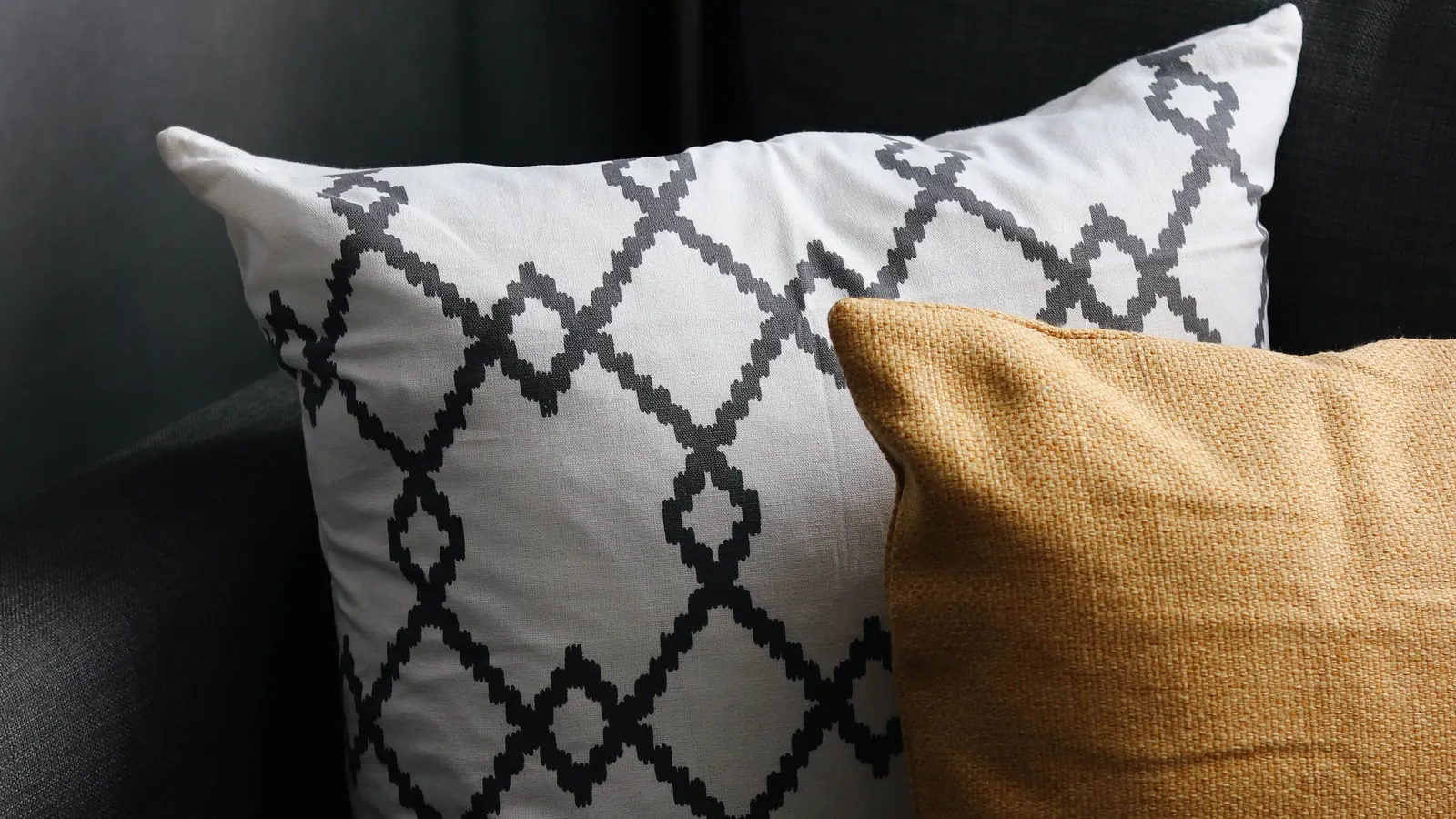
Value matters as much as hue. On a charcoal sofa the logic flips: dark upholstery swallows dark pillows, so pale and mustard shapes pop forward, with a white geometric behind a smaller yellow square. Squint at the sofa from the doorway: you should see three values, one light, one mid and one dark, spread across the group rather than clumped at one end. A tan leather sofa takes this well, since a deep green velvet square and a cream wool one sit against the hide like furniture in a library; a pale slipcovered sofa wants one dark note to keep the group from drifting away. Whatever the sofa, try covers in daylight and in the evening before buying a set, because the same color can swing warm or cool.
If you are choosing purple
A muted lilac and a deep plum carry very different visual weight. On a pale neutral sofa, plum is a strong accent and lilac is a soft one. Repeat the purple once more elsewhere, such as a small vase or the stripe in a throw, and leave another pillow plain. If the sofa is already busy, begin with one solid purple cover.
Pattern and texture
Choose one pattern to lead: a big floral, a broad stripe, a geometric. Pair it with a solid or a pattern at a clearly different scale, such as broad against fine, and compare the two from across the room. A strongly patterned sofa wants solids. A plain sofa is the place for a patterned pillow.
Texture does as much as color when the palette is tight. Smooth linen beside a nubby weave, or velvet beside a flat cotton, gives a single color family some depth. Check zippers, trims and embroidery against upholstery and against you; raised details look good on a display pillow and can bother you through a whole film.
Bella Maison’s Indian Beauty Beaded Cushion Cover shows that trade-off on one label. It is a 17-inch cotton square with multicolor traditional motifs and a beaded surface, and the retailer recommends hand washing and drying flat to protect the beadwork. That puts it in the corner nobody leans into, where the beadwork reads as raised texture against a plain linen or velvet square behind it; at 17 inches it belongs in the front row, in front of a 20-inch or larger square, not at the back of the ladder.
Start by clearing the sofa of pillows and throws so you can see its shape: seat depth, arm height, back cushions. Put one pillow back and sit. If you move it at once, the arrangement should be a light accent; if it supports you, a fuller group may suit. A sofa that several people use every evening needs open seats, while a reading corner used by one person can take a larger group at the far end.
Layouts for a pair, a corner and a sectional
- A balanced pair. One pillow at each end, matching or similar in weight, with the middle clear. It suits a compact sofa.
- A relaxed group at one end. A large square in the corner with a smaller one in front, and the opposite end plain. Put the group at the end where nobody is using an armrest or recliner control.
- A sectional in zones. Start at the outer ends, then decide whether the inside corner needs a pillow at all. Repeat one color across the groups so the long run holds together, then sit in every regular seat.
A rectangular cover as the odd shape
Bella Maison’s Rose Embroidered Decorative Pillow Cover is listed as a 14-by-20-inch polyester cover with a hidden zipper, in plum with rose-gold embroidery. A lumbar of that kind sits well in front of larger squares. The retailer lists machine washing with similar colors or hand washing, and no tumble drying, and presents it as a cover, so confirm whether an insert comes with your purchase. We have not tested it; the details come from the retailer. Match the insert to the cover’s listed size, since a much larger insert strains the zipper.
Fill, feel and care
A pillow that needs constant reshaping is fine for occasional styling and tiresome in a busy family room, so pick the fill you prefer for the pillows you lean on. Choose covers whose care instructions you will follow: a removable cover only helps if you can wash it as directed and slide the insert back in without straining the closure. Compare how a fabric feels against skin and clothes if the pillows will be used for lounging rather than display.
The last test
Sit, lean, reach for a side table and stand up. Any pillow that ends up on the floor each time is one too many, or one in the wrong place. A good arrangement resets in a minute after a movie night. Stop adding when the colors repeat, the shapes vary and there is still somewhere to sit.
Retailers to browse
Compare colors, sizes, materials and return details on the retailer’s current listings.
- Browse decorative pillows at Bella Maison
Bella Maison
Opens Bella Maison’s decorative pillows collection, not a single product.