Rugs for Tile Floors: Backing, Pads, Clearance and Heated Floors
Ceramic, porcelain and stone are not interchangeable under a rug, and heated floors have their own rules. Check the underside, the pad and the height at the door.
By DecoraMintPublished 5-minute readMore in Decor
In this guide
Tile is hard, cold and slick, which is exactly why people lay rugs on it, and exactly why the underside of the rug matters more here than the top. Porcelain, ceramic and natural stone are all sold as tile, but they take sealers differently, wear differently and sit over different heating systems. The rug that behaves on one can slip or mark another. This guide is about movable rugs over a tiled floor, not tile patterns.
Know your tile before you buy the pad
Look for the spare-tile carton, the flooring invoice or the installer’s paperwork, and note the product name, the surface finish and any sealer applied afterward. A stone-look or wood-look surface says nothing about what the tile is made of. If you rent, ask the owner before using any adhesive or an unfamiliar backing. In an older home with no records, treat the floor as unknown and pick the most conservative arrangement: a felt pad, a clean dry floor and a smaller trial first.
The compatibility question you are really asking is whether the backing or pad can stain, stick to or abrade your particular surface and its grout. Some rubber, latex and vinyl backings can stain or bond to certain finishes, so when you contact the flooring maker, name the actual rug backing and pad. A good reply is a written answer about that combination, and “safe on hard floors” is too vague to rely on.
Backing and pad: grip against cushion
RugPadUSA’s tile-floor pad collection recommends a more cushioned pad on tile so a rug wears evenly, and it separates the jobs: non-slip pads for high-traffic areas such as foyers and hallways, cushion pads for large rugs already anchored by furniture, and felt-and-rubber for those who want both. It also lists a dense felt pad for larger rugs that need no grip. That is one seller’s catalog, and we have not tested these pads. Read it as a way to split the decision: a rug that stays put in a doorway wants grip, while a living-room rug under a sofa wants softness.
Note that a comfortable sample does not tell you it will stay in place, and a thin, secure arrangement may feel too hard in a seating area. Test both. Before laying anything, look at the floor itself. A loose tile, a chipped edge or an uneven spot needs repair on its own, and a thick rug is no substitute for that.
Clearance at the door
Pile height is not the number a door cares about. The door sees rug, pad, binding and any curl at the edge together, so hold your sample and pad under the door’s full swing. Do not rely on the door flattening the rug each time it opens; if it catches, use a thinner pairing, move the rug or leave that stretch bare. A runner can fit between two walls and still foul a door at one end, and a rug by a kitchen island can land under a cabinet door. Draw the openings on the same plan as the rug.
Heated tile
Heated floors have their own limits, and the heating maker’s instructions win over any pad’s radiant-heat label. The Schluter DITRA-HEAT handbook does not recommend area rugs over that system. If one is used, its insulating R-value must not exceed 1, and it must stay off the floor-temperature sensor, where it can insulate the sensor and switch the heat off before the rest of the floor warms. That is one system’s rule, so follow your own system’s handbook. If you cannot identify your system or find the sensor, ask the installer or maker before laying a rug, and do not alter a heating installation to suit a rug without qualified guidance.
Which room the rug is in
A dry living area. Decide what the rug is for: a seating zone, a soft spot for feet or a break in a large tiled floor. Under the whole seating group it reads as a room within the room; a small rug between sofa and coffee table is a different effect. Tape the outline, set furniture where you normally use it, and leave enough tile showing to give the floor a border.
An entry. Daltile’s natural-stone FAQ says sand, dirt and grit do the most damage to natural stone, that mats or rugs inside and outside an entrance help minimize them, and that the underside of the mat or rug should be non-slip. Grit also works under the rug, so lift it to clean the floor beneath. Keep the door swing and your shoe-removal spot in mind.
A dining area. Pull the chairs out the way you do at a meal. A rug that holds the table but not the chairs creates an awkward step from rug to tile. A very large rug is handsome, but moving a table and chairs to clean beneath it becomes a chore that tends to be skipped.
A kitchen or bathroom. Treat splash exposure as a selection point and read the rug’s care instructions for that setting. A decorative living-room rug is not a bath mat. Plan how you will lift and dry the rug after a spill, and fix water problems at the source rather than hiding them.
Pattern, grout and the room
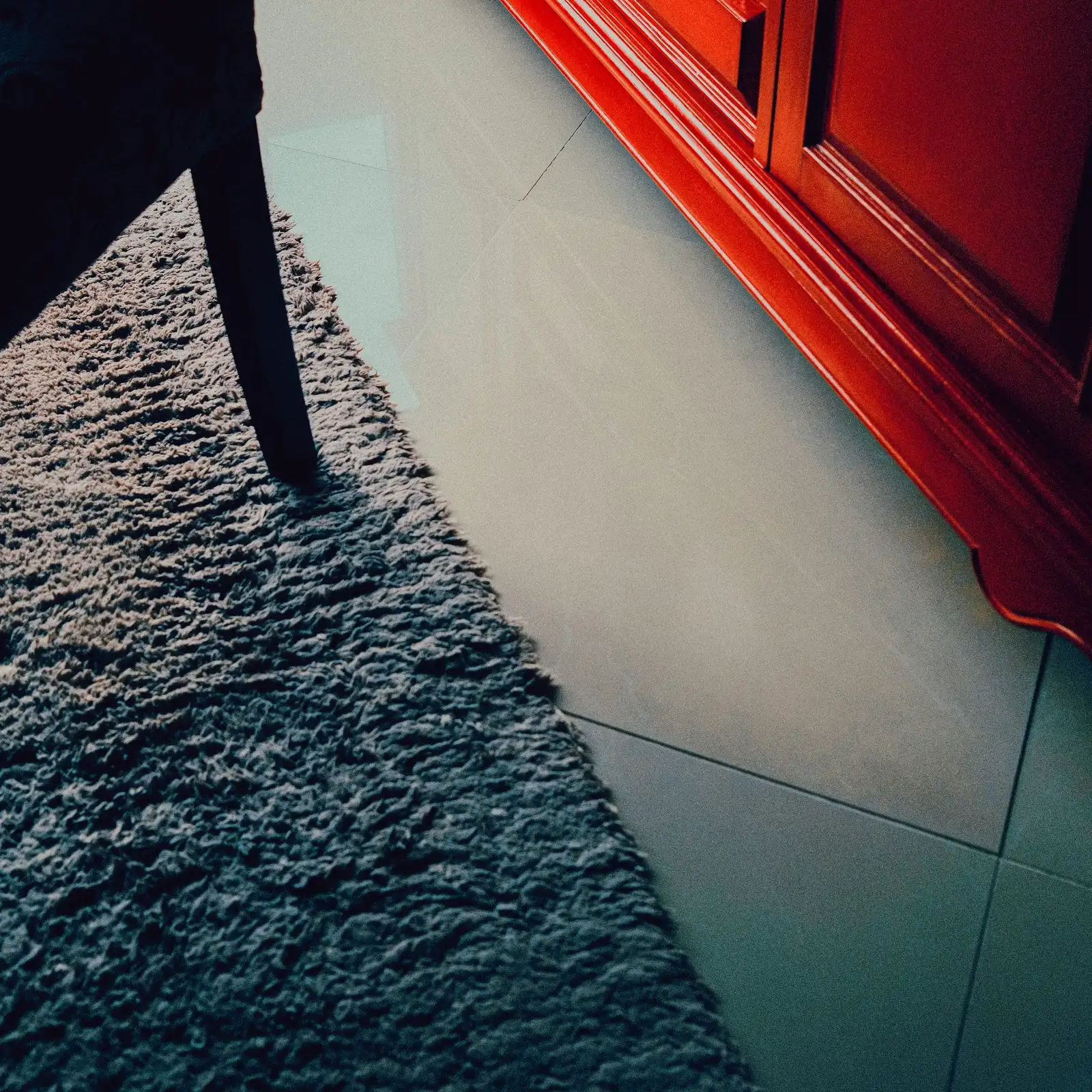
Stand in the doorway and look at the tile’s grid or repeat. A calm gray porcelain floor in large squares lets a patterned wool rug be the focus; a busy encaustic-style pattern wants a plain, textured rug in one of its colors. The rug need not align with the grout lines. Centering it on the seating group usually looks better than centering it on a distant tile joint, and if a thin strip of bare floor at one edge looks accidental, adjust the furniture and rug together. A tiny thumbnail cannot show how two patterns compete, so judge a sample at room scale. We would let the furniture, not the grid, decide the alignment.
Cleaning on tile
Rug, pad and floor each have their own care instructions, and a method for one may harm another. Floor cleaners can damage a rug’s fibers or backing. Choose a size you can lift, and look underneath from time to time for grit, moisture or a backing that has begun to change. A rug should not be used to hide damaged tile; get the floor assessed.