Kitchen Rugs and Runners: Choose the Right Size, Placement and Care
A kitchen rug has to stay flat, clear the dishwasher and fridge doors and survive spills. Watch how you move between sink, fridge and counter, then choose size and construction.
By DecoraMintPublished 6-minute readMore in Decor
In this guide
We may earn a commission from links on this page, at no extra cost to you. Affiliate disclosure
Cleanability beats color in a kitchen. The floor in front of the sink collects drips, crumbs and the odd dropped egg, so the question that sorts rugs is how you will deal with the mess, not which pattern flatters the cabinets. A rug you can lift, shake or wash in minutes earns its place. One that needs a weekend and a laundromat will end up in the closet.
Walk the work triangle first
Cook something ordinary, even if you only mime it, and notice where you actually stand: at the sink, at the stove, at the counter where you chop. Note where you step back to load the dishwasher and which doors swing open. Then tape a possible footprint on the floor with painter’s tape that suits your floor and repeat the routine. A rug should not leave a narrow strip of bare floor you have to side-step, and it must not touch an appliance door as it opens.
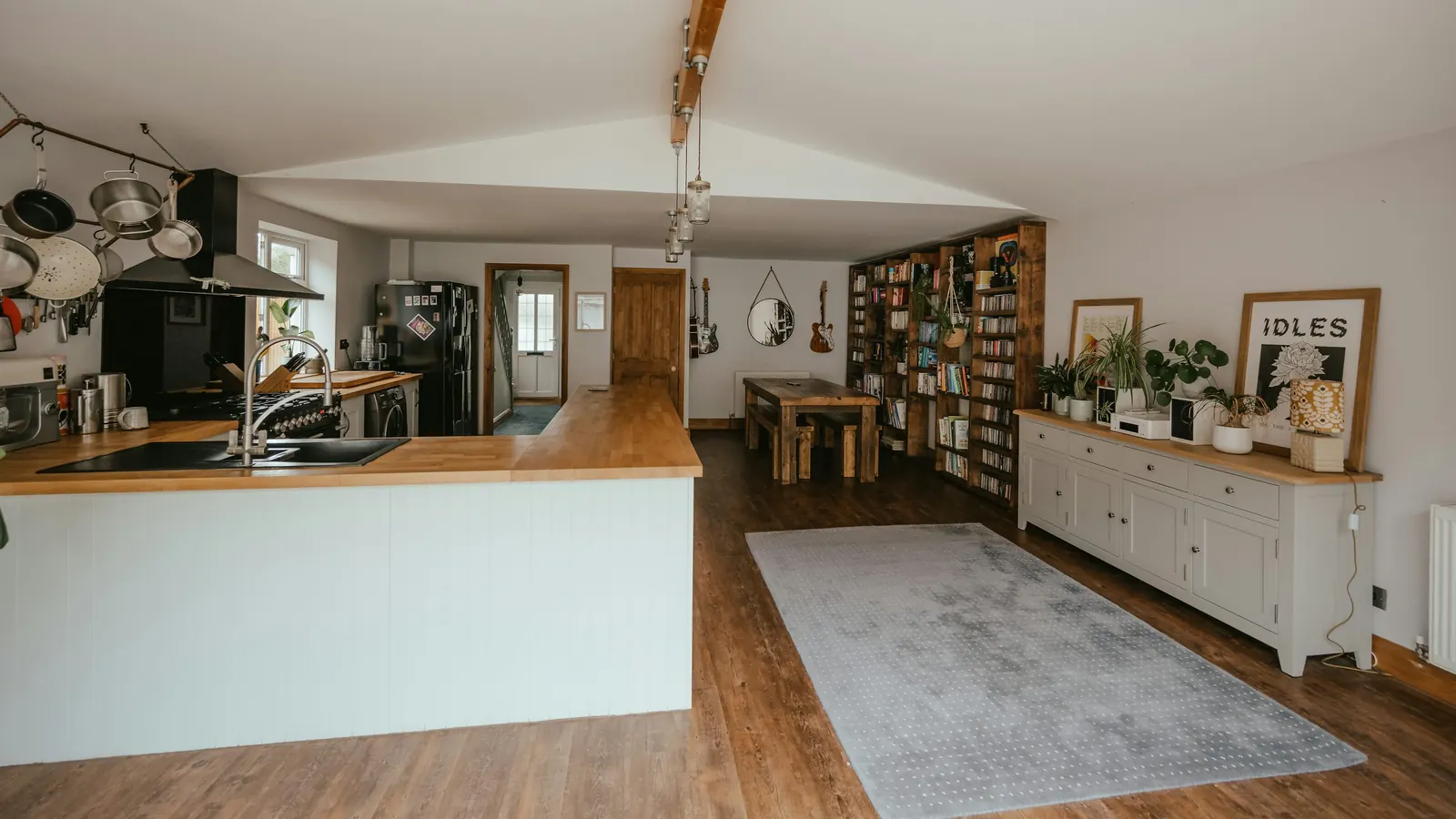
Listing images flatter a kitchen. The room shown may be wider than yours, and an image cannot tell you whether the rug is washable.
Runner, small rug or nothing
| Arrangement | Where it works | What to settle |
|---|---|---|
| Long runner | Aisle beside cabinets or an island | Width, door clearance, where each end stops |
| Small rectangle | One workstation, usually the sink | Whether the edges sit outside your busiest crossing |
| Larger area rug | Open area beside the kitchen | Furniture, work paths, access for cleaning |
| Bare floor | Tight aisles, heavy splash zones | A floor you can mop quickly |
A runner need not span every cabinet. Its ends should stop somewhere that makes sense, not at an awkward point beside a door or across a turn. In an L-shaped kitchen, one long piece rarely follows both legs, so decide whether one workstation needs covering at all. Two small rugs with a gap between them create more edges to trip on than one well-placed piece.
Measure between the actual projecting surfaces: cabinet fronts, an island base, a freestanding appliance, a dining bench. Then check installed thickness, because pile height alone may leave out the backing and pad, and the whole stack has to clear the dishwasher, oven and fridge doors. Do not trim a rug or pad to cure interference unless the maker allows it; a lower profile or another spot is the better fix. If chairs sit near the rug, pull them out fully, since a leg that catches the edge makes the dining end irritating even when the rug fits with every chair tucked in.
Flat weaves and what they clean like
A flat weave lies low under oven and dishwasher doors, and crumbs show on it and shake off. A deep or looped surface hides crumbs and holds them. Fiber alone will not tell you about stain resistance or durability, so read the full care line, then look at the edges: long fringe tangles in a vacuum and catches a heel at the stove.
Ruggable’s care guide separates its two-piece cover-and-pad rugs, all-in-one washable rugs and Easy Care Wool rugs, which are not machine washable and should air-dry only. In the two-piece system the cover goes in the machine and the pad never does. Before buying any washable rug, find out which component is washable, whether it can be tumble dried and on what setting, where you will air-dry it if not, and how the backing or pad gets cleaned. We have not tested these products, and the details are one maker’s.
Washer size is the practical limit. Ruggable’s washer compatibility guide lists runners, 2-by-3, 3-by-5 and 4-by-6 sizes as fitting a 2.4 cubic foot machine, adds 5-by-7 at 3.1 cubic feet, and lists 8-by-10 only at 4.5 cubic feet, with 9-by-12 not listed for any machine. In a kitchen the size that matters is usually the small one, and a runner or workstation rug that fits your drum is far more likely to be washed. Do not force a rug into a drum because a different size is listed as compatible.
A braided line from another retailer shows what a usable size rule looks like. Super Area Rugs lists its Ridgewood braided rugs, texturized polypropylene about 0.33 inch thick, as washable in a standard home machine up to 4 by 6, with 5 by 7 and larger sent to a commercial-capacity washer; either way it calls for a cold, gentle cycle and line drying. The runners come 2 feet wide in 4-, 6- and 8-foot lengths, the braid is reversible, so a stained face can be turned down until wash day, and the listing recommends a rug pad, which brings the slip section below into play. The Super Area Rugs store opens on its homepage rather than on the rug; Ridgewood sits under its Braided Rugs menu. In the room, a braid reads as rows of rounded cord, closer to painted shaker cabinets and butcher block than to flat slab fronts, where a striped flatweave keeps the cleaner line.
If a robot vacuum runs through the kitchen, read its limits against the rug’s edge and pile before the two meet; a low-profile label does not guarantee it will cross.
Anti-fatigue mats are a different product
A decorative rug and a purpose-made anti-fatigue mat are built differently and meant for different jobs. If you stand at the counter for long stretches, a mat made for standing may suit that one spot better than a woven rug, and you can put a good-looking runner elsewhere. A thick pad under a rug adds cushioning, but nobody should expect it to behave like a purpose-built mat. Choose any mat with a tapered or beveled edge you can see, since a thick, abrupt edge is a trip point.
Slip, pads and the floor
Kitchens combine smooth floors, spills and quick turns, so a rug that creeps is a hazard. Find out whether the rug has an integrated backing, needs a particular pad or allows a separate one, and make sure that backing suits your floor. Rubber, latex and adhesive backings are not right for every wood, vinyl, tile or heated floor, so go to the flooring maker’s care notes if you are unsure. The pad should sit slightly inside the rug’s edge, and stacked layers should be avoided because the combined thickness and stability differ from what the maker intended.
Lay the rug on a clean, dry floor and lift it from time to time. Dirt and moisture that settle underneath still need cleaning. If a corner curls, the rug shifts or an appliance door catches it, take it out of that position until you have fixed the cause. If you cook around a pet’s water bowl, move the bowl or the rug, since a constantly damp patch needs a better arrangement.
Cleaning plan, drying and color
Wipe up spills before they dry, blotting instead of rubbing when the care label says so, and keep the label where you can find it. Let washed pieces dry completely before they go back on the floor, and for a two-piece system, make sure the cover lies flat and is attached as instructed.
Take the cabinet finish, counter and floor as your palette. Against white cabinets and pale wood, a flatweave in faded blue stripes gives the room one cool note and hides small crumbs; against dark cabinets, a rust or cream runner lifts the aisle. Pick the pattern last, after the size and the washing routine are settled. Our decor guides cover coordinating textiles beyond the kitchen.
Look at your rug again when the kitchen changes. A new dishwasher, a movable island or a different chair can change clearances, and the rug’s old spot may no longer work.