Office Rug Guide: Chair Movement, Desk Fit and Floor Protection
Watch where your chair rolls before you pick a pattern. The rug has to work with the casters, the desk and the floor, and a chair mat is not the same as a rug pad.
By DecoraMintPublished 5-minute readMore in Home Office
In this guide
We may earn a commission from links on this page, at no extra cost to you. Affiliate disclosure
A rolling chair asks more of a rug than anything else in the house. Every time you push back from the desk, the casters have to climb whatever pile is under them, and the rug edge sits exactly where the chair stops. Plan the rug around that movement and the rest, pattern included, falls into place.
Rolling resistance and pile
Casters roll easily on a firm, thin, flat surface and struggle in a soft, deep one. Floortex, which makes chair mats, rates each mat for a maximum carpet pile height including padding, and the limits differ by mat: its vinyl mat is listed up to 3/4 inch (low pile to 1/4, standard to 3/8, medium to 3/4), while its polypropylene mat is listed only for low pile up to 1/4 inch. Borrow the habit for rugs. Measure your rug’s total thickness with its pad, and treat anything near the top of that scale as a surface for a reading chair, not a rolling one.
So for the working zone, compare these features:
- A tight, low surface that stays flat under the casters.
- Bound edges that lie flat and do not curl.
- No fringe where wheels or chair feet pass.
- A backing meant for the planned use.
- Care instructions that suit spilled coffee.
Chair mat or no mat
Two layouts handle most home offices. In the first, a firm, low rug sits under the desk and you roll directly on it. In the second, the chair rolls on a mat and the decorative rug sits elsewhere, perhaps under a reading chair or beside the desk, so no edge falls in the caster path. A mat over a rug can work only if the mat is made for that surface.
For the first layout, one rug maker states a preference outright. BENI’s craft page advises against rolling casters where you can avoid them, and where you cannot, it points to its flatwoven Zahara construction before its knotted Atlas, so the chair glides rather than ploughing through pile. It also suggests at least 30 inches of rug beyond the desk edge for chair clearance. BENI’s Zahara Flatwoven collection gathers those hand-woven wool flatweaves. Read the figure against the scale above, though: BENI puts Zahara at about 0.4 inch thick before any pad, a little past the 3/8 inch (0.375) Floortex gives for standard pile, so roll the chair across a swatch, which BENI sells, before ordering, and keep the caster note from the next section in mind. In the room, a tight striped or geometric flatweave lies flat enough that the chair base and desk legs sit on a clean, level line, and the pattern stays readable in the band in front of the desk. BENI weaves each rug to order, quotes 14 to 18 weeks for Zahara sizes up to 9 by 12, and allows changes only within 24 hours of ordering.
Floortex’s selection and care instructions pair smooth-backed mats with hard floors and gripper-backed mats with carpet, with the gripper matched to a measured pile depth, and they limit spiked mats to carpet because spikes damage wood. The floor must be clean, dry and flat before a mat goes down, since trapped dirt or moisture can harm the finish over time. Floortex adds that a mat rated for short pile cracks on deep pile for lack of support, that some highly polished or treated surfaces may be unsuitable for a mat even with an anti-slip back, and that a mat should be tested where it will sit for friction and stability. These are one maker’s instructions, and we have not tested its products. They are written for bare floors and carpet, so use a mat over a rug only if its maker approves that pairing, measure the rug and pad together against the mat’s pile limit, and remove any mat that creeps, rocks or catches a caster.
The chair itself
Casters differ by chair. Herman Miller’s Sayl chair page lists caster options for different floor surfaces, which shows that one chair can ship with several wheel types. The page describes a nylon carpet caster for low-to-medium pile and a soft-tread caster for hard floors or carpet that improves traction and cuts noise on hard floors. If your chair feels sticky or skates on a rug, the fix may be a caster change the chair maker permits, not a new rug. Buy replacement wheels your chair’s maker lists for it, because a wheel that suits the surface badly can let the chair roll as you sit down.
After any change, try normal seated movement slowly. Watch for bunching, a caught edge or a mat that shifts, and stop using an arrangement that tips or catches.
Map the chair’s range
Sit in your usual position, then do what you repeat all day: push back to stand, reach a drawer, turn to a second screen, roll to the printer. The base of the chair, not the seat, defines the space you need. Mark the outer limits with a sketch or tape that suits your floor, along with desk legs and drawer units.
Desk width is only a rough guide to size. A 60-inch desk can sit above several rugs, and the depth you need depends on how far the chair travels behind it. Measure that travel instead of buying the next standard size up. Avoid letting an edge fall right where the chair usually stops or turns. If the room is small, leaving the chair zone bare and putting the rug elsewhere beats squeezing a rug in where every edge is wrong.
Check door swing, threshold and drawer opening against rug and pad together before delivery, and keep corners out of your regular walking route, since an edge that curls or catches is a trip hazard. A rug will not protect a floor from every kind of wear, and a floor with a special finish or a heating system should be named when you ask its maker about compatibility. Don’t slide a loaded desk onto a rug. Move it first, then lay the rug flat according to its instructions, and use leveling feet only as the desk’s manual allows.
Color and the room it sits in
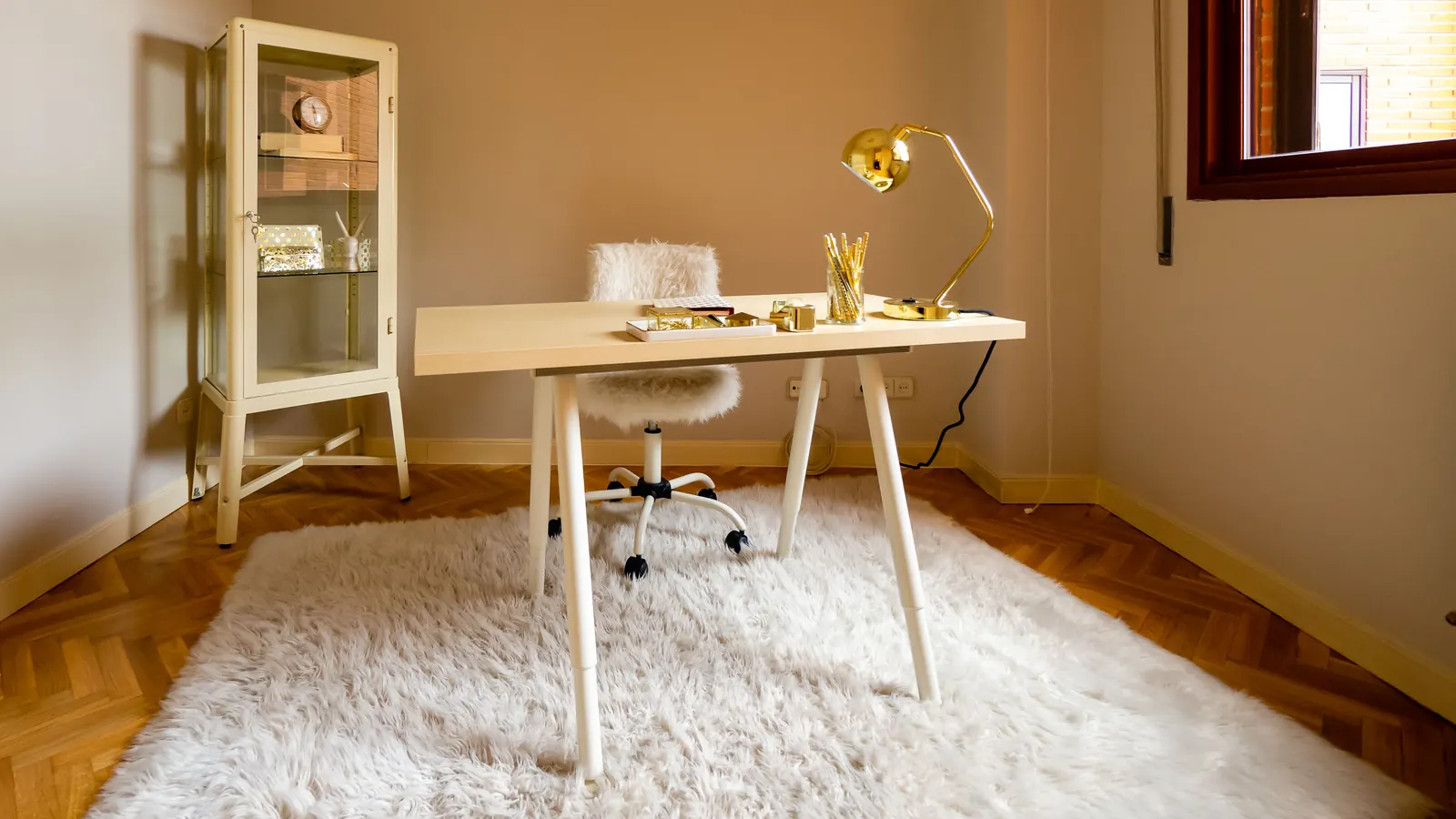
In a room that is mostly an office, the rug can set the palette. A dark walnut desk with a gray chair suits an indigo or slate flatweave, while a pale oak desk against white shelves wants a warm gray or sand surface that keeps the room open. For a desk in a bedroom or living room, repeat one nearby color and let a different pattern mark the work corner. A large motif hides under a desk, whereas a small repeat stays legible around it, so lay a paper outline and see how much will show. Look at a sample by day and under the lamp you use at night. Settle on the quietest pattern you like, because a rug in this spot gets looked at over a long day.
Clean the rug as its label directs, and lift it from time to time to check for grit under a pad or mat, since grit works against both the rug and the floor.