Desk Lamp Buying Guide: Reach, Reflections and Room to Work
The tallest lamp with the most joints is not always the most useful. Map where you write and read, check screen reflections from your chair, then compare reach, mounting and controls.
By DecoraMintPublished 5-minute readMore in Lamps
In this guide
A lamp on the same side as your writing hand puts the shadow of that hand right where the pen is. Move it to the opposite side, aim it at the paper and keep the beam out of the screen, and a modest lamp will often beat a tall, many-jointed one parked behind the monitor.
OSHA’s workstation guidance points the same way: add task lighting for reading and writing, keep brightness around monitors under control, and position the lamp so it does not reflect in the screen. It also suggests glare shields or shades that direct light away from your line of sight, and a number of low-powered lamps in place of a few high-powered ones, which it says gives less glare. That is workplace ergonomics advice, not a home lighting code, but it describes a good desk well. To test your own, sit where you work with the room lights on and compare the screen with the lamp on and off. If a reflection appears, change the lamp’s position or aim and look again, and make sure your hand does not shadow the page.
Where your hands actually work
Lay out what you use: laptop, notebook, an open textbook. A laptop alone leaves a lot of desk; a monitor plus a book spread open uses nearly all of it. Mark the patch that needs the extra light and the spots where a lamp base cannot go. If the notebook migrates from beside the keyboard to straight in front of you, a lamp that reaches only one corner will keep annoying you.
A desk that moves between jobs, such as bill-paying at night and a craft project at the weekend, may need a lamp you can reposition easily instead of one fixed over a single spot. Decide which task earns the permanent position, and let the occasional one make do.
Think about the room as well. A pool of warm light on a clean wooden desk, with the rest of the room dimmed, makes close work feel contained and calm. Under a bare overhead fixture, the same desk feels flat. A shade or diffuser on the lamp softens the edge of the light, so the paper is bright without a hard bright spot at its center.
Light quality: color and CRI
We would lean toward a neutral white for paper work and a warmer one for evening reading, and match the temperature of the other lamps in the room. CRI, the color rendering index, scores from 0 to 100 how faithfully a source shows colors. It matters if you draw, sew or match paint swatches and hardly at all for email. Treat it as a tiebreaker when the maker publishes it.
Base, clamp or wall
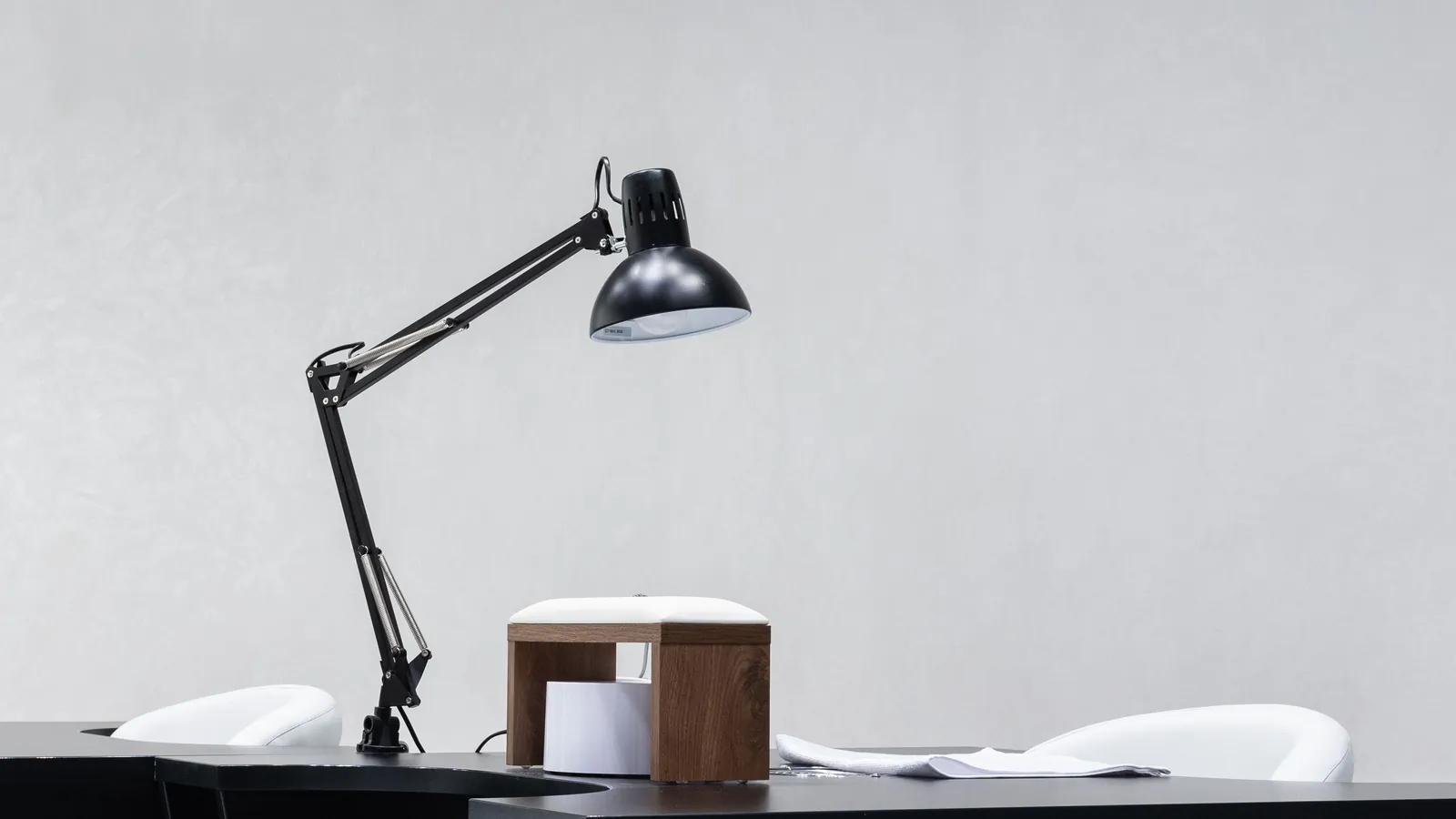
A freestanding base moves from desk to desk, but its footprint takes up working space; a small lamp head can sit on a surprisingly large base. A clamp frees the surface and uses the desk edge instead. Inspect that edge and the underside first: a deep apron, drawer, cable tray or beveled edge can stop a clamp from seating even when the top is thin enough. Glass and hollow-core tops are a different matter, and a desk that cannot take the clamp calls for another mounting style, not improvised blocks or extra tightening.
Wall-mounted task lights remove the base entirely but need their own installation, and they fix the light in place if you rearrange the desk.
Two IKEA lamps show the two formats, based on their published specifications and not on any test:
| Lamp | Published format | The question it raises |
|---|---|---|
| IKEA TERTIAL dark gray 20355434 | Adjustable arm and head; clamp opening up to 2.25 inches; separately purchased E26 bulb | Does the full clamp fit your actual edge and underside? |
| IKEA NÄVLINGE yellow/white 70574721 | Adjustable arm and head; integrated LED; listed 5-inch base diameter | Can the base stay on the desk while the head reaches your task? |
TERTIAL’s assembly document depicts distinct mounting arrangements, so follow the one you use; a clamp range is no approval for every surface. NÄVLINGE’s product page describes a replacement light source, yet its AA-2147446-7 instructions call the LEDs non-changeable and prohibit disassembly. Ask IKEA how the exact item is serviced before buying, and do not open it yourself. TERTIAL takes a separately bought bulb, so use one within the maximum wattage and base type marked on the lamp or in its instructions, and let it cool before changing it.
Reach, not height
Advertised height says little about how far a head reaches sideways or how far it turns. Draw the desk from above, mark the mounting point, and mark the near and far edges of the task area; if the head cannot span them from a permitted mounting position, move on. An articulated lamp may not stay stable at every pose its joints allow, so judge it in the pose you will use.
Look up as well. A low shelf can foul a raised arm, and a head that reaches the notebook may cut across the top of the screen.
Take a laptop with a notebook on the right. Leave the entire page usable, then compare a freestanding base behind that area with a clamp, opening the laptop and moving the notebook as you normally would. If the base pushes the notebook off the desk, its price and finish stop mattering; if a clamp hits the apron, its space-saving promise does not apply to that desk.
Switches, settings and cords
A switch on a rear cord is awkward when the lamp is clamped behind a monitor, and a switch on the head moves every time you aim it. Judge reach from your working position. If brightness or color settings matter, find out how they are selected and whether the lamp remembers them after power is cut. A USB socket is a separate feature from the light, so compare its stated output with your device and do not let it decide the lamp. A rechargeable lamp needs runtime figures at the brightness you will use and a charging routine you will actually follow.
For a height-adjustable desk, allow cord slack through the full travel: a cord that reaches comfortably at the lowest height may pull taut at the highest. Do not route it through a moving part or rely on a stretched connection.
LED names the light source; whether a lamp dims depends on the controls of that exact model. A task lamp is aimed at a work area, so judge the room’s other lighting separately instead of expecting one directional head to cover every activity. And the tallest lamp is rarely the answer: an arm that cannot reach the paper from a workable mounting point leaves the placement problem unsolved.
Our lighting collection has more on room lighting. For a desk, the better lamp is usually the ordinary one that sits where it does not get in the way, reaches the paper and has a switch you can find without looking.