Bedroom Rugs: Choose the Surface, Placement and Daily Care Together
Start where your feet land: beside the bed, at the wardrobe, by a chair. Then choose between one large rug, two runners or small bedside rugs and check the cleaning.
By DecoraMintPublished 4-minute readMore in Decor
In this guide
We may earn a commission from links on this page, at no extra cost to you. Affiliate disclosure
Bare feet decide how a bedroom rug feels. On a winter morning you notice only the first stride of floor beside the bed, so the rug that matters is the one you step onto, not the one hidden under the frame.
Matching the rug to the bed
Bed Bath & Beyond’s bedroom rug guide pairs a 5-by-8 with a twin and a 6-by-9 with a full, each leaving 18 to 24 inches beyond the bed per side, and an 8-by-10 with a queen and a 9-by-12 with a king, leaving 24 to 36 inches per side. It suggests adding about a foot of length if a bench or trunk sits at the foot. Those are one retailer’s pairings. Ruggable’s size guide concentrates on living-room layouts, which helps if your bedroom has a seating corner. Measure the assembled frame, not the mattress name, since a headboard, projecting legs or a trundle change where the edge falls.
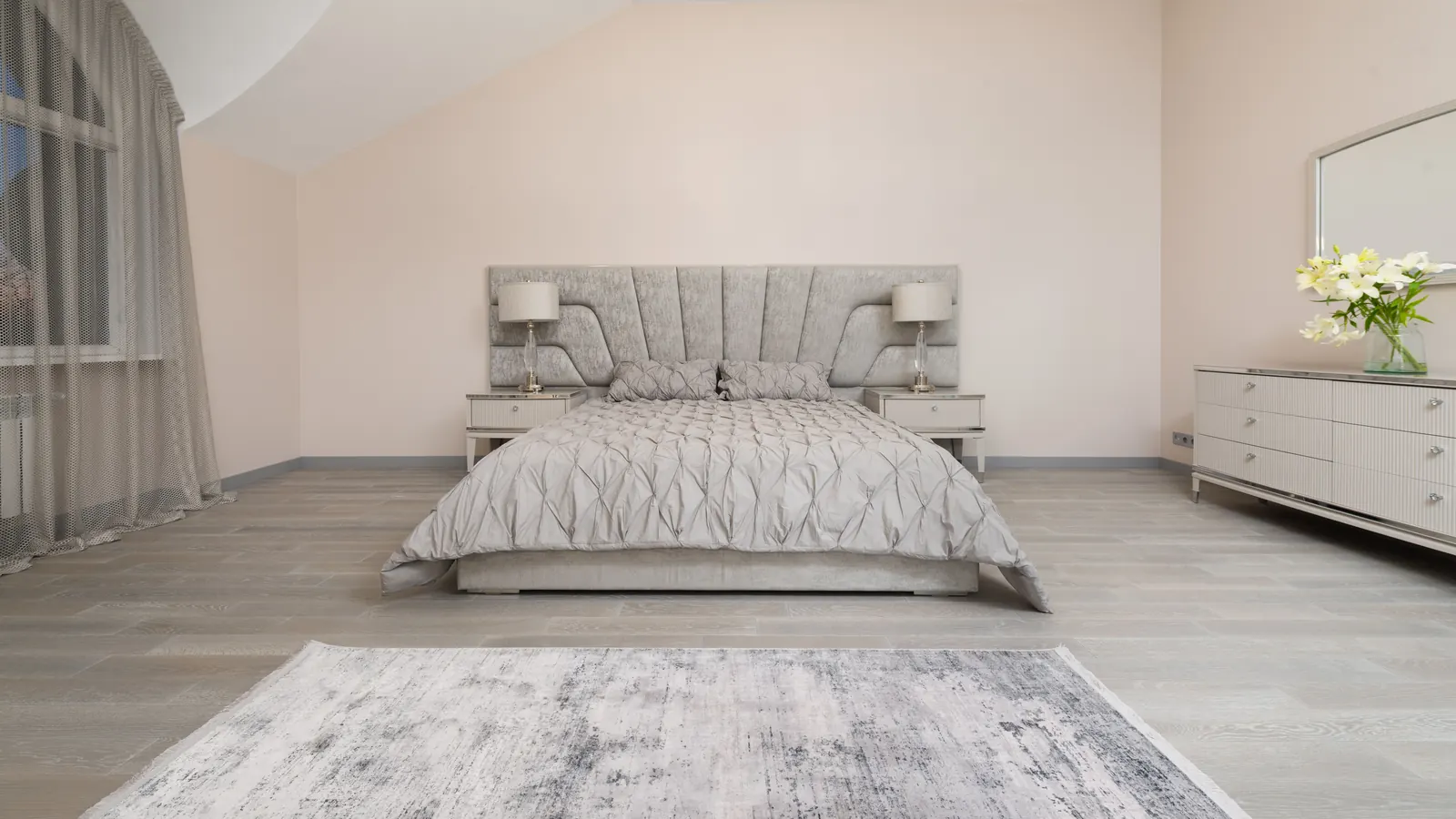
The same guide describes three arrangements. A full rug sits under the entire bed. A partial rug runs out from under the bed toward the foot, covering about two thirds of the way, and the guide suggests it for medium rooms because more of the pattern shows. A pair of runners, one down each side, suits small rooms and tighter budgets and leaves more floor visible. Tape the outline on the floor, then open every drawer and door.
What touches your feet
Pile and weave decide softness more than the fiber name does, because wool can be a plush loop or a thin flatweave. A deep tufted surface is gentle under bare soles. A flat weave is firmer, vacuums easily and lets a door pass. Since only the exposed band is felt, you can put the softest material where feet land and the tougher one along the route to the door. If you share the room, take a sample to both sides of the bed: one person’s cloud is the other’s lint trap.
Visible area is also how to judge pattern. Under a queen bed a bold central medallion may vanish while the border shows, so imagine only the margin.
Layering for a softer landing
A small, softer rug over a larger flatweave gives you a firm base and a plush step. Keep the top piece inside the lower one with a clear margin, and choose a low-pile base so the edge does not become a step. If the top piece slides, remove it instead of stacking grip layers.
A low platform bed in white linen on a pale oak floor, with a charcoal wool flatweave pulled two thirds out from under it: the rug frames the bed like a mat around a print, and a round shaggy piece by the window gives bare feet something warm without crowding the path. A bed dressed in a busy patchwork quilt wants the opposite, a plain rug in the quilt’s quietest color so the floor settles the picture. Lay the quiet base first and add any extra softness as a piece you can lift out for cleaning.
BENI weaves both layers of that scene in wool, by hand and to order, and its craft page gives the heights that decide whether the pairing works. Its Zahara flatweave is about 0.4 inch thick, and BENI itself describes it as the base when layering rugs; BENI’s Zahara Flatwoven collection shows how stripes and tight geometrics keep a crisp outline in the band of floor around the bed, the part that stays visible. BENI’s FAQ recommends a pad under Zahara rugs to keep them in place, which suits the low, stable base this section calls for.
For the soft step, the knotted Atlas pile averages about 1.25 inches, and BENI’s Atlas Low product pages give about 0.75 inch. BENI’s Atlas Knotted collection shows what that depth does to color: the pile holds shadow between the knots, so a cream or rust reads deeper and more matte than the same yarn woven flat, and a small piece of it by the bed looks like a deliberate change of texture rather than a second rug. Keep the tall pile clear of the door swing. For sizes up to 9 by 12, BENI quotes 14 to 18 weeks for Zahara, while Atlas designs vary by page (12 to 16 weeks for Après, 18 to 20 for Fado). It warns that finished sizes can differ from the order by up to 5%, and treats orders as final once its 24-hour change window closes, so the taped outline has to be settled first. If the bedside sees a pet or morning coffee, weigh that against its care guide, which sends any spill that soaks through to a professional rug cleaner; a washable rug is the easier route there.
Doors, pads and cleaning
Judge clearance at doors and drawers with rug and pad together, since a low rug that clears alone may catch once a pad lies beneath it, and a curled corner at the bedside is a trip hazard in the dark. A pad marketed as non-slip is not approved for every floor finish, so follow the flooring maker’s guidance on the combination. If vacuuming means two people lifting the bed, a smaller rug or two runners will get cleaned more often.
For a washable rug, find which piece goes in the machine, the whole rug or a cover, and whether your washer takes that size. Larger sizes may only fit a commercial machine.
Light colors need the room’s own light, so look at a sample in the morning and again by lamp. A pale rug need not match the sheets, but it should look deliberate beside them.