Body Pillows: How to Choose by Fill, Size and Feel
Memory foam, fiber, plush or weighted? How to choose a body pillow by length, fill and cover fabric, for warm sleepers, cold sleepers and small beds.
By DecoraMintPublished 8-minute readMore in Pillows
In this guide
We may earn a commission from links on this page, at no extra cost to you. Affiliate disclosure
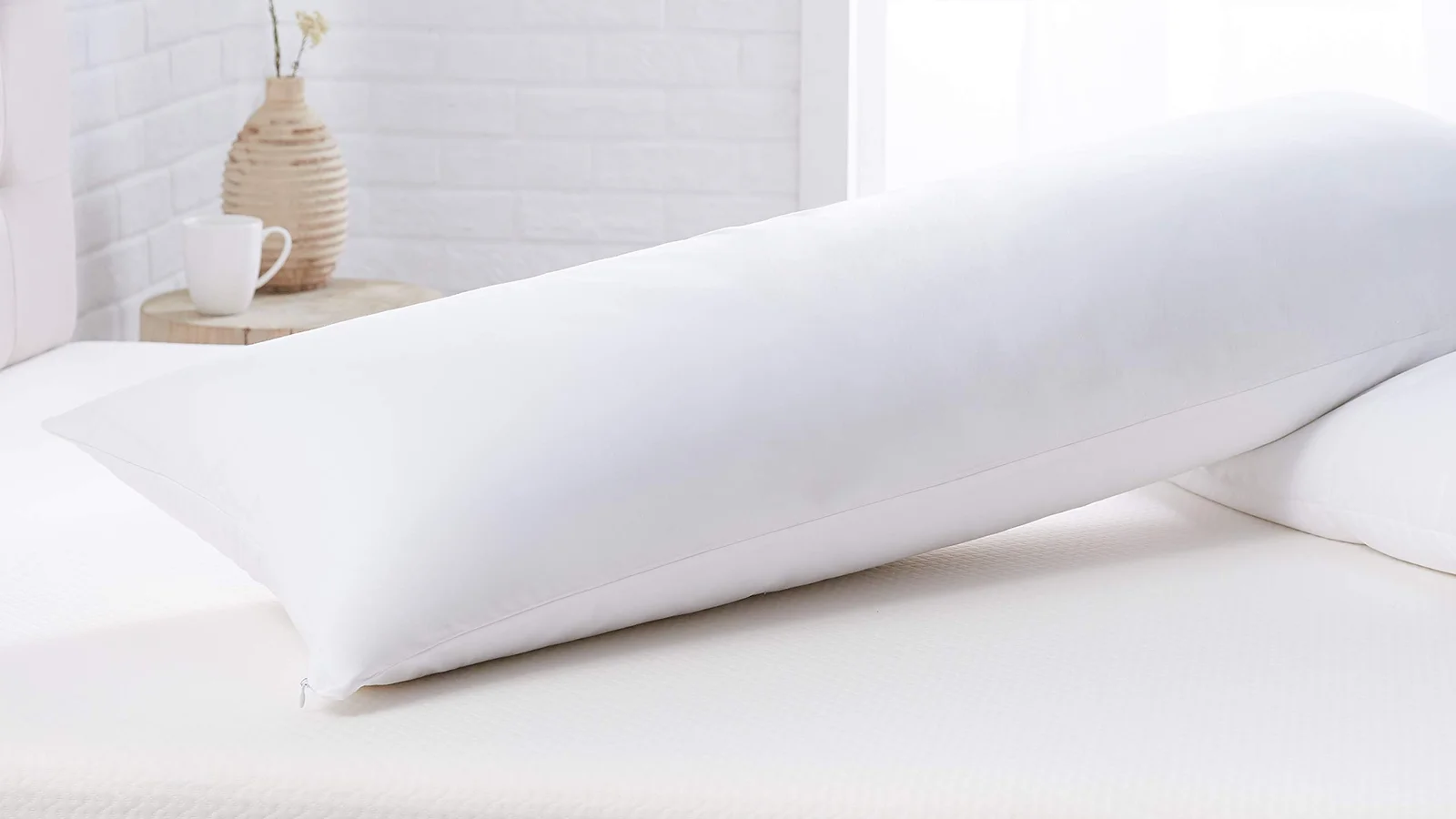
Most people buy a body pillow by length, then discover that the 54-inch cushion that looked cozy in the product photo fills half a shared bed. The better first step is to lay a folded blanket or a few cushions where the pillow would go and live with it for an evening. Notice whether you want something to hold along your front when you lie on your side, a shorter piece you can move around, or a backrest for the sofa. Each calls for a different pillow, and a long one may block your route to the edge of the bed.
This guide covers ordinary adult comfort and buying choices. It says nothing about treating a condition or about pregnancy sleep, and a body pillow never belongs in an infant’s sleep space. We have not run comparative sleep tests.
Shape and the space it takes
A straight pillow can shift between several positions, while a shaped pillow commits more of the bed to one arrangement. Shared beds show the difference fastest. A full-length pillow in a pale linen-textured case looks generous and calm on a made bed, but in use it becomes a wall down the middle, and the partner on the other side feels it. A shorter piece, tucked between the knees or hugged to the chest, leaves the bed looking more open and is easy to push aside when you turn over. For scale, ZONLI’s Wheat Short Body Pillow is listed at 39 by 12.2 inches: 15 inches shorter than the standard 54 and under two-thirds of its 20-inch width, so on a full or queen bed it reads as a cushion rather than a divider.
For reading on a sofa, a sleeping pillow may not hold its shape upright. Look at shape retention and how easily the cover comes off before you settle on it as a backrest.
An adjustable straight pillow
Coop’s Original Adjustable Body Pillow is listed at 20 by 54 inches, with a memory-foam-and-microfiber fill and a separate cover. Fill can be added or removed. That makes it a good example of the straight, adjustable type.
What matters in the shop is access to the fill. A zipper might open only the outer cover, not the insert, and a removable pillowcase does not mean the loft can be changed. If you do adjust the fill, keep what you remove clean and away from children and pets, as the maker directs, and change one small amount at a time so you can judge each step in the same position. Buying extra fill straight away defeats the point of finding the amount that suits you.
What makes a body pillow feel cooler
Three separate changes get lumped together: a smooth cool-touch face, a less bulky fill, and a different outer case. Any of them can change the first impression, but none of them shows comfort across a whole night. ZONLI’s MuscleEase Cooling Body Pillow is a clear case of the first change: the listing describes a two-sided cover with a cool-to-the-touch fabric on one face and a softer, wrinkle-resistant finish on the other, so the cooling element is a surface you can turn away in winter, not a different insert.
Coop’s Cool+ body pillow gives a concrete contrast. The brand lists the same 20-by-54-inch format with a cooling-oriented construction and a removable cover, and availability changes, so treat it as a comparison of documented features, not a promise it can be ordered today. The specification lists a polyethylene, polyester and spandex case over a nylon and polyester liner that holds a gel-foam pad. Those construction differences from the Original do not show a lower body temperature overnight.
The gap between a cool touch and moisture evaporating is also what NC State’s fabric-testing explanation describes. The lab method is for fabrics, and the question it suggests is worth putting to any seller: which component was measured, and how?
Before you replace a whole pillow, work out where the heat complaint comes from. A thick plush case feels quite different from a smooth one on the same insert. If the problem is bulk or shape, a new case will not fix it.
Cases: fit, closures and quantity
Read the insert’s dimensions and the case’s stated fit together. A 20-by-54-inch label is a starting point, but a deep, firmly filled pillow can be harder to slide into a case than a flatter one of the same nominal size. Check where the closure sits and whether the case was made for that model.
BEDELITE’s body-size pillowcase page lists a 20-by-54-inch body option as a single case, while its head-pillow sizes come in pairs. That is an ordering trap worth knowing: a size menu does not tell you how many cases are in the package. Availability changes, so it works as a specification example only.
A few details to weigh before color:
- Closure. An envelope overlap and a zipper are inserted differently and touch you differently.
- Quantity. One spare case often helps more than a coordinated set of unrelated sizes.
- Care. The case label and the insert’s instructions are separate documents.
- Texture. Choose the face you want against your skin, since cooling labels cover many different finishes.
Two body pillows from ZONLI
ZONLI, a floor-bedding retailer DecoraMint links to, sells both shapes this guide keeps coming back to, and the choice between them is mostly a choice of length and cover.
On a shared bed or a sofa, the 12.2-inch-wide Wheat Short leaves most of the mattress clear, and its cotton case sits easily with matte linen or percale bedding. The MuscleEase is the opposite proposition: one continuous length from shoulder to knee, for a sleeper alone or on a wide bed. Its cool-touch face is the smooth contact-layer change described above; read it as a fabric that feels cool when you first lie on it, not as a measured drop in temperature. The listing’s support and pressure wording, like the product name, is marketing, and this guide makes no such claim.
The two listings document different things. The MuscleEase names its fill; the Wheat Short page describes the cotton case but not what is inside, so you cannot compare firmness or loft from the listings. On care, the Wheat Short listing says the case is machine washable, while the MuscleEase listing says the pillow itself is machine washable with a low tumble dry. Both arrive vacuum-packed: ZONLI allows 24 hours for the MuscleEase to expand and up to 48 hours for the Wheat Short, so judge either only after that.
Case, new pillow or neither?
If you already like your pillow’s shape and support, a correctly sized removable case is the smaller change. If its fill or firmness is what bothers you, a case cannot help, and a new fixed-fill pillow is a guess. Neither ZONLI listing describes adjustable fill, so if you do not yet know how much loft you want, the adjustable Coop Original described above is the better fit, even though this page has no sponsored link for it. The Cool+ is worth weighing, stock permitting, only to compare a whole cooling build, liner included, instead of just a new surface. A compatible cooling-marketed case changes only the contact layer.
None of these has had independent comparative sleep testing for this guide, so put a suitable shape and a washable contact layer ahead of any cooling promise, and keep a comfortable pillow even when another listing quotes a cool-touch score. Check current stock and return terms before you order.
Washing, drying and parking it
A removable washable case helps when the insert needs a different method. Foam should stay out of the washing machine unless that component’s own instructions allow it, whatever a retailer says about the whole product. Think through drying and storage before you order something this large: where will it sit when the bed is made, and where can it dry? A pillow that spends every day on the floor suits the room poorly, however good the fill.
Weighted pillows and the head pillow
A weighted cushion adds mass and is harder to lift, reposition and wash. Judge it separately instead of treating it as an ordinary body pillow with an extra feature; nothing here shows that added weight improves sleep or suits a given person. A body pillow also serves a different placement from your head pillow, so decide where each sits instead of stacking them, and stop any arrangement that feels uncomfortable.
Where to start
Size settles the first question. On a shared bed or in a small room, a shorter straight pillow such as ZONLI’s 39-inch Wheat Short keeps the mattress open, as long as you accept that its listing does not name the fill. For a side sleeper with space who wants one long surface, the next question is firmness: unsure, start with the adjustable Coop Original (no sponsored link on this page) and tune it; happy with a fixed fill, ZONLI’s 20-by-54-inch MuscleEase gives the same length with a two-sided cover. If you run warm, compare the Cool+ build, the MuscleEase’s cool-touch face, or a correctly sized removable case on the pillow you already like. A decorative case works when it fits and suits the pillow’s instructions, because an undersized one compresses the insert. For the wider room, browse pillows, the bedroom and the living room.
The picks
Prices and availability update from the retailer feed.

For a shared bed or a small room
Wheat Short Body Pillow
Listed at 39 by 12.2 inches, 15 inches shorter than the standard 54, so it fits between the knees or against the chest without walling off the bed. The 100% cotton case comes off through a hidden zipper and is listed as machine washable.
Price as of

Full length, with a cool-touch side
MuscleEase Cooling Body Pillow
The standard 20-by-54-inch size, filled with shredded memory foam blended with fiber (listed as PP cotton). One face of the cover is a cool-to-the-touch fabric and the other a softer finish, so you can flip it by season; the listing says the whole pillow is machine washable on a low tumble dry, so read the insert's own care label before putting shredded foam through the machine.
Price as of