Cooling Comforters: Compare the Claims, Filling and Bedding Setup
Cool when you get into bed and comfortable all night are different promises. Decide what you want to change, then read the shell, the filling and the size separately.
By DecoraMintPublished 5-minute readMore in Cooling Bedding

In this guide
The cool you feel as you slide under a comforter has a name in the textile lab: qmax. NC State’s textile testing center describes it as the instantaneous thermal feeling at the first contact of a material with skin, and says a higher value means heat leaves the body faster, so the fabric feels cooler. That is a measure of the first moment. The hours after you fall asleep, when most people decide a comforter is too hot, fall outside it, so read a cooling claim for what it was measured on.
This guide explains what the claims, shells and fillings mean and how to build a lighter bed around them. It does not rank products from sleep testing and it makes no claim about night sweats or any medical condition.
What a cooling number describes
When a listing prints a qmax or “cool-touch” figure, look for the thing that was tested: a fabric swatch, one face of the shell, or the finished filled comforter. A swatch score shows how the surface feels on contact. The weight and loft of the filling, the sheets under it and the temperature of the room decide how the bed feels at three in the morning. Two numbers from two different product pages, using different methods, cannot be lined up against each other.
If the page gives a figure but no method, treat it as a statement about surface feel and put your attention on the parts you can judge for yourself: what is inside, how much, and what it is wrapped in.
Shell and filling are two decisions
The shell is the outer fabric and the filling is what lies inside it. A listing that talks mainly about the shell can say little about the filling, so find both.
The Company Store’s comforter buying guide sorts fills into duck or goose down, down-free alternatives that mimic down, and basic cotton or synthetic fill, and its site lists comforters as lightweight, all-season or extra-warm. For a hot sleeper the warmth level is a separate choice from the fill type, and a lightweight version of an ordinary fill may suit better than an all-season version of one marketed as cooling.
When you read a listing, look for these, in roughly this order of usefulness:
| Detail | A useful answer |
|---|---|
| Shell fibers and percentages | Named fibers on each side, not a collection name |
| Fill type and the warmth option you are selecting | The same filling at the lightweight, all-season or extra-warm level |
| Fill weight for your size | A figure given for the size you are buying |
| How the filling is held | Stitching or baffles described, so it does not shift into lumps |
| Finished comforter or insert | Whether you must add a cover |
Compare equivalent sizes. A king comforter weighs more than a twin because there is more of it, and the heavier one is not necessarily the warmer construction.
Bamboo on the label
A bamboo comforter is often not made of bamboo fiber in the way the name suggests. The FTC’s consumer guidance explains that soft bamboo-branded fabric is likely rayon or viscose, made by chemical processing, with no trace of the original plant left, and that there is no evidence rayon made from bamboo is naturally antibacterial. Read the fiber content, which will say viscose, rayon or bamboo viscose, and treat antimicrobial or eco claims as needing evidence for the finished fabric.
Zonli’s Z-Magic Bamboo Cooling Comforter is one example of this kind of listing. We have not tested it and cannot confirm its marketing claims; its current page is the place to read the selected size, shell, fill and care before you decide.
Reversible comforters can pair two fabrics, so find out which side faces you. With a duvet cover, the cover becomes the surface you touch, and its fabric shapes the first contact more than the insert’s shell does.
Build the bed around a lighter layer
Strip the bed in your mind and list what is on it: fitted sheet, flat sheet, comforter or insert, cover, throw and blanket. Note which layers you pull off by midnight. If only the comforter is too heavy, a lighter insert can be the whole answer; if you keep shedding three layers, the bed may simply be over-layered, and a flat sheet with a thin blanket gives you steps between “none” and “everything”. Our cooling blanket guide covers that route, and the separate cooling sheets choice is a different decision from the comforter.
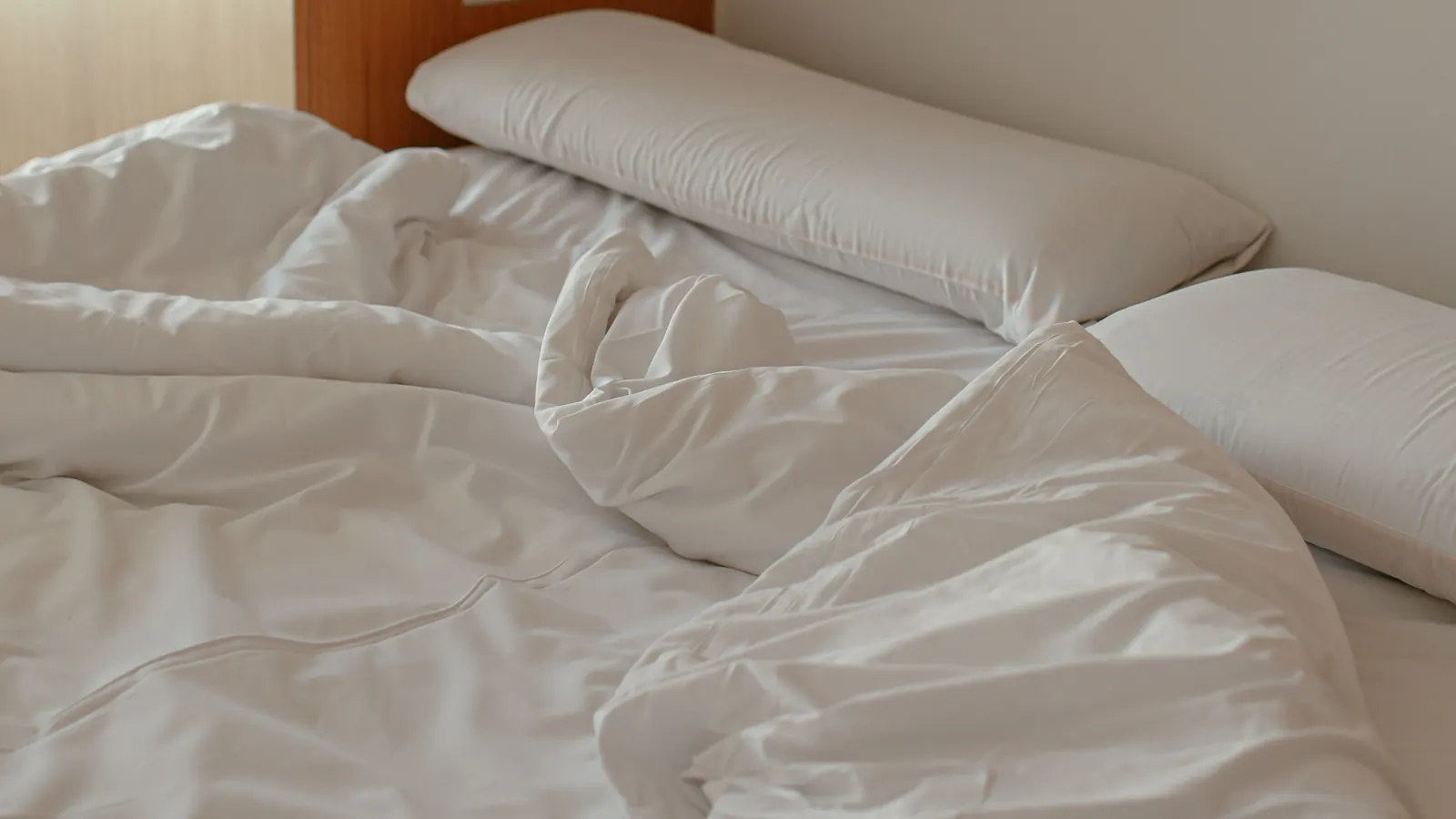
A lighter bed might have a white percale cover, a lightweight comforter pushed to the foot and a linen throw folded across the bottom third. The surface is smooth and light, the bed still looks full without being bulky, and one layer on top can come off in a second. A heavy, puffed comforter in a dark cover looks richer on the shelf and leaves nothing to take off. The lighter fill is what we would pick, with color and texture carrying the bedroom, for instance a plain cover in a mid-tone sage with a nubbly throw in warm ivory at the foot of the bed.
In a shared bed where one person runs warmer, two separate coverings, or one large comforter with an extra blanket on the cooler side, can be a better answer than a single elaborate product.
Layers like these are for adult beds. A comforter, quilt or any loose bedding stays out of a baby’s sleep space: CPSC and the American Academy of Pediatrics call for a bare crib, bassinet or play yard with only a fitted sheet, with layers of clothing or a wearable blanket for warmth.
Size and handling
Use the finished width and length rather than “queen” or “oversize,” and include your mattress depth and the drop you like on each side. If you plan to use a duvet cover, follow the maker’s sizing and attachment guidance for the pair, because a cover that is close in size can leave the insert bunched or the cover too tight. A very large comforter is harder to move, wash and store, so choose the coverage you will use.
Trial and care
Before you buy, look for the care instructions, since size and bulk decide whether it fits your machine, and for any home trial. A trial and an ordinary unused-item return are different, so read what counts as use, whether packaging must be kept and who pays for the return. To compare two comforters fairly at home, hold everything else steady, the sheets, the protector and the thermostat, so you know which change you are noticing.
When a seller cannot say what the shell and filling are, choose the product that can.