How to Make Use of Corner Closet Space Without Blocking Access
A closet corner that looks empty is often taken by hanging sleeves, a drawer swing or your arm. Three layouts that decide who gets the corner, and how to test them before buying more.
By DecoraMintPublished 6-minute readMore in Small-Space Furniture
In this guide
Where two hanging rods meet at a right angle, the last sleeves on one wall swing into the first shoulders on the other, and the corner ends up holding a tangle of hangers. The arithmetic explains why. Hunker’s closet rod guide puts a rod at least 12 inches from the back wall so hangers clear it, which means every run of clothes occupies a strip at least that deep along its wall, and in the corner the two strips overlap. Making the corner useful starts with deciding which run owns it and how you will reach what is stored there; the small-space furniture guides apply the same logic to the rest of the home.
Find what is in the way
Empty the troublesome corner and the section beside it, but leave a representative load of clothes on each neighboring rod. An empty hanger is a poor stand-in for a winter coat or a full row of shirts, because the garments are what decide how far the rod’s contents project.
Open nearby doors and drawers fully and mark their swing on the floor with removable tape suited to the surface. Then stand where you would reach for something. Work out what is blocking access: the garments, a door, a drawer, a shelf edge or the depth itself. Then sort the items you reach for daily from those that can wait a second step.
One hanging run wins the corner
Let the main run continue to the wall and stop the second one short. Slide a loaded group of garments to the end of the main rod, then hold the second run’s clothes in the position you are considering. Where they touch is the place to stop, and the stopping point depends on your wardrobe and the closet, not a standard gap. The leftover wall can take a shallow shelf, a row of hooks or nothing at all if the closet is tight.
This layout suits a closet that is mostly for hanging. As a common guideline, Hunker lists a single rod at about 64 to 65 inches (within a 60 to 68 inch range) and a double hang with the upper rod at 80 inches and the lower at 40, and notes that shelves above about 7 feet are hard to reach without a stool.
Give the corner to shelves
If the closet holds more folded goods than hanging clothes, a corner of shelving can be the cleaner answer. The test is whether you can see an item and lift it out without dismantling what is in front. Space the shelves for what lives on them: a stack of T-shirts, an upright bag and a shoebox each want a different opening.
Treat the deepest point as reserve storage. Put what you use often at the open edge, and what you use a few times a year behind it in a clearly labeled container. If retrieving one box means moving three unrelated stacks, the shelf has become an obstacle course. A rotating corner organizer swings through a circle of its own, so run that circle past the doors and hanging garments before buying one. An L-shaped continuous shelf can beat two shorter runs for capacity, but a long shelf can hide everything at its far end and shorter runs show what is there.
Keep the corner open as the place you stand
Sometimes the most productive corner is empty: it is where you stand to open a drawer, lift a box or slide a rod’s contents along, and leaving it clear can make two neighboring runs work properly. This matters beside drawers and pull-out accessories, whose closed footprint does not show the room needed to open them. Test the whole motion with neighboring doors, baskets and garments in place.
Wall space above or beside the open corner is usable only if what goes there stays within reach and does not intrude on the movement below. A narrow ledge at head height is a hazard that a few extra inches of shelf do not repay.
A purpose-built corner system
IKEA’s PAX add-on corner unit is a designed example. It is open storage with four adjustable shelves in a narrow frame, 20 5/8 inches wide and 14 inches deep in the size listed, and it connects to PAX wardrobe frames of particular widths and depths. Doors and the corner hinges are sold separately, so the unit works as open shelves on its own or as part of a closed run. The page carries a tipping warning: it must be securely anchored to the wall with fasteners suited to your wall type, and assembly takes two people. The assembly instructions show connected cabinets and coordinated doors, which is why neighboring door swings belong in the plan from the start.
For an installed wardrobe, identify the exact system before ordering additions, and keep hinges, connectors and wall fasteners to that maker’s own parts.
A walk-in corner, worked out
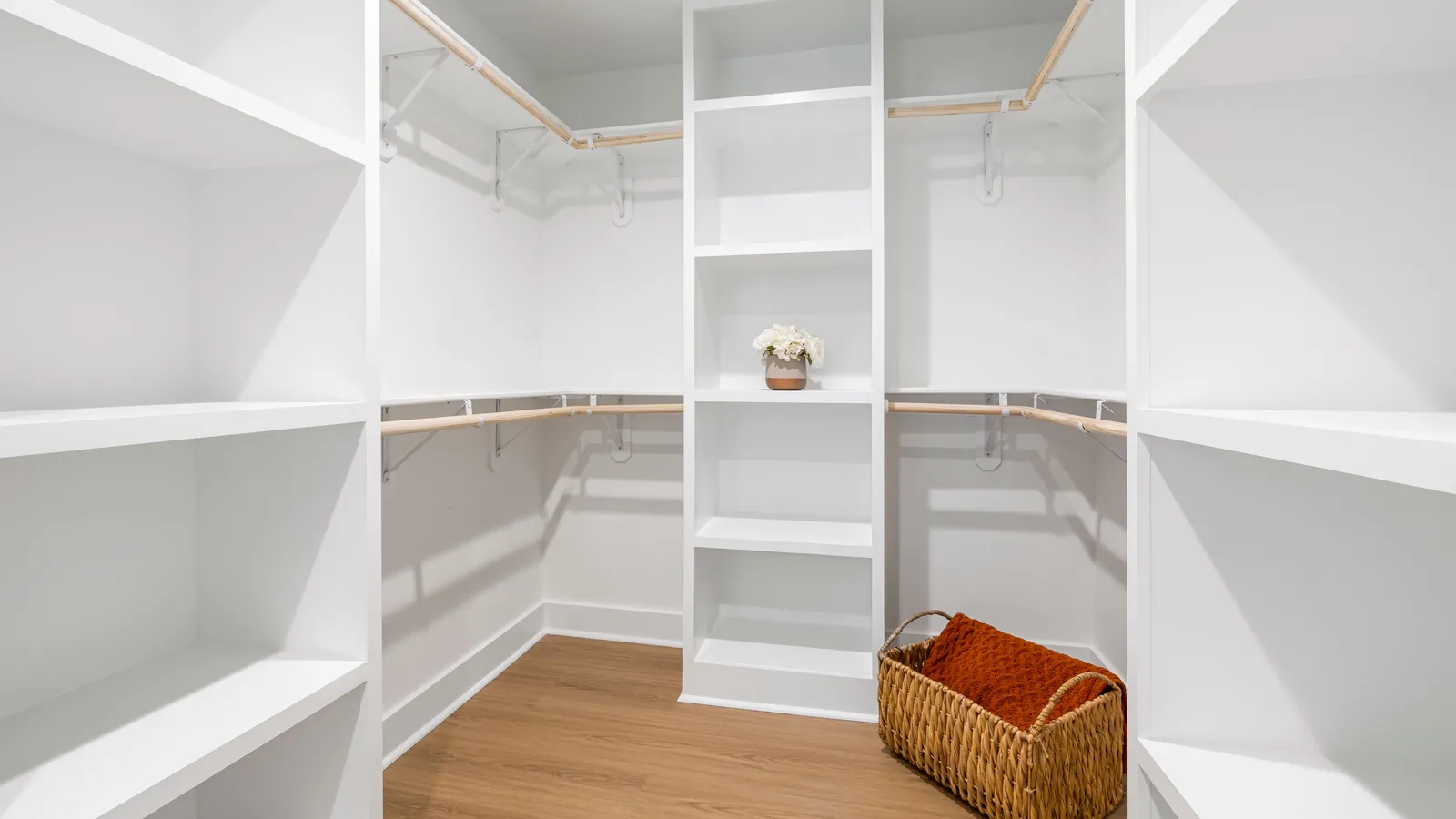
In a walk-in with white shelves, a wood rod and a warm ceiling light, we would give the long wall to hanging and the short wall to a column of open shelves that begins about knee height, with a bench or a low drawer unit below. Shirts and trousers then hang at a comfortable middle height, folded knits sit at eye level on the shelves, and shoes and bags go where a bench lets you sit and reach them. The corner itself stays clear, a square of floor wide enough to turn in, and that clear square is what makes the two runs feel generous instead of crammed.
Lighting changes how it feels. A single bulb in the middle can leave the corner, with a rod’s shadow across it, as the darkest part just when you are reaching deepest. Light on a shelf front or under a shelf edge, or a bar along the long wall, brightens the area where you reach, and the lumens and warm-to-cool appearance printed on a bulb’s label, explained in the FTC’s bulb label guide, let you choose the light you want. Battery-powered or plug-in strips avoid wiring but bring cord or battery access with them. A hardwired fixture is a job for an electrician: the National Electrical Code limits which luminaires may go in a closet and how far they must sit from stored items, and the distance varies by fixture type and code edition (one electrical-trade summary gives 6 inches for a surface-mounted fluorescent fixture). Choose a fixture marked suitable for closets.
Containers and daily storage
A box needs a retrieval route as well as a parking place. Try pulling it straight out, turning it and carrying it through the closet opening, and make sure the handle stays reachable. For a deep shelf, a few clearly labeled containers of one category beat many loose items: a bin of scarves is easier to manage than one of odds and ends from three rooms. Test one bin before buying a set, since a tapered bin has a smaller usable base than its rim suggests.
Put daily clothing in the easiest zone, keep heavy or awkward objects out of overhead reserve space, and give each category a limit, reviewing its contents before it spills into the open corner.
Trying it before fixing anything
Rehearse dressing, putting laundry away and fetching a reserve item, with outlines or spare boxes standing in for new pieces and the doors in their usual positions. For new shelving, rods or furniture, follow the exact system’s instructions for loads, fasteners and anchoring, because layout advice cannot set them. Tall units, including corner towers, are tipping hazards unless fixed to the wall as their instructions direct. Rental agreements and any wiring or mechanical services in the walls come before drilling.
If the closet cannot be altered, start with reassigning the deepest corner to occasional items and with fewer competing containers, and add freestanding pieces only when they are stable. The corner is working when you can take out the item you came for, put it back and open the neighbors without moving an unrelated pile.