Lace Curtains: Choose Pattern, Coverage and a Practical Finish
Lace shows its pattern through the balance of open areas and dense motifs, so the same panel changes with gathering and light. Plan coverage, privacy and care along with the design.
By DecoraMintPublished 5-minute readMore in Blinds & Shades

In this guide
Machine-made lace curtains grew out of Victorian Nottingham. According to Wikipedia’s account of the machine, John Livesey invented the lace curtain machine in Nottingham in 1846 as an adaptation of John Heathcoat’s bobbinet machine, and curtains designed for the 1851 Great Exhibition needed over 12,000 Jacquard cards for their patterns; we have not checked those details against a primary source. That history matters at the window today because lace is a pattern first and a fabric second: what you see is a lattice of dense motifs and open ground, and the way it hangs decides which parts of the drawing show.
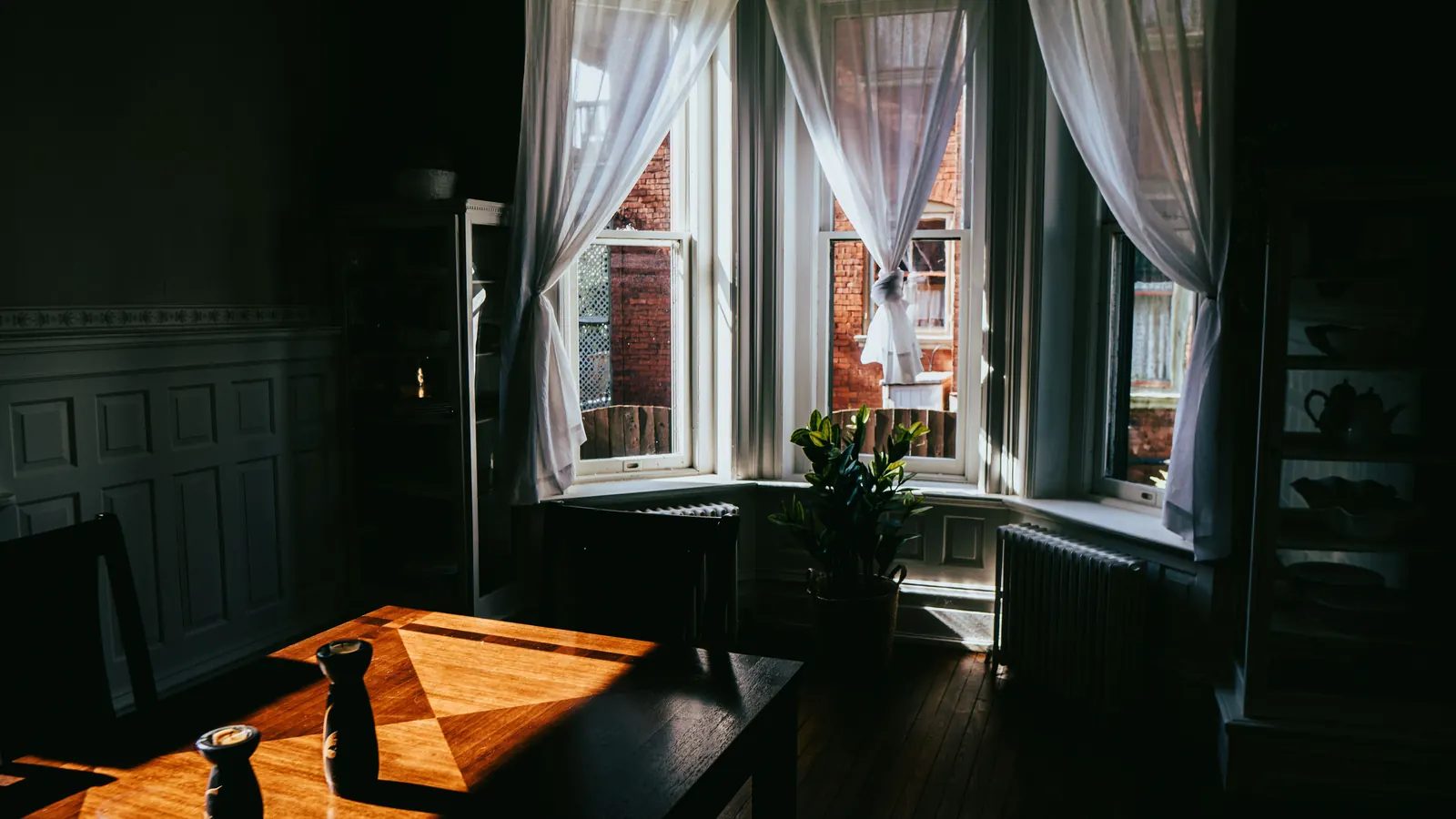
Light is the other half of the picture. A lace panel in front of a window does not blank the glass; it breaks daylight into a soft scatter, so shadows of roses, ferns or geometric trellis lines drift across the floor and the wall through the afternoon. A small repeat reads as a quiet, even haze. A large motif with open space around it throws distinct shadows that move with the sun. In a room with plain walls, a panel like that is the best decoration the window can have; against busy wallpaper it can feel like too much going on.
Reading the pattern
A close-up photograph can hide how a design repeats. Ask for a view of the whole panel, then work out which parts carry the drawing: an all-over repeat, a broad lower border, vertical bands or a calm center with decorated edges. Look at it from the doorway too, since a pattern that seems delicate at arm’s length can read as one broad band across the room.
- A small repeat gives an even field and loses detail from across the room.
- Large spaced motifs read as distinct shapes, but fold away in a deep gather.
- A strong lower border gives a defined finish near the sill and can disappear behind furniture or a shortened hem.
- Vertical bands read as upright lines and need to align where two panels meet.
Cooper Lace’s measuring guidance shows how fashion changed this. It says 19th-century lace was typically hung full, at 1½ to 2 times the window width and falling near the baseboard or lower, while 20th-century lace was preferably 1 to 1¼ times the glass width, no more than 1½ times, with panels just touching the sill. Fuller gathering means deeper folds and a pattern partly hidden in them, and a flatter hang shows the drawing more directly, so choose fullness by how much of the design you want to see.
Keep the border, mind the length
A scalloped or decorated lower edge belongs to the design. Cooper Lace says its seamstress shortens panels from the top so the decorative border is not cut. That is one supplier’s service, so ask what is possible for your exact curtain before cutting or commissioning an alteration. For a sill-length arrangement, line up the border with the sill and the window’s lower rail. For a longer drop, make sure the pattern stays visible above furniture, because a beautiful band hidden behind a cabinet earns little.
Measure from the attachment point for your heading, since a rod pocket, rings and hooks place the top of the fabric differently, and settle that before ordering a custom length when the hem cannot easily be altered.
One panel, a pair or a cafe tier
A single panel shows a centered design without a seam and suits a narrow window that stays covered. A pair makes a center opening and two inner edges, so check whether those edges are plain or decorated and whether the design has a left and right orientation; two identical panels may not mirror each other. A cafe tier covers part of the window and gives the lower section a patterned finish, but the glass above stays open to the view. For a broad window, one continuous run reads as a single field and separate panels keep each opening distinct.
Privacy, and what goes behind lace
Lace is open work, so it gives no dependable privacy at night, whatever the pattern density or the color. If the room needs screening, add an independently operated shade or lined curtain behind or beside the lace, and leave room in the hardware for both. A plain closed layer behind gives the motif a calmer background, while open glass lets the pattern interact with the view, so look at both states before choosing a strong design for a room used mostly in the evening. A backing sewn to the panel moves with it, whereas a separate shade works on its own.
Coordinating lace
In a plain room, let the lace carry the detail and keep other window accessories quiet. Against a mullioned window, a dense repeat creates overlapping lines, so test it. Next to patterned wallpaper, choose lace with more open ground or a defined edge, and compare scales, because two motifs of similar size compete even in the same color. Lace under plain outer drapery works well, though the outer panels should be wide enough not to hide the decorated edges permanently. Warm ivory beside bright white can look deliberate or mismatched, so hold the two samples together.
Washing lace
Lace names a look and a construction, so the care depends on the fiber and finishing. Olde Worlde Lace’s care page gives different methods by fiber: its polyester panels go through a gentle machine cycle in warm water with no bleach, tumbled until damp and then line dried, while its cotton and cotton-blend panels are hand washed in cool water with mild detergent, never wrung or tumbled, and reshaped while wet, with a cool iron if needed. Cooper Lace suggests dry cleaning for Madras and says its Nottingham lace can be washed in cold water with mild detergent, by hand or on a delicate cycle, and should not be ironed; creases relax after hanging, and a light spritz of water helps. These are those suppliers’ instructions for their own products, so follow your own panel’s label, including any lining, trim or heading.
For an older curtain with no label, you cannot tell the fiber from age, color or delicacy. A qualified textile cleaner can assess it far better than a generic machine-wash recommendation. If panels come down often, make sure the heading and window height are manageable, and confirm whether the listing sells one panel, a pair, a tier or a valance before you order.