Memory Foam Mattress Toppers: Construction, Feel and Care
Do you want a slower response when you move, more cushion over a firm bed or a removable layer? Pick the change first, then read the layers, density and cooling claims.
By DecoraMintPublished 4-minute readMore in Bedroom
In this guide
Press a palm into memory foam and the dent closes slowly, like a handprint in wet sand, rather than springing back. That delayed recovery is what a memory foam topper brings to a bed: a surface that settles around the shoulder and hip and holds the shape for a moment. Whether you want that depends on how you move at night and what is wrong with the mattress underneath.
What the foam does
Memory foam is viscoelastic, and the Polyurethane Foam Association’s technical bulletin describes its time-dependent response and notes that temperature changes measured firmness and recovery. Formulations differ, so one showroom impression does not describe them all. In practice, a topper may feel firmer in a cold room and softer once your body has warmed it.
Think about movement. People who like to sink and stay put tend to enjoy the slow response; people who turn often may find it clings and slows them. If you turn a lot, look for a topper whose maker describes quick recovery. Our bedroom guides cover related bedding choices.
Layers, thickness and what is really inside
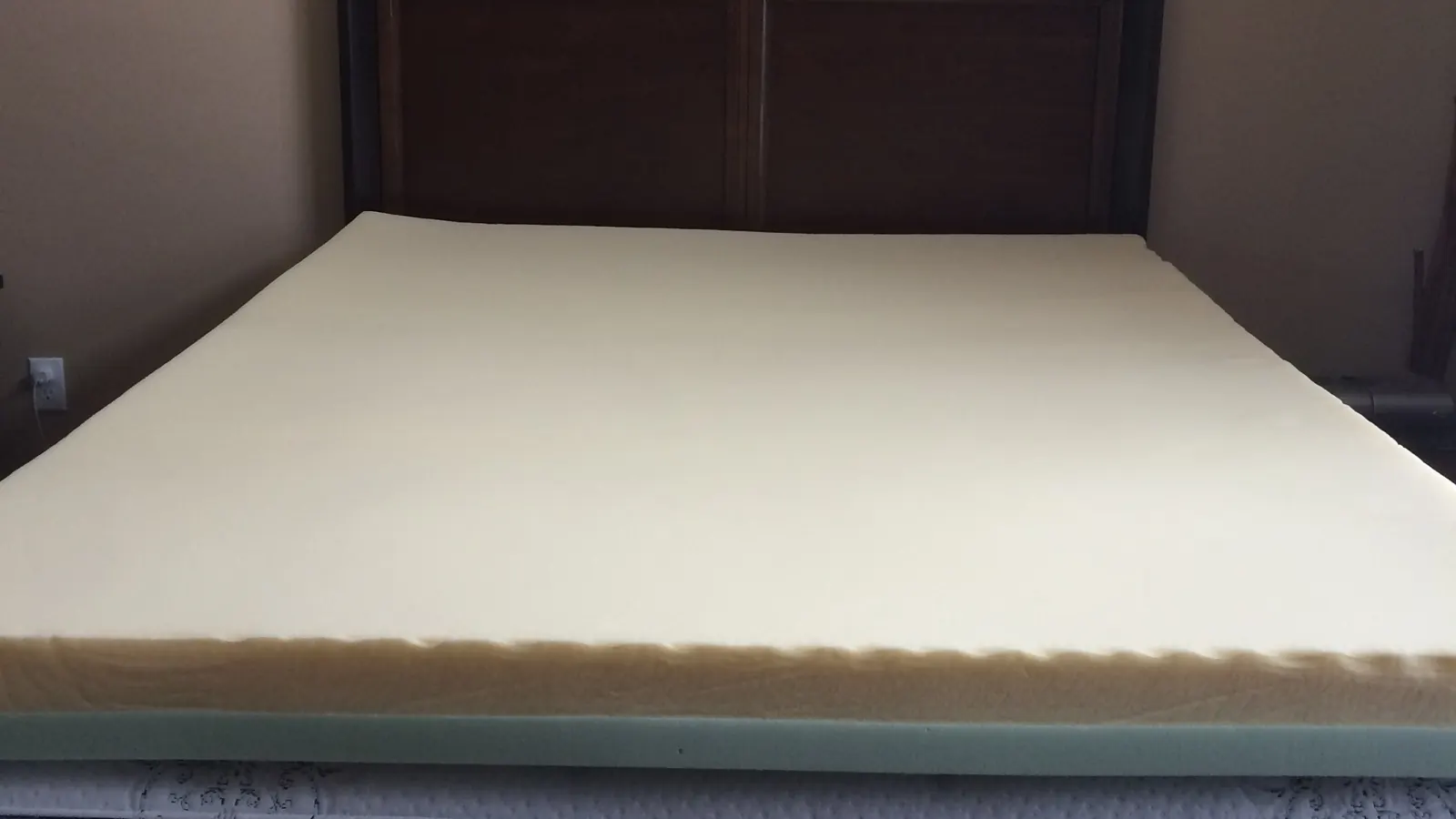
A listing for a four-inch topper might mean four inches of memory foam, or a thinner foam layer on support foam, or a quilted cover that adds visible loft without adding foam. Look for a layer-by-layer description and the section diagram, not the lifestyle photograph of a made bed. If the description and diagram disagree, ask the seller before you order.
Worth knowing about the common features:
- Memory foam over support foam: a good listing gives the thickness of each layer and says which side faces up.
- Quilted cover: is the quoted thickness measured with the cover on?
- Gel infusion: look for which layer holds it and what evidence the maker offers for the claimed benefit.
- Zoned or contoured surface: some have an orientation, and the listing should state the usable footprint.
Thickness changes how much foam sits above the mattress, but the mattress below still shapes the result. Choose from the maker’s own thickness options rather than a generic weight chart.
Density and firmness are separate numbers
The PFA performance guide separates density, the mass per volume, from firmness, the resistance to indentation. A denser foam is not automatically firmer, since formulations combine the two in different ways. A listing that gives density but no firmness leaves half the question open, and one that gives only “soft” or “firm” should not be turned into a density figure. A heavy shipping box also includes packaging and other components, so it cannot be used to work out foam density.
Cooling claims
An infusion, perforation or cooling cover is a feature you can name, but each stays a seller’s description until the listing says what it was compared with and under what conditions. Memory foam also responds to temperature, so a foam that feels soft in a warm room may feel firmer in a cold one. Choose the topper for its response first, and treat any cooling feature as a bonus.
Fit and the look of the bed
A topper raises the finished surface. Add its thickness to the mattress height, then any protector, and compare the total with the fitted sheet’s stated pocket depth. The bed will sit higher against nightstands, hide more of a headboard and be a bigger step in and out. Match the topper’s finished length and width to the mattress, then see what holds it: straps, a skirted cover or a permitted protector. Do not glue it down or cut the core to fit.
Pale, smooth covers keep the bed looking calm, and a topper with a quilted cover gives a plumper, hotel-like edge, while a bare foam slab under a fitted sheet looks flatter. Which you prefer depends on whether you want the extra softness visible.
Cover versus core
A removable cover and the foam beneath are separate items. Tempur-Pedic’s topper-cover guidance permits washing its topper covers at specified settings, and that refers to the covers only. For the foam, follow the maker’s own instructions, and skip soaking, steam or heat drying. If spills are likely, use a protective layer the maker allows.
A topper is an extra layer above the mattress; it cannot fix a hollow, broken support or tired foundation, and it can hide a fault. Fix the bed first.
Safety and returns
Mattress toppers are adult bedding. The American Academy of Pediatrics lists mattress toppers, quilts and comforters among the soft items to keep out of a baby’s sleep area, and a baby should sleep on a firm, flat surface with only a fitted sheet.
Compressed foam arrives vacuum-packed and will not go back in the box, so look for a return policy that covers an unpacked topper, states how long the trial runs and says who pays shipping. A defect warranty and a comfort trial answer different problems.