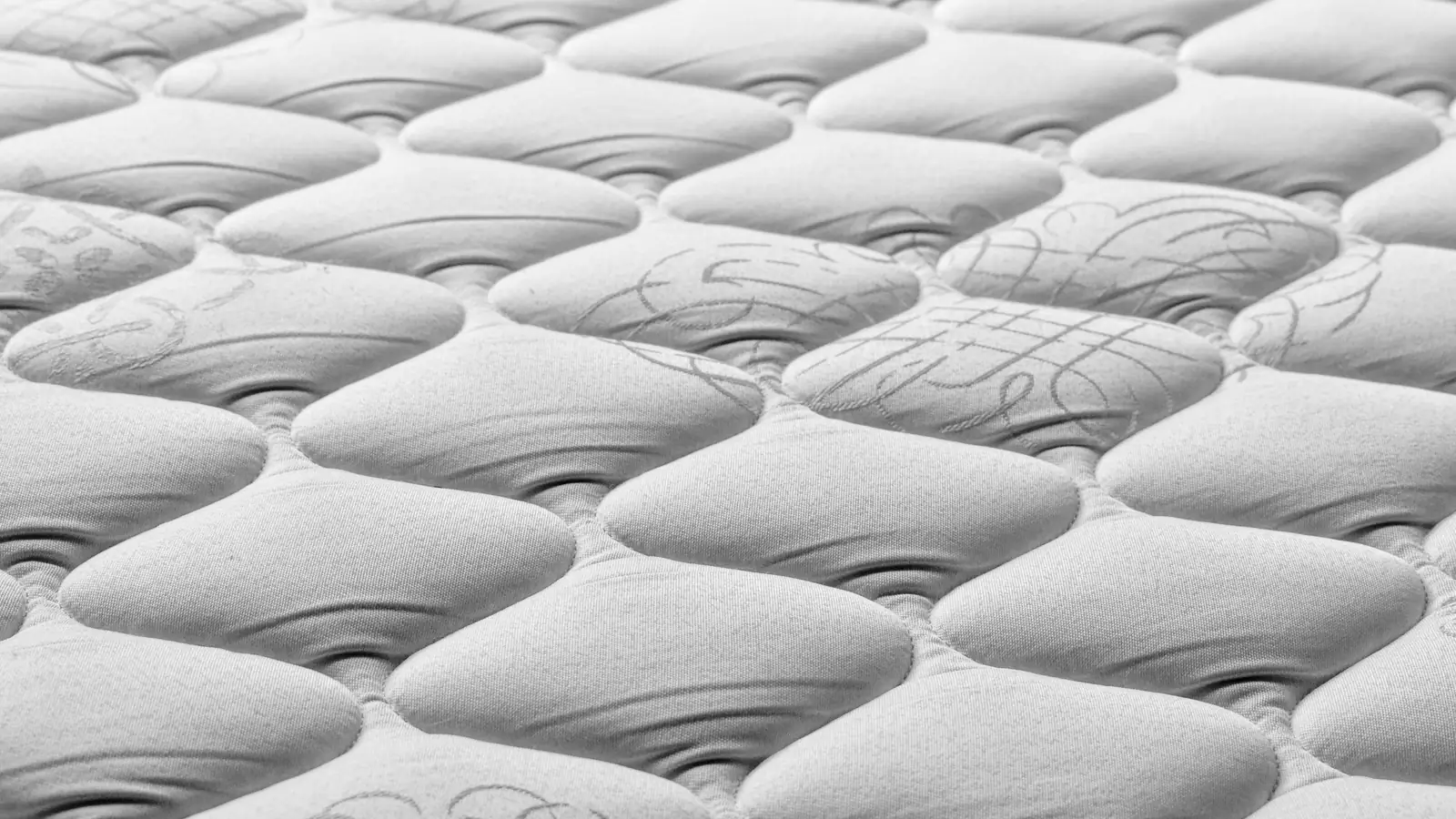
Innerspring and Hybrid Mattresses: Layers and Coils Explained
Innerspring and hybrid overlap more than the labels suggest. Read a mattress from top to bottom, compare coil counts on the same basis and look at the edge separately.
By DecoraMintPublished 6-minute readMore in Bedroom
In this guide
Press a palm into a spring mattress and let go. On some beds the whole surface answers at once, a broad, buoyant push that travels toward the far side; on others only the patch under your hand gives, and the rest stays still. That difference lives in the coils, and it is the first thing worth understanding about any innerspring or hybrid. The labels themselves overlap: a hybrid commonly means a spring mattress with a thicker stack of foam or latex on top, so the useful question is which springs sit inside and how much cushioning covers them.
Four coil designs and how each one feels
The main support unit in nearly every spring bed uses one of four designs. The Sleep Foundation’s coil guide describes them this way.
Bonnell coils are hourglass shaped, wider at top and bottom than in the middle, and wired together so they move as one unit. That gives the classic springy, slightly bouncy bed: supportive, but less able to follow the separate weights of two bodies.
Offset coils are a refinement of the Bonnell, with squared-off sides that flex like a hinge. They tend to be quieter and to contour a little more, and they cost more to make.
Continuous-wire units are formed from a single wire bent into rows of loops and joined with helical wires. They are durable and inexpensive, and they read firmer and less contouring than offset or pocketed designs.
Pocketed coils are cylindrical springs, each sewn into its own fabric sleeve, so each can compress without dragging its neighbors along. That is the design behind the “only the patch under your hand moves” sensation, and it is why pocketed units are the usual choice for couples who notice each other turning over. They are generally the priciest of the four. Those fabric pockets are sealed deep inside the mattress for good.
Pocketing helps, but it promises nothing on its own. Everything layered above the coils shapes how much movement you feel, so judge the finished bed.
Wire gauge, and the small coils near the top
Gauge describes wire thickness, and it runs backwards: mattress coils typically span 13 to 17 gauge, with 13 the thickest wire and 17 the thinnest, according to the same guide. Thicker wire makes a firmer, sturdier spring; thinner wire flexes more readily. If two listings use the same coil type, gauge is one of the few concrete numbers that hints at why one feels firmer.
Many hybrids add a second tier of small springs, often called microcoils or minicoils, roughly 1 to 3 inches tall, in the comfort layers above the main unit. They add a little lift and airflow under the foam. Component maker Leggett & Platt’s 2023/2024 catalog shows the same spread of designs: springs joined with spiral wire, fabric-pocketed springs, continuous-wire systems and spring components meant for comfort layers. As a component catalog, it shows what exists; it cannot tell you what a given retail mattress contains.
Coil counts only compare on the same basis
A big headline number is easy to admire and hard to use. Before setting two counts side by side, find out:
- which mattress size the count refers to (a king holds more springs than a queen of the same design);
- whether it covers only the main unit or adds in a microcoil layer;
- the coil type and gauge behind each figure.
A queen count for the support unit and a king total that includes a layer of tiny comfort coils measure different things, so the larger number proves little. If a maker publishes none of these details, write “unknown” in your notes; do not fill the gap with an imagined industry average.
Where innerspring ends and hybrid begins
No spring mattress is bare metal. Even a traditional innerspring has a cover, quilting and some cushioning between you and the coils, so adding foam does not draw a clean line between the two categories. The U.S. International Trade Commission’s 2018 mattress report describes mattresses in terms of a core, upholstery and outer covering, and discusses innerspring and hybrid construction side by side. Cocoon by Sealy’s explanation uses memory foam over a coil layer as its example of a hybrid, a fair illustration of the term, though other hybrids use latex or different foams.
In practice, the feel splits along the cushioning. A traditional innerspring with fiber quilting and a thin foam layer sits you “on” the bed, with a lively, bouncy response and plenty of air moving through the coils. A hybrid with several inches of memory foam pulls you a little “into” the surface before the springs push back. Latex over coils lands between the two, buoyant but cushioned. To see which you are looking at, read the layers from the cover down: the quilting or cover, each comfort and transition layer with its thickness, any microcoil tier, the main coil unit, and the edge.
Test the edge on its own
Perimeter construction varies more than the brochure badges suggest. A “reinforced edge” means something only when the listing says what was changed, such as firmer foam rails or heavier-gauge springs around the border. In a showroom, sit on the edge as if pulling on socks, then lie a hand’s width from it, then roll toward the middle. A steady seat and a comfortable sleeping edge are two separate results, and on a full or queen shared by two people, the outer few inches see real use.
Box springs, slats and turning
An older box spring is not automatically suitable for a new innerspring, and a hybrid is not automatically cleared for every adjustable base. Look for the exact model’s foundation requirements, including slat spacing and center support on larger sizes; those terms can decide whether the warranty holds.
Rotating head to foot and flipping over are different jobs. Older spring beds were often turned over, but a mattress built with a designated sleeping side should stay that way up; flip only if the care instructions say it is two-sided.
A short hybrid shortlist to compare
These three are documented US-market models with different builds, offered as a starting point for comparison; we have not tested or ranked them. The links are plain manufacturer references with no affiliate arrangement, and prices and delivery terms change by size.
| Option | Stated build | Why compare it |
|---|---|---|
| Brooklyn Bedding Signature Hybrid | Foam over encased coils; Soft, Medium or Firm | Several firmness choices; the optional pillow top changes the build and height. |
| Saatva Latex Hybrid | Latex over wrapped coils; Medium-Firm | A latex surface over a single coil layer, in one stated firmness. |
| Saatva Classic | Two coil layers, pillow top and some memory foam | A more spring-forward, coil-on-coil build with three firmness choices. |
The current Signature Hybrid product page states 13.25 inches without the pillow top and 14 inches with it, while an older figure of about 12.25 inches still appears in the maker’s support comparison. Use the height on the product page for the configuration you order when you plan fitted sheets and frame height, and ask the maker to resolve any mismatch on your order.
Saatva’s construction comparison contrasts the Classic’s coil-on-coil arrangement with the Latex Hybrid’s single support-coil layer under latex. Its firmness names are Saatva’s own scale and do not line up with another brand’s Medium or Firm.
Choose Signature if you want to pick among foam-hybrid firmness levels, the Latex Hybrid if a latex surface is the priority, and the Classic if you like the traditional bounce of a heavily sprung bed. None of these is evidence that one relieves pain, sleeps cooler or isolates motion better. Before ordering, add up the delivered cost and what a return would cost you, including pickup fees, and note whether the trial allows a refund, an exchange or both, plus any minimum number of nights before a return is accepted.
If you strip all of this back to one rule: share the bed with a restless sleeper and pocketed coils are the place to start; sleep alone and love a lively, airy bounce, and a traditional Bonnell or offset unit under thin quilting is worth lying on before you dismiss it as old-fashioned.