Wall Sconces: Choose the Light Direction, Reach and Power Supply
A sconce frees the nightstand and brings light closer to a chair, but it fixes the light in one spot. Plan reach, power supply and controls before choosing a finish.
By DecoraMintPublished 5-minute readMore in Lighting
In this guide
Yes, a wall sconce can replace a bedside or reading lamp, and it hands back the whole tabletop when it does. The trade is permanence. A table lamp moves when you rearrange the room; a sconce commits the light to one spot on the wall, so where the light falls, how far the fixture sticks out and how it gets power all need settling before you fall for a finish.
What a sconce does to a wall
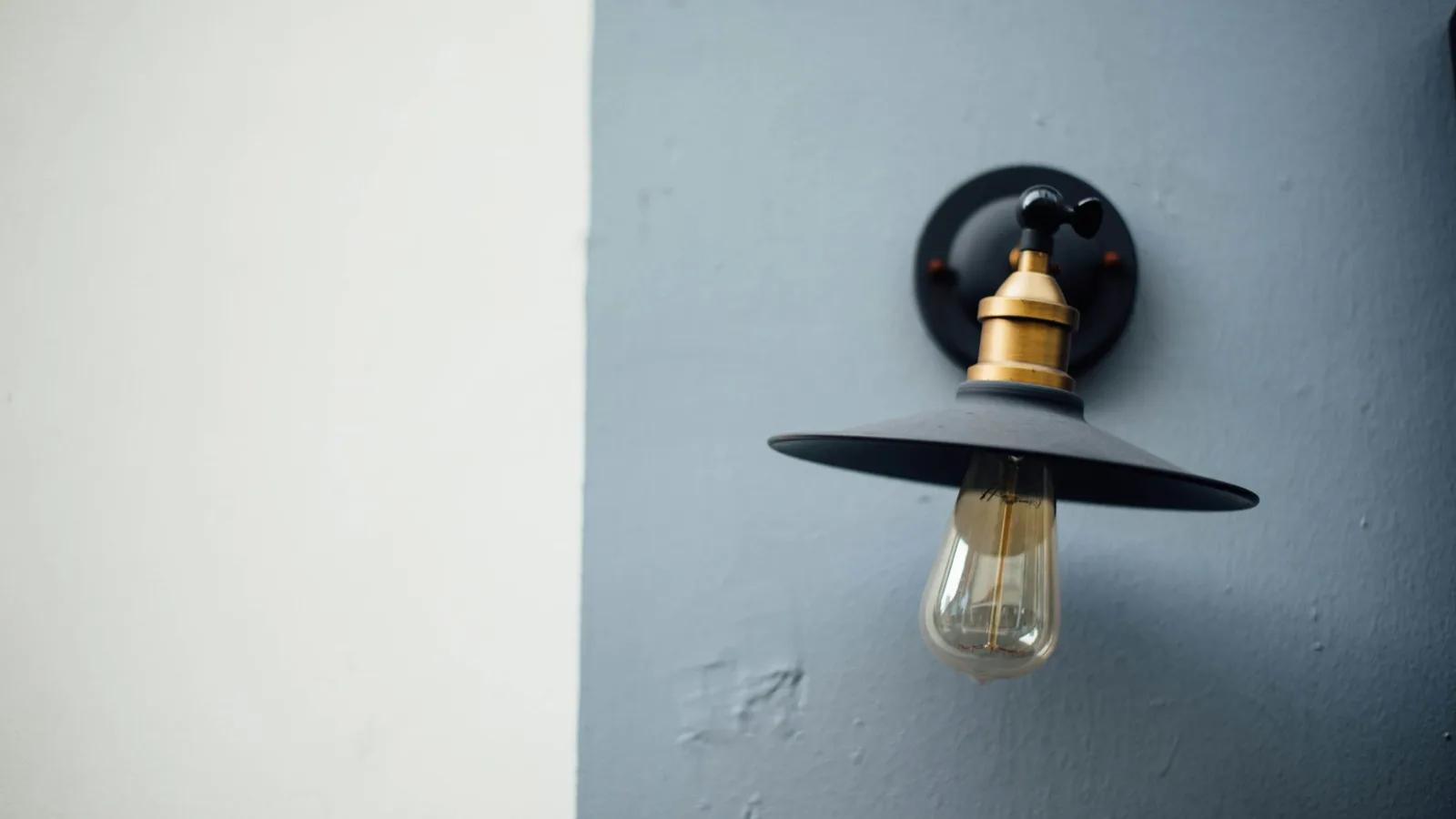
A sconce lights the wall as much as the room, and the wall becomes part of the design. An up-and-down shade throws two soft fans of light, one toward the ceiling and one toward the floor, and makes a hallway feel taller. A downward cone puts a defined pool on a nightstand or a page. An opal glass globe glows evenly and gives a warm, diffuse light that flatters faces. An exposed bulb, like the one in our photograph against a deep blue wall, is pure atmosphere, though looking straight at it from the bed is less charming.
Texture changes the effect, too. Light raking down from a sconce picks out every ridge in limewash, grasscloth or brick, which can be beautiful, and every patch in a badly finished wall, which is not.
| Job | Features to look for | The trade-off |
|---|---|---|
| Bedside reading | Directional head, switch reachable from the pillow | It can intrude on the space where you sit up |
| Reading chair | An arm that reaches the page | Long arms take up room when extended |
| Decorative glow | A shade that paints the wall nicely | A pretty glow may not light a task |
| Flanking a mirror | Light on the face from both sides | A bare bulb reflected in the glass distracts |
| Hallway or entry | Shallow projection | Wide shades crowd shoulder height |
If you want a glowing glass shade and a strong reading light, two fixtures may serve you better than asking one sconce to do both. Our lighting collection covers the freestanding alternatives.
Power: plug-in, hardwired or battery
Find the power type in the exact US listing before anything else, because similar-looking models often come in plug-in and hardwired versions.
Plug-in sconces need a reachable outlet and a sound mounting spot. Sketch the whole cord run around headboards, curtains and furniture backs, and keep it out of walkways. Cord length on paper can fall short once the cord bends around a nightstand. Never bury a flexible cord inside the wall.
Hardwired sconces become part of the house wiring. Wall support, the electrical box and the switch arrangement belong in the decision, and a qualified electrician should handle the installation. When replacing an old fixture, compare backplates: a bigger shade does not guarantee the new plate covers the old footprint.
Battery or rechargeable sconces trade the cord for a charging routine. Find out how you reach the battery once it is mounted and which brightness setting the runtime claim assumes. Treat a decorative battery light as a mood light unless its stated output, and trying it where you read, show it can do more.
Plug-in spotlight or hardwired glow: two IKEA sconces
IKEA’s black RANARP wall/clamp spotlight, 80331402, has an adjustable head and mounts either with a wall bracket or a clamp. The US listing specifies a separate E12 bulb and a 138-inch cord. Its assembly instructions show the two mounting routes and call for fittings suited to your wall. That flexibility belongs to this model; it is no license to clamp any sconce to a headboard or curtain rod.
IKEA’s AKTERSPRING 30618821 is a hardwired opal glass and brass-plated wall lamp with a listed 7-inch depth and a separately purchased E12 bulb. Its manual shows the electrical connections and a removable shade.
One is a movable spot on a cord; the other is a fixed glow wired into the wall. We are comparing their published details, not their light output, and neither is ranked above the other. Listings and stock change, so check the current version before ordering.
How far it sticks out
Measure projection outward from the wall, not just the shade width. A fixed globe, a short pivoting head and a swing arm with similar shades can take up very different amounts of air. A 7-inch-deep fixture like the AKTERSPRING sits close; a swing arm reaching across a chair claims much more.
Think through the fixture in use. At its reading position, does the shade touch the curtain, the headboard, a shelf or the sconce on the other side? Does a shoulder clip it as you get out of bed? An elegant parked position is beside the point if the useful one causes a collision.
Placement from the seat, not the tape measure
No single mounting height suits every bed, chair and hallway. Bed height, headboard shape, the direction the light points and who uses it all shift the answer. Set the bed or chair in its final place, sit as you normally do, and judge where the shade falls in your view and where your hand lands for the switch. Treat each side of a bed on its own if the furniture or the sleepers differ; symmetry is lovely, but an unreachable switch spoils it.
Recliners and swivel chairs move, so place the light for the position you actually read in.
Bathrooms, showers and outdoor walls need a fixture rated for damp or wet locations as the spot requires. Look for that rating on the label or spec sheet, whatever the fixture’s style.
Switches and dimming
Who turns it on, and from where? A cord switch, a switch on the fixture and a wall switch each create a different routine. Bedside lights want a control reachable without getting up; a living-room pair is easier on one wall switch.
For dimming, the fixture, bulb and dimmer all have to be compatible. A replaceable bulb does not make a fixture dimmable, and a smart plug only switches on and off.
Bulbs and cleaning
Find out whether the sconce takes a standard bulb or has an integrated LED, and what can be replaced if it fails. With a replaceable bulb, match the base, size and maximum wattage in the instructions, not just the shape you like. Cut the power as the instructions direct before cleaning, and think about reaching the shade safely. A beautiful sconce behind a heavy bed will need that bed moved every time a bulb goes.
A single sconce serves one chair or one side of the room perfectly well, so skip the pair unless the symmetry matters to you. If a plug-in model tempts you as a hardwired fixture, buy the hardwired version, or get the maker’s explicit guidance and an electrician’s assessment, before anyone touches the plug.