Wedge Pillows: Compare Shape, Dimensions, Covers and Intended Use
A reading backrest, a leg rest and an under-mattress incline are different wedges. Decide the job, read height and footprint together and keep medical advice separate.
By DecoraMintPublished 5-minute readMore in Pillows
In this guide
Height on its own does not describe a wedge pillow; the angle does, and the angle comes from height and length together. A 10-inch wedge that runs 24 inches across the bed rises at roughly 23 degrees, while the same 10 inches spread over a longer base makes a gentler slope that supports more of your back. So read every wedge as a small ramp: how high it rises, how far it runs, and what it is meant to hold up, whether your back while you read, your legs, or your head and upper body at night. Those are different jobs, and one cushion rarely does all of them well.
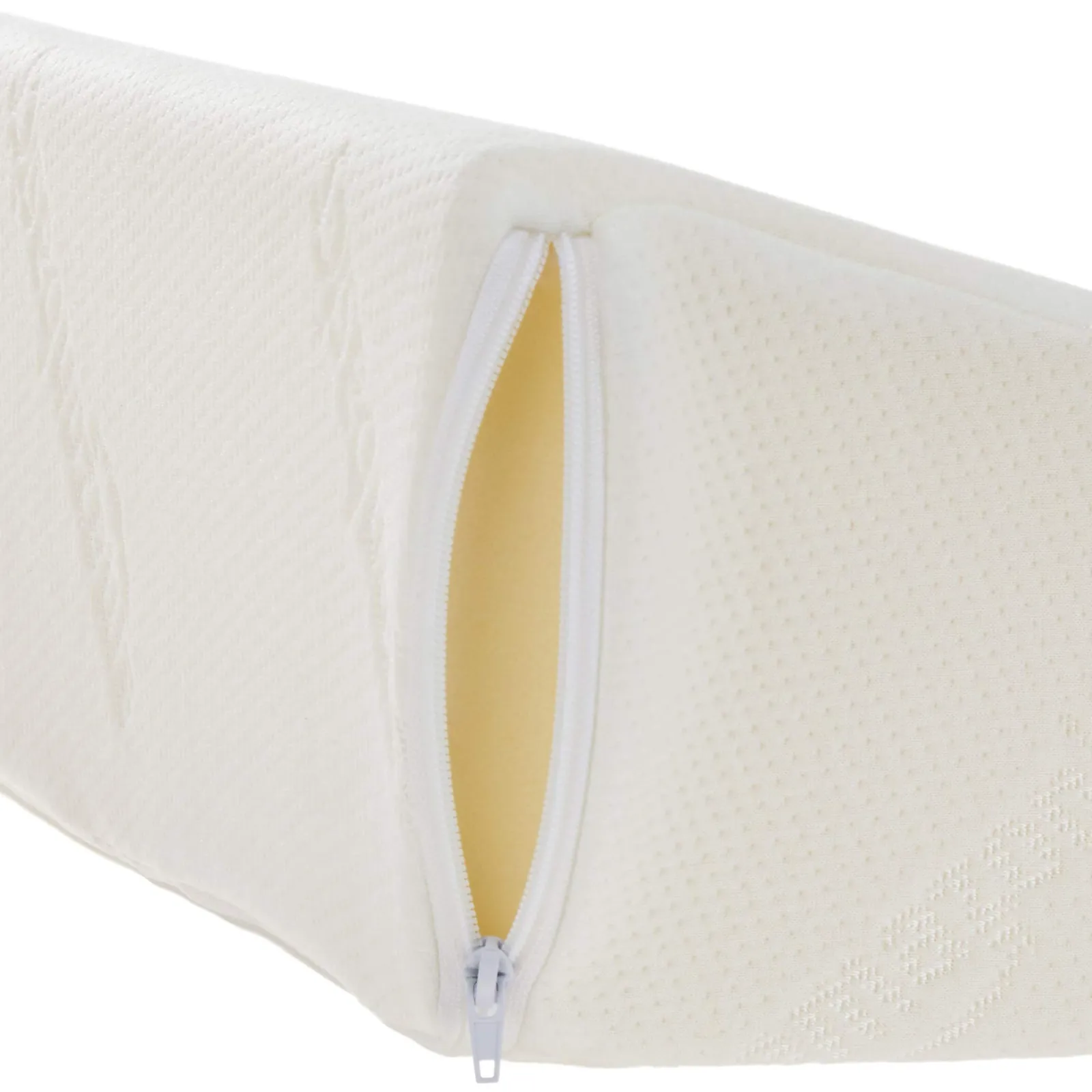
This guide compares product features for adults. If the reason for buying is reflux, breathing, recovery from surgery or another health concern, get instructions for your situation first; the medical sources below describe arrangements, not specific products. The pillow collection covers other formats. The construction detail pictured here shows a removable cover over foam; it is neither a clinical recommendation nor a product tested by DecoraMint.
Working out the incline
A straight-sided wedge is a right triangle, so the slope follows from its rise over its run. Use the length the maker gives for the side that lies flat on the mattress, and check which of the three dimensions they label as length, since listings do not always order them the same way.
The Brentwood Home Zuma listing makes the arithmetic concrete. It offers one 24-by-24-inch footprint in three heights, 7, 10 and 12 inches, which works out to slopes of about 16, 23 and 27 degrees if the 24-inch side is the run (rise over run: 7/24, 10/24 and 12/24). Same floor plan, three different ramps. The page describes a foam core and a removable washable cover.
Foam compresses under you, so the angle you rest at will be a little lower than the geometry, more so on a soft mattress topper. And taller wins nothing on its own: pick the height for the job.
Matching the shape to the job
Reading and sitting up. A wedge used as a backrest needs a tall, fairly steep face and a firm base that will not skid away from the headboard. Look at the contact surface and how much mattress it occupies; a wide wedge can take over half of a full-size bed.
Raising your legs. Leg wedges are usually lower and sometimes have a contoured top or a flat platform for the calves. Buy one designed for that use; turning a back wedge around rarely gives a comfortable knee angle.
Raising your head and upper body for sleep. This is the use most connected to reflux. A wedge for sleep has to be long enough that your shoulders and upper back are on the slope along with your head, so your head is not bent forward over the top edge. The NIDDK guidance below describes support for the head and upper back.
Under-mattress risers. A wedge that goes beneath the mattress tilts the whole sleeping surface. It works differently from a top-of-bed cushion, with its own compatibility questions for your mattress and base.
What the medical sources describe
For reflux, the NIDDK’s GERD treatment page lists raising your head 6 to 8 inches off the bed, using a foam wedge or extra pillows under your head and upper back, among the lifestyle changes a doctor may recommend. MedlinePlus’s heartburn guidance discusses a wedge beneath the mattress and cautions that sleeping on extra pillows may not work well because you can slide off them. The two sources frame the details differently, which is a good reason to ask your clinician which arrangement suits you and to bring the wedge’s dimensions to that conversation. Neither source names a best wedge.
For sleep apnea, a product sold as an “apnea pillow” has no treatment evidence behind the name. NHLBI’s treatment guidance describes clinician-directed options such as positive airway pressure and oral devices, and notes that a provider may recommend sleeping on your side instead of your back. If positioning is relevant to you, ask your sleep clinician whether a wedge would work alongside prescribed equipment, and do not change treatment because of a pillow’s name.
Keep adult wedges away from babies. CPSC safe-sleep guidance says not to add pillows to a baby’s sleep space, and that includes small or “infant” looking wedges.
Foam, seams and covers
“Foam wedge” can mean one block, layered slabs, or folding sections. A soft top layer over a firm base feels very different from a single dense block, so ask what the whole core is made of. If there is a fold or seam, look at where it would land under your back. Use only removable sections the maker designed; do not carve the foam to change the shape.
The cover matters more than it looks. A slick fabric on the underside can let the wedge creep down the bed during the night, while a grippy base stays put against the headboard. Check where the zipper sits, whether the cover alone is washable (the foam usually is not), and whether a replacement cover is sold in that exact size, since a taper is hard to fit with anything generic. Do not improvise straps or ties to hold a wedge in place.
Where it goes during the day
A large wedge is a bulky, pale triangle that does not tuck neatly away. Mark its footprint on the bed with tape before ordering, including the space a partner’s pillows take, and measure where it will spend the day: under-bed clearance, closet shelf depth, the door it has to pass through. Some people leave a reading wedge on the bed and dress it with a throw or a fitted cover that matches the bedding, so it reads as part of the headboard arrangement instead of medical equipment.
When it arrives, especially if it comes compressed, follow its own unpacking instructions and check the size and cover label against your order before discarding the packaging. Ask whether adding a pillow on top is acceptable; it changes the effective height and angle, and if the setup is for a medical reason, that is a change to clear with your clinician. An adjustable base moves the whole mattress while a wedge sits on top of it, so the two answer different needs. Lay the wedge against your headboard with your usual bedding, and buy the size only if its footprint fits beside your partner’s pillows and its cover can be replaced.