Bamboo Window Shades: Weave, Privacy Liners and Practical Choices
An unlined woven shade can still show silhouettes after dark. Choose the weave and the liner together, then measure for the exact system and plan care for natural materials.
By DecoraMintPublished 6-minute readMore in Blinds & Shades
In this guide
A shade sold as “bamboo style” may contain no bamboo at all. In the Persilux catalog we reviewed, the bamboo-style roller is described as polyester roller fabric with a bamboo look, which is why it is not recommended here as a bamboo shade. That is the first thing to settle: genuine woven bamboo, a mix of natural fibers, or a synthetic that imitates them. The second is privacy. An unlined weave filters daylight into warm stripes, and after dark, with the lamps on, it can show the room and the people in it. For a bedroom or bathroom, choose the weave and the liner together.
What the shade is actually made of
Bamboo shades belong to the wider family of woven natural shades, which can include bamboo, reeds, grasses, wood and other fibers. The mix changes the texture, the color variation and the care. Ask for the material specification of the exact color you choose, because one maker’s range can mix several fibers.
Hunter Douglas’s bamboo shade guide places bamboo within this broader woven-wood category, and it shows why the category name helps less than seeing the weave itself. A fine grass weave and broad bamboo strips look completely different at the same window, one almost like linen, the other boldly striped.
A bamboo-look synthetic can be a sensible choice, especially where moisture or exact color matching matters. It is simply a different purchase, with different care and a flatter, more uniform look.
Judge texture at window scale
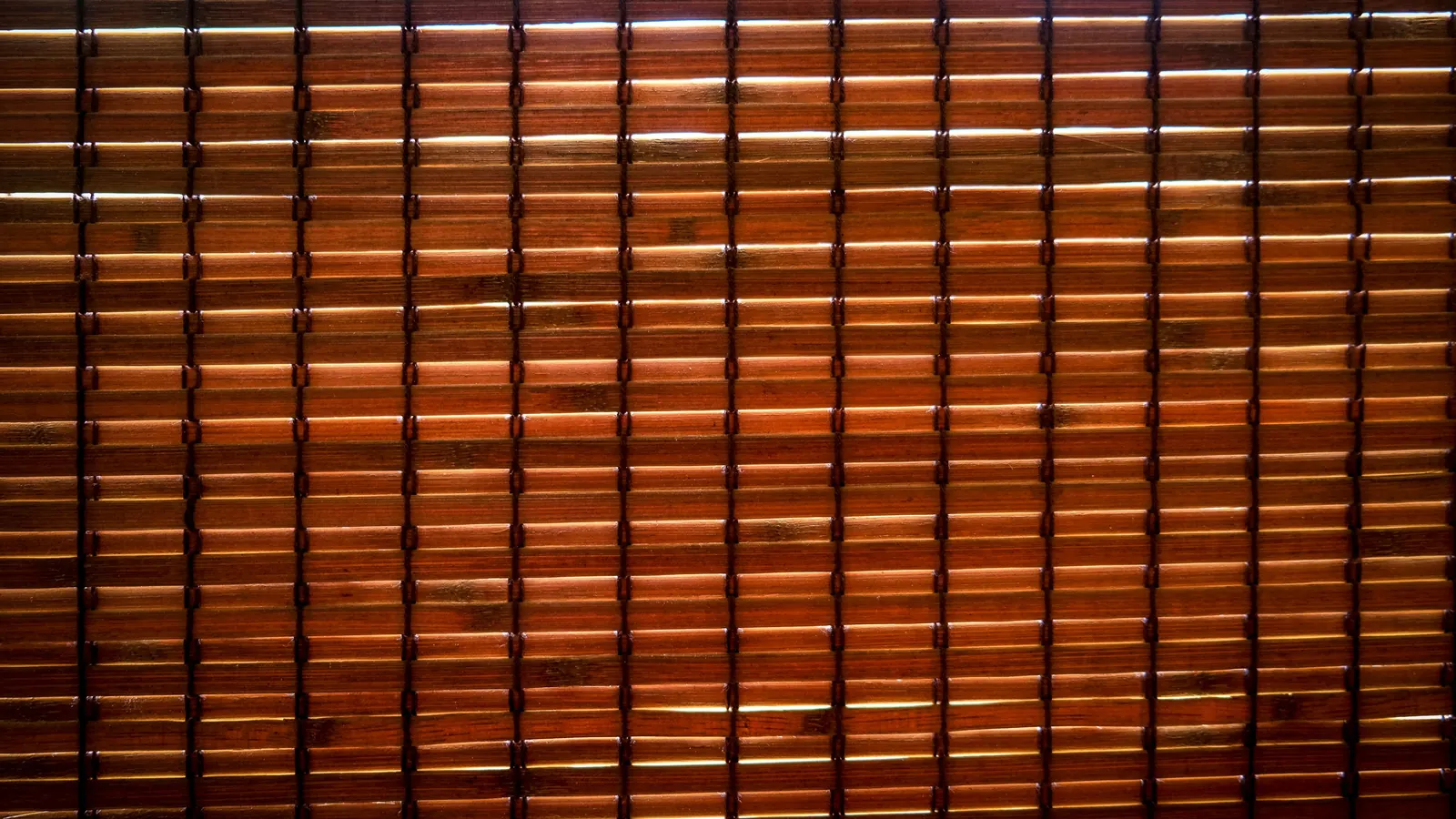
Hold a sample upright in the window, not flat on a table. Backlight shows the gaps between strands, and the warm amber glow that makes these shades so appealing. Look at it against your wall color, trim and nearby wood furniture under the light you normally use.
A fine, tight weave reads almost like fabric from across the room and suits a calm, Scandinavian-leaning space. Broad strips give strong horizontal lines with a more tropical or rustic feel. Knots, uneven strands and shifts in tone are part of a natural weave; decide whether you love that before ordering several shades.
On a wall of matching windows, ask how much variation the maker considers normal and whether the shades can be cut from the same material lot. Strand-for-strand matching across separate shades is not realistic. If perfect uniformity is essential to the design, a manufactured fabric will serve you better.
Unlined, lined or independently lined
| Configuration | Main benefit | Main trade-off |
|---|---|---|
| Unlined weave | Texture and filtered daylight | Privacy varies with the gaps |
| Attached liner | More consistent coverage | Liner moves with the shade |
| Independent liner | Separate light and privacy settings | More hardware and controls |
An attached liner sits behind the weave and rises and falls with it. It changes both how much light passes and how the shade looks when lit from behind, so compare the weave with its actual liner, not with a white card held behind the sample. A white liner calms the pattern and gives a cleaner look from the street; a darker one keeps more of the weave’s character but can read heavier from inside.
An independent liner lets you keep the decorative weave down and raise or lower the layer behind it, so you can have filtered light by day and privacy at night from one shade. The mechanism is product-specific: Hunter Douglas offers an independent liner in the headrail of compatible woven wood shades, an example of the option, not proof that every bamboo shade has it.
Ask whether the liner covers the full width and length of the weave, what color it shows to the room and the street, how it operates, and what the shade looks like with both layers raised. Extra layers need extra space, even when the finished shade looks simple in a photo.
How much an open weave shows
Look at a sample after dark with the room lights on, ideally from outside, at the angle a passerby would have. An open weave can reveal far more at night than it does at noon, and gaps beside the shade count too.
In a living room where the goal is softer daylight, an unlined weave is often enough, and it is where these shades look their warmest. For a bedroom or bathroom, any doubt about privacy is a reason to add a liner or choose another treatment. Darker color helps less than you might think; weave spacing and lining matter more.
A room-darkening or blackout liner still leaves light at the sides and around the headrail. If you want real darkness, compare the complete coverage of the installed shade, and consider an outside mount that overlaps the frame.
Roman folds versus roll-up
Many woven shades rise into soft, cascading folds that gather in a stack near the top of the window; others roll up into a neat cylinder. Fold styles show off the texture even when raised, while roll-ups keep a slimmer line. Look at your chosen style both up and down, since the mechanism changes how much glass stays covered.
Ask for the stack height at your ordered length, because a sample photo of a short window will not show the stack on a tall one. In a dim room, an outside mount above the frame lets the stack sit on the wall and keeps more glass clear, if the wall space and mounting surface allow.
Valances and edge binding finish the look. Check whether a valance is included, how deep it is and whether it lines up across neighboring windows. A contrasting edge binding looks tailored and deliberate, and it also draws the eye to small differences in width or mounting height.
Measuring for the system you chose
Record width and height at several points, the usable depth and any obstructions, then follow the measuring instructions for the exact shade. Skip generic deductions on a made-to-measure order unless the seller tells you to apply them.
On an inside mount, there can be two depths to know: the minimum needed to install the shade, and the depth needed for it to sit flush. Handles, cranks and locks eat into that space. On an outside mount, settle how far the shade extends beyond the glass, its mounting height and where the bottom edge lands. If several windows share a wall, sketch the outlines together so the heights line up.
Caring for natural materials
Natural weaves do not like water. LEVOLOR’s natural-shade technical guide describes natural variation, possible dimensional changes with temperature and humidity, and dry cleaning methods for its natural shades, and cautions against water, solvents and abrasive solutions. Read the care instructions for your own shade before hanging it near steam or cooking splashes.
Natural material is not automatically suitable outdoors, and a covered porch is still outdoors; use a product made for that exposure. Plan for regular dusting, which a deep valance, layered curtains or furniture under the window can make awkward. If the window needs frequent wet wiping, as in a busy bathroom or above a sink, a different material is the safer choice.
Controls and child safety
Pick controls you can reach comfortably. A cordless bottom rail can be awkward behind a deep sofa or on a high window, and a motorized shade needs power and service access.
Woven shades have a corded past. Traditional roll-up styles hang on lift cords that loop under the rolled shade, and fold-up styles lift on cords running down the back, and both designs were covered in December 2009, when the CPSC and the Window Covering Safety Council announced a repair program for Roman shades and roll-up blinds after child strangulation deaths, with further retailer recalls through 2010. Accessible window covering cords remain a strangulation hazard for young children, so in homes with infants and young children choose a design without accessible operating cords, ask how any inner cords are kept out of reach, and keep cribs, beds and climbable furniture away from windows. Vintage-style photos sometimes show the old corded versions; copy the weave, not the cord.
Comparing quotes
Price the same weave, liner, lift, valance and mount across suppliers so the quotes are truly comparable. Ask whether the sample represents the finished material and how much variation to expect, and read the custom-order return terms and who is responsible for measurements before paying.