Cordless Blinds: Controls, Reach and Choosing the Right Type
Cordless removes the hanging pull cord, not every cord, and it covers several different controls. How each one lifts, what you can reach and when a motor makes more sense.
By DecoraMintPublished 7-minute readMore in Blinds & Shades
In this guide
We may earn a commission from links on this page, at no extra cost to you. Affiliate disclosure
The classic cordless blind works on a simple trick: a spring hidden in the headrail is matched to the weight of the slats or fabric, so the blind stays wherever you leave it. You pull the bottom rail down and it holds; you push it up and the spring winds the lift cords in. The cords are still there, just tucked inside the headrail and rail where a child cannot loop them around a neck. Which version you choose, spring, button release or motor, decides how the blind feels to use every morning, and whether you can reach it at all.
The safety reason cordless matters
Window covering cords can strangle a young child in moments, even with an adult nearby. The CPSC’s window-covering guidance calls cordless coverings the only way to eliminate that hazard where young children are present, and advises moving cribs, beds and furniture away from windows. That is the one rule worth taking from this page if there are small children in your home or visiting it.
The industry has moved in the same direction. Under the WCMA’s voluntary standard, which took effect on December 15, 2018, stock blinds and shades sold in stores and online must be cordless or have short or inaccessible cords. Custom orders were treated separately. The CPSC adopted a federal rule for custom window cords in late 2022, but a federal appeals court vacated it in September 2023. Instead, the 2022 revision of the industry standard, which applies to custom products made from June 1, 2024, removed free-hanging operating cords from made-to-order coverings. Older blinds are the bigger worry: the CPSC says blinds sold before November 2000 typically have inner cords that can form a loop and should be replaced.
Cordless removes the dangling pull cord, but internal lift cords still run through the slats or pleats. Never cut, tie or pull them out, and if a rail breaks or a cord becomes reachable, take the blind out of use around children and contact the maker for a fix.
How the lift systems differ
Spring-balanced rails
This is the classic cordless blind. The spring motor in the headrail is sized for the weight of that blind, which is why the rail glides and stops wherever you let go. Balancing a spring against a load that changes as the slats stack up on the bottom rail is a real engineering problem, and patents for these mechanisms describe brakes and friction elements added to stop the rail creeping. It is one reason one blind needs a firm, even pull while another wants a gentle nudge. Product pages often name the system without describing the feel: Persilux lists the cordless lift on its blackout roller as a “spring hydraulic system” with free-stop, and on its bottom-up cellular as an “upgraded spring system”. Neither tells you how heavy the pull is.
Button or release controls
Some rails have a button you hold while moving the blind, then release to lock it. LEVOLOR’s cordless wood-blind instructions cover both a rail-guided system and a button-operated one, and treat lifting separately from tilting the slats with a wand. Two blinds that look identical in a room can ask for completely different motions.
Motors
A motor does the lifting for you, which is the answer for high, wide or hard-to-reach windows. Remote, app and voice control are separate features, so a motorized blind may offer one, two or all three. Power varies too: replaceable batteries, a rechargeable pack, a solar charger or a hardwired supply each mean something different for a blind above a sofa. Ask how you charge it, whether the physical remote works without an internet connection, whether it is included, and which hub, if any, smart control needs.
Persilux’s motorized blackout roller puts several of those answers on the order form. You pick a wired or a battery motor (the page says the rechargeable one charges in about six hours and lasts three to five months, and the listing mentions solar-panel charging), then pick the remote separately, with “No Need” among the choices. A remote is in the box only if it is on the order, so check that line before paying.
Before ordering any manual version, find out from the instructions or a demonstration:
- where to hold the rail, and with one hand or two;
- whether a button must stay pressed while you move it;
- whether slats should be open before you raise or lower;
- what to do if the rail goes uneven.
If your grip is weak, try a display model at the height it will hang. A rail that feels easy on a countertop can be hard work above your shoulder.
Slats or fabric?
Cordless is a mechanism, not a style, and the bigger decision is still how you want the window to look and manage light.
A slatted blind, in faux wood, wood or aluminum, lets you tilt light up toward the ceiling while the window stays covered, which softens a bright afternoon in a living room. It adds strong horizontal lines and leaves thin seams of light between slats. A fabric shade gives you one continuous surface instead: a roller is the flattest and most minimal, a cellular shade adds soft pleats and insulation, a Roman shade brings a tailored fold and more fabric at the top. Top-down bottom-up shades add a second rail so you can open the top for sky light and keep the bottom private.
For a wider look at the shade side, see how to choose window shades. Whatever you pick, test privacy at night with the lights on; closed slats and light fabrics both reveal more after dark than at noon.
Reach decides whether manual works
Measure how high the rail sits when the blind is fully raised, then trace the path your hand will take to it. A kitchen counter, a deep tub, a desk or a sofa can put a perfectly ordinary window out of comfortable reach. If you would need to climb on furniture, choose a motor or a different mount. Do not tie a cord or ribbon to a cordless rail to pull it down; that defeats the point and brings back the very hazard you paid to avoid.
Top-down bottom-up shades need a second reach check for the upper rail. If you will mostly leave the shade in one position, the extra rail may not earn its place.
Fit and size limits
Cordless says nothing about depth. The headrail still has to sit securely in its brackets, and the blind has to clear handles, locks and the sill through its whole travel. Follow the maker’s ordering rules: some want the opening size and make their own deductions, others want the finished size.
Wide windows need extra care. A spring sized for a narrow blind may not be offered at a large width, and a size available in one control system may not exist in another. Splitting one opening into two or three blinds solves the size problem but adds gaps, rails to align and more controls to operate each day.
The two shades featured here show the gap between control systems in numbers. Persilux makes its custom blackout roller up to 105 inches wide with a pull cord or a motor, but only up to 82 inches with the cordless spring lift, while its bottom-up blackout cellular goes to 104 inches cordless. Both pages also sell corded versions, so cordless is a line you select on the order, not a given. On a window between 82 and 104 inches wide, that leaves the cellular as the cordless one of the pair. Beyond 104, the motorized versions reach only 105 or 106 inches, so a much wider opening has to be split.
The featured shades: a roller and a honeycomb
The two products featured with this guide are cordless shades, not slatted blinds, chosen for readers who care most about cordless operation and are still open on style. We picked them from their product pages, checked on October 27 and November 4, 2026; they are not hands-on test winners. Both are sold as blackout, which is a bonus in a bedroom and more darkness than a kitchen needs, and on an inside mount light can still slip around the edges of either, so compare the fabric width with the bracket width before settling the mount.
If you want tilting wood or faux wood slats, neither of these is the answer. Look for a slatted model with documented cordless lift and a wand or tilt control.
When the rail stops cooperating
Keep the product name, order number and manual. If the blind sticks, look for something obvious in the way without taking it apart, then follow the model’s troubleshooting steps and contact the maker if they do not help. Spring mechanisms differ, so skip generic reset tricks, lubricant and brute force, and stop using the blind if a rail, bracket or cord looks damaged. Clean only as the care instructions allow; the fabric or slats and the lift mechanism may have different limits.
The picks
Availability updates from the retailer feed. Where our copy of a price is out of date, the retailer’s site shows the current one.

Roller shade, one flat fabric panel
Blackout Roller Shades (Custom Size)
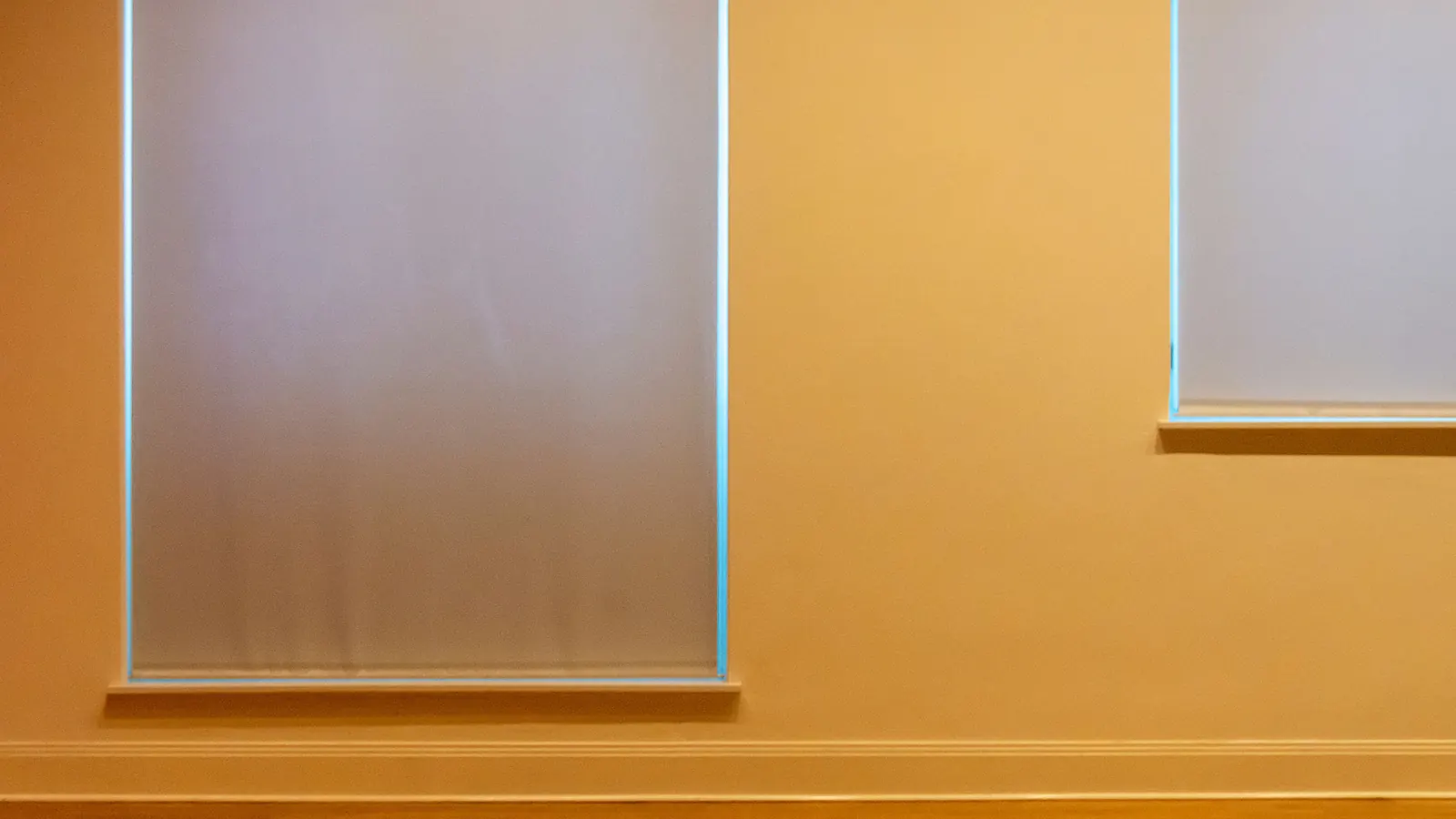
Cordless and made to measure, sold as blackout, with a continuous panel instead of tilting slats, in white, beige and light grey. The listing describes the cordless design as a safety feature; the cordless version is made up to 82 inches wide, and the same page also sells pull-cord versions.

Honeycomb shade that folds into a stack
Bottom Up Only Blackout Cellular Blinds (1.5" cell)
A cordless honeycomb shade with 1.5-inch cells in blackout fabric, in five colors. It raises from the bottom only and folds into a stack instead of rolling, and the cordless version is made up to 104 inches wide, which are the practical differences from the roller.
Retailers to browse
Compare colors, sizes, materials and return details on the retailer’s current listings.
- Browse blinds and shades at Persilux
Persilux
Opens Persilux’s blinds and shades collection, not a single product.