Cordless Roller Shades: How They Work, Fabrics and What to Check
How cordless roller shades raise and lower without a cord, spring vs free-stop vs motorized lifts, light-filtering and blackout fabrics, mounting and measuring.
By DecoraMintPublished 7-minute readMore in Blinds & Shades
In this guide
We may earn a commission from links on this page, at no extra cost to you. Affiliate disclosure
If you can reach the bottom rail without stretching, a free-stop cordless roller shade is the simplest thing to buy: tug the rail down, move it to any height, let go. If the window is high, wide or behind a counter, a motor earns its cost. Everything else on this page, from fabric to mount, is detail around those two choices.
Three ways a cordless roller lifts
| Lift | How you use it | Limits |
|---|---|---|
| Spring-assisted | Pull the rail down; a light tug lets the spring roll the shade up | Can feel jumpy or drift if the spring tension is off |
| Free-stop | Move the rail to any height and release; it stays there | The rail has to be within reach |
| Motorized | Remote, app, wall switch or voice | Higher price; a battery to charge or wiring |
Makers do not use these names consistently, and some call a spring-and-clutch design free-stop, so look at what the listing says the shade does when you let go. Persilux shows the confusion inside one catalog: the size table for its custom-size blackout roller labels the cordless option a “Spring Hydraulic System”, although the same page advertises a free-stop function, while its dedicated free-stop roller labels the cordless option “Free-Stop System”.
That 77-inch limit decides the wide window. The custom-size blackout roller takes its spring cordless lift to 82 inches, and its corded and motorized versions to 105, so a living-room window between 77 and 82 inches stays cordless with the spring version, not the free-stop one. A very large or heavy shade can be hard to lift by hand, and a tall window puts the rail out of reach once the shade is up. A pole or a motor solves that. A good motorized listing names the battery or charging port and says whether smart-home control needs a separate hub.
Cords
A cordless roller has no pull cord or bead chain hanging down, which removes the hazard that matters most in a child’s room. CPSC says cordless coverings are the only way to remove the strangulation hazard, and the Window Covering Safety Council recommends them for homes with infants and young children, with cribs, beds and climbable furniture kept away from windows. The federal custom-cord rule was vacated in September 2023, and the industry standard ANSI/WCMA A100.1-2022 covers custom products made from June 1, 2024. Motorized shades remove the operating cord as well. Follow the installation instructions, and look for accessible inner cords too, since a cordless lift can still have cords inside the shade.
Fabric: sheer, filtering, blackout or screen
- Sheer softens glare and gives little privacy at night.
- Light filtering lets daylight through and blurs the view from outside; shapes can show when the lamps are on.
- Blackout stops light passing through the fabric, though the edges still leak.
- Solar screen fabrics are rated by openness, and vendors commonly offer 1%, 3%, 5% or 10%. A lower number is woven tighter, so it cuts more glare and shows less of the view; a higher number keeps more of the view.
Hunter Douglas Architectural’s roller-shade brochure separates open-weave fabrics, blackout fabrics and edge-channel arrangements, and shows dual-shade systems with two fabric layers. Those are commercial-grade options, and a residential shade may offer only some of them.
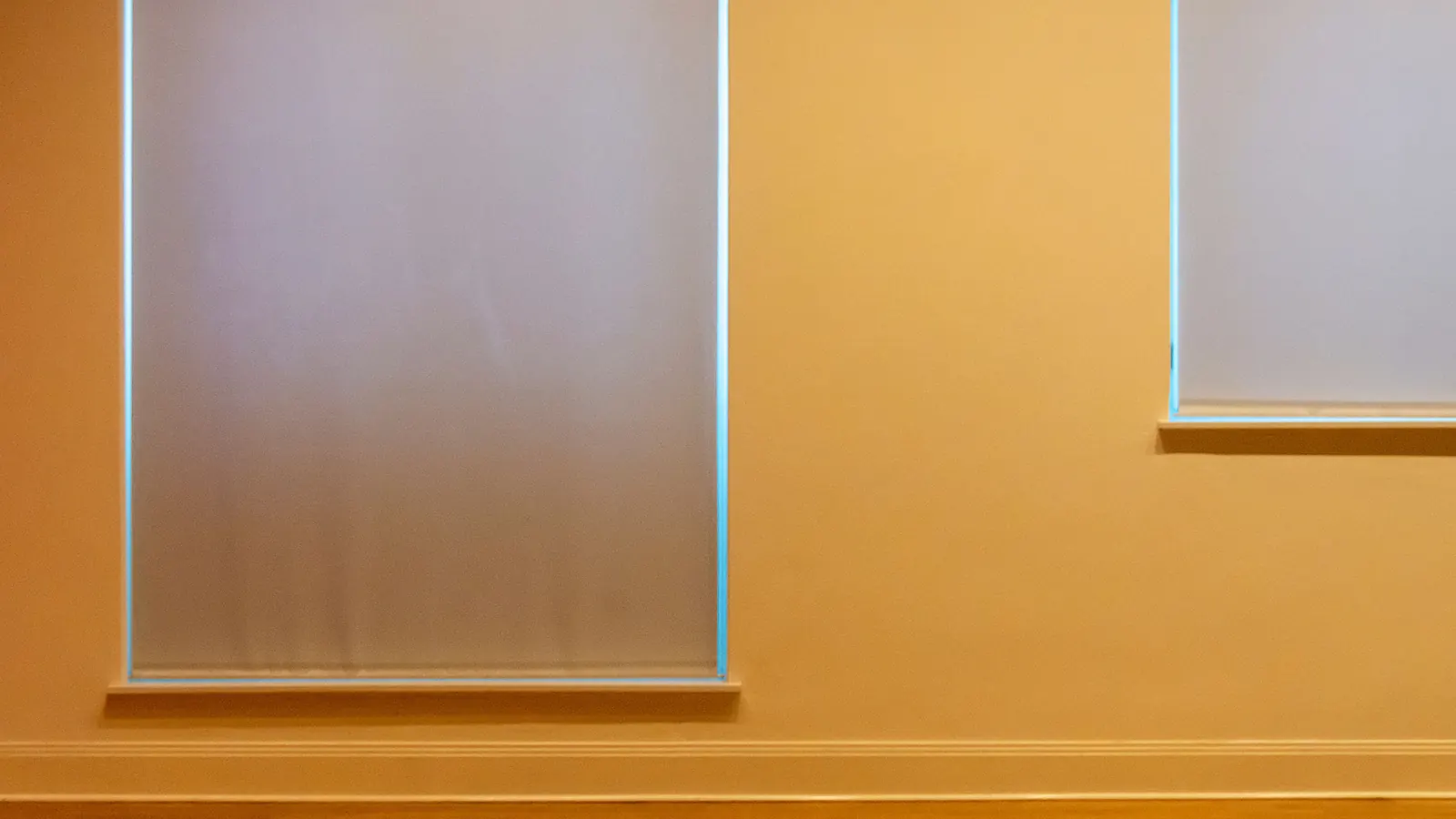
Think about what each window needs. A kitchen window above the sink does well with a light-filtering roller in white or warm greige: the cloth glows like paper in the morning, the flat face stays out of the way of the faucet, and a wipe with a damp cloth handles most splashes. A bedroom wants blackout fabric in a deeper tone such as slate or taupe, so that when the shade is down at night it reads as a clean panel against the wall instead of a bright rectangle. Persilux’s Eco-Friendly Blackout Roller Shades come closest to that brief in stone grey or light khaki, and the page says the fabric is made from recycled materials; the free-stop roller’s grey and black are the darker alternatives if the lift matters more than the cloth. A screen fabric is our suggestion for a home office, where the aim is to cut screen glare while keeping the view, and a second blackout roller behind it only if the room doubles as a guest bed.
The Persilux picks on this page cover a free-stop blackout, a made-to-measure blackout, an eco-friendly fabric, a no-drill version and a motorized one. They are described from the retailer’s listings, we have not tested them, and the links are affiliate links that may earn us a commission. For other types, read how to choose window shades or browse window treatments.
Light gaps and roll direction
Roller fabric is a little narrower than the bracket-to-bracket width, so an inside mount always leaves a thin gap on each side. Persilux’s size tables put the “gaps on both sides” at 0.43 inch for its free-stop roller and 0.40 inch for the spring version. That is under half an inch, yet against a dark bedroom wall with a lit street outside it reads as a bright line down each edge. To close it, mount outside the frame and overlap the opening by a couple of inches each side, switch to a cellular shade that sits closer to the frame (see blackout cellular shades), or add side channels or curtains.
Standard roll puts the fabric against the window, behind the tube. Reverse roll brings it down in front of the tube, which hides the roll from the room and helps the shade clear a crank or handle. Not every model offers both.
Mounting and measuring
An inside mount sits within the frame and looks neat, but the frame needs depth for the brackets and the rolled fabric. Persilux’s roller size tables ask for at least 2 inches (the measuring notes on the same pages say 1.5), with 1.57 inches of the headrail then standing out of the opening, and 3.54 inches to recess it fully; in a frame between those figures the cassette projects into the room like a narrow shelf above the glass. An outside mount goes on the wall or trim above the window, covers the whole opening and suits shallow frames or windows with handles in the way. If you cannot drill, see no-drill blinds and shades.
For an inside mount, measure the width at the top, middle and bottom and give the narrowest, then the height at the left, middle and right and give the longest, and let the retailer make its deductions unless its guide says otherwise. For an outside mount, measure the area to cover and add about 2 to 3 inches each side and above for better light control. Compare the overall bracket width with the finished fabric width so you know what shows at each side, and note the minimum mounting depth and each model’s maximum width and height; very large openings may need a motor or two shades side by side.
On a bay or very wide window, ask the supplier for a drawing of the individual shades and their clearances, because handles, angled corners and neighboring rolls can collide even when every width is right. Several shades on one wall look deliberate when the roll direction and the lower bars line up.
Custom shades are usually made to order and may not be returnable, so order a fabric sample first if the color matters. Vacuum with a brush attachment or wipe with a damp cloth, and avoid soaking or machine-washing, since many coatings crease or delaminate.
The picks
Availability updates from the retailer feed. Where our copy of a price is out of date, the retailer’s site shows the current one.

Free-stop lift that holds any height
Cordless Free-Stop Blackout Roller Shades
Free-stop means the shade stays at whatever height you leave it. The listing describes blackout fabric that blocks harsh sunlight, and the product page lists UV protection, in white, beige, grey and black. The cordless version is listed up to 77 inches wide and 96 inches tall.

Custom-size cordless blackout
Blackout Roller Shades (Custom Size)
Cut to a custom size and sold as cordless and blocking light, in white, beige and light grey. The product page calls its cordless lift a spring system and lists it up to 82 inches wide; corded and motorized versions go to 105 inches.

Blackout in an eco-friendly fabric
Eco-Friendly Blackout Roller Shades
Customized to order, with a fabric the product page says is made from recycled materials, in white, light khaki and stone grey. Its cordless lift is the same spring type as the custom blackout roller, so the difference is the cloth, not the mechanism.

No-drill blackout for windows you cannot drill
No Drill No Tools Plain Fabric Blackout Roller Shades
From the no-drill, no-tools range, with a plain flat-woven fabric the listing says hangs without wrinkles or patterns, in white, grey and black. The product page offers a cordless version up to 87 inches wide; it describes both adhesive brackets and a pressure mount, so ask which one ships.

Motorized with remote and smart-home control
Motorized Blackout Roller Shades (Custom Size)
The motorized version of the custom blackout roller, with a high-torque motor for heavy or large shades. The product page lists USB-C or solar-panel charging and remote, app and voice control. It is the one for a window you cannot comfortably reach.
Retailers to browse
Compare colors, sizes, materials and return details on the retailer’s current listings.
- Browse blinds and shades at Persilux
Persilux
Opens Persilux’s blinds and shades collection, not a single product.