Dual Roller Shades: Two Fabrics vs Zebra Shades Explained
Two independent fabrics and a banded zebra shade both get called dual. Know the mechanism first, then choose by privacy, darkness, mounting and the controls you will use.
By DecoraMintPublished 7-minute readMore in Blinds & Shades
In this guide
We may earn a commission from links on this page, at no extra cost to you. Affiliate disclosure
Before you buy anything sold as a dual roller shade, ask one question: can I fully lower one solid fabric while the other stays rolled up? If the answer is yes, you are looking at two independent rollers, typically a daytime fabric and a blackout or privacy fabric at the same window. If the answer is no, it is almost certainly a zebra shade: one banded fabric of alternating sheer and opaque stripes that slide past each other. Both get labeled “dual,” “double” or “day and night,” and they live very differently in a room.
Two rollers or one banded shade
A two-roller system winds two separate fabrics onto two tubes. Leave the daytime layer down for soft light, roll both up for the full view, or drop the night layer when you want darkness or privacy. Depending on the system, the rollers share a purpose-built bracket or are mounted separately.
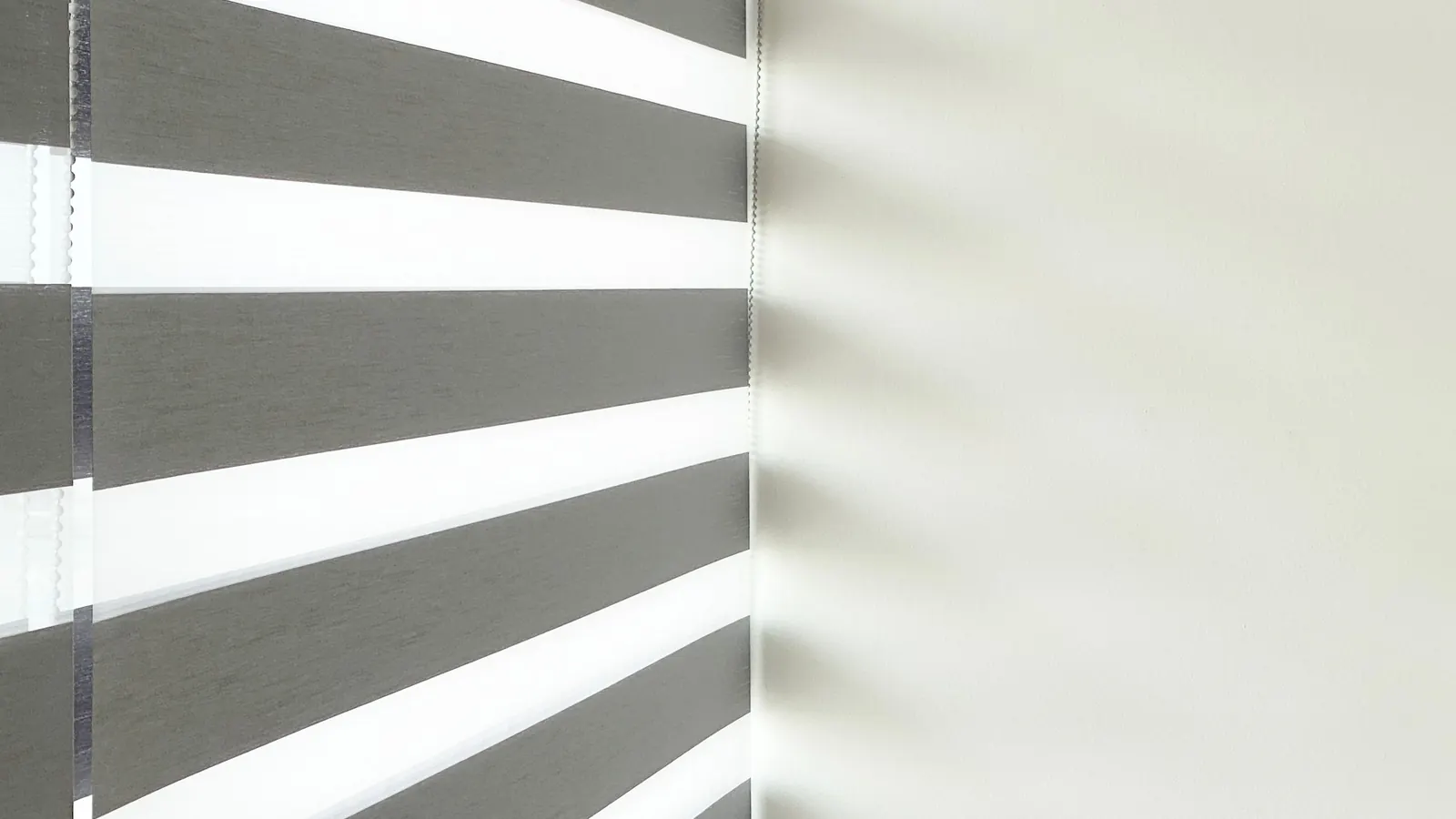
A zebra shade loops one continuous banded fabric into two layers, front and back. Moving it shifts how the bands line up: sheer over sheer lets light through in stripes, opaque over sheer closes the view down. It also rolls up out of the way. You are adjusting one design, not swapping between two full fabrics you chose separately.
| Construction | What changes | Best reason to choose it |
|---|---|---|
| Two independent rollers | Which complete fabric is lowered | Different daytime and nighttime fabrics |
| Banded zebra shade | Alignment of sheer and opaque bands | Frequent light adjustment with a striped look |
| Single roller shade | How much glass is covered | A simpler covering when one fabric is enough |
Even big retailers blur the names: Blinds.com groups zebra shades under dual sheer shades. That is why a product diagram or operating video tells you more than the category heading.
Where two rollers earn their place
Think of a home office that doubles as a guest room. By day you want filtered light on the desk without glare on the screen; at night a guest wants a solid, opaque panel. Two rollers let one window do both jobs.
The daytime layer could be a translucent fabric or a solar screen, and they behave differently. A solar screen keeps some of the outward view and cuts glare, but it is not a reliable privacy layer after dark. A translucent fabric diffuses light into a soft glow and hides more of the view, yet it can still show silhouettes at night.
If your lighting needs rarely change, a second roller is money and hardware you may not use. A living room with lined curtains may only need a daytime roller; a spare room used mostly at night may be happiest with one blackout roller. Picture what you actually do at that window across a day before paying for a second fabric, mechanism and possibly motor.
Where a zebra shade suits better
Zebra shades suit people who like a crisp horizontal pattern and want to fine-tune light without raising the whole shade. In a living room you can nudge the bands through the afternoon as the sun moves, then roll the shade up when you want the garden back.
The stripes are part of the room whenever the shade is down, so think about what sits near it. Next to striped wallpaper, slatted furniture or strong horizontal tile, the lines can start to compete. A small swatch rarely shows how a large band repeat reads across a wide window, so ask for a photo of your chosen fabric on a finished shade.
Read “blackout zebra” carefully. An opaque band blocks light through that band, but the sheer stripes, the overlap, the edges and the headrail all let some through, so the installed shade is not blackout in the way a solid fabric can be. Persilux’s own figures make the point: it puts the light-filtering version of its no-drill double-layer zebra at about 65% shading and the blackout version at around 90%. That is a dim room, not a dark one: for sleeping past a summer sunrise, pair it with a blackout roller or lined curtains, or take the two-roller route above. For a bedroom, ask exactly what the blackout description covers and, if possible, see the closed position with light behind it.
The two Persilux shades listed with this guide are both banded designs, not two independent rollers. We checked their merchant pages on October 27 and November 4, 2026 and are going by those descriptions, not hands-on use. They part ways on fitting more than on looks. The jacquard zebra’s cassette needs 3.54 inches of frame depth to sit fully within the recess, and the shade is made up to 105 inches wide with its cordless lift. The no-drill one, as the name says, goes up without drilling or tools, asks for 1.25 to 1.5 inches of frame depth (the page gives both figures) and stops at 86 inches wide, in a much longer list of fabrics: more than 40 light-filtering and blackout choices, including stripes, prints and a linen look. In a rental where drilling is off the table, the no-drill shade is the one that fits; across a living-room window wider than 86 inches, only the jacquard reaches. If you need two separate fabrics, take the question at the top of this page to a supplier of true dual rollers.
Will the night layer really hide the room?
Judge privacy with the room lights on at night, when the bright side of the glass is indoors. A fabric that looks private at noon can turn into a lit screen at 9 p.m. Look from the angles that matter, such as the sidewalk, a neighbor’s deck or a facing window.
With two rollers, the night fabric must give you the privacy you need on its own. With a zebra shade, look at the bands in the fully overlapped position and from an angle; even “closed,” the bands can show more than a continuous opaque panel would. For a bathroom or a street-facing bedroom, make privacy the first sample test, and if doubt remains, choose an opaque covering or add a second treatment designed to sit alongside the shade.
Fitting two tubes in the window
Two rollers need room for both tubes, their brackets and both hanging fabrics. There is no universal depth allowance, so get the mounting drawing for the exact model and size and compare it with your window recess, including handles, locks, trim and the path each fabric takes off its roller.
Lutron’s dual-shade guidance shows the split clearly: some of its ranges support dual arrangements on shared hardware, while others need separately mounted shades. Those details belong to Lutron’s products, but the question applies to any system you price.
When you request a quote, pin down:
- Overall width versus fabric width. Hardware usually extends past the fabric; ask how much glass the fabric itself covers.
- Projection. Neither roller nor bottom bar should hit the handle or the other fabric.
- Mounting surface. The brackets need solid support for the whole system.
- Access. You should be able to reach manual controls, or charge and service motors.
- Roll direction. Stick to the maker’s approved configuration; reversing a roll changes clearance and light gaps.
Use the seller’s ordering instructions for deductions; adding your own on top can leave the shade short.
Edge light with blackout fabric
A blackout fabric on a two-roller system can still let light in beside the fabric, above the roll and under the bottom bar, and the daytime layer in front does not seal those gaps. For a bedroom where darkness matters, look at approved side channels, an outside mount that overlaps the frame, or curtains that work alongside the shade, and ask the supplier what light to expect at the edges.
A neat drawing can still leave a bright strip right beside the pillow. Request the fabric width, hardware width and mounting diagram together, and if the window is tight to a side wall or ceiling, make sure the brackets and any valance can actually be installed and serviced there.
Controls and cord safety
With two manual rollers, find out how each one operates and where its control sits. With cordless rails, make sure you can reach them through their full travel without leaning over a bed or sofa. With motors, ask whether the rollers move independently, which remote or wall control is included, how they are powered and what extra hub a smart-home setup needs.
Two rollers mean two sets of controls, and so twice the chance of a cord within a child’s reach. Window covering cords can strangle young children, and the Window Covering Safety Council recommends cordless coverings in homes with infants and young children, with beds, cribs and climbable furniture kept away from windows. In those homes, choose cordless or motorized operation for both rollers, not just the front one. If a manual roller does use a bead-chain loop, it should be held taut by a tension device fixed to the wall or frame, and the whole installation should be free of accessible cords, internal ones included.
Both Persilux zebras listed here are also sold in corded versions, the jacquard one with a metal lift cord, so in a home with young children the cordless or motorized option is the one to select on the order.
The picks
Availability updates from the retailer feed. Where our copy of a price is out of date, the retailer’s site shows the current one.
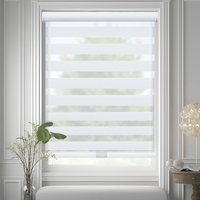
Jacquard zebra with a stop-anywhere lift
Zebra Blinds With Jacquard Pattern
A banded zebra shade, not two independent rollers, in jacquard-patterned polyester in white, cream, grey and dark grey. The listing describes a cordless design that can be moved and stopped at any time, and the product page says it blocks 60 to 70% of light.

No-drill zebra for rentals
No Drill No Tools Double-layer Zebra Shades
A no-drill, no-tools double-layer zebra shade, offered in light-filtering and blackout styles, which the product page puts at about 65% and around 90% shading. The listing cites UV protection and says the no-punch design protects windows and walls. Still banded, not two independent rollers.
Retailers to browse
Compare colors, sizes, materials and return details on the retailer’s current listings.
- Browse blinds and shades at Persilux
Persilux
Opens Persilux’s blinds and shades collection, not a single product.