Bathroom Blinds: Privacy, Moisture and Practical Fit
A bathroom blind has to give privacy with the lights on, cope with the moisture at that window and still let you open it. Test those three before you compare materials.
By DecoraMintPublished 5-minute readMore in Blinds & Shades
In this guide
Picture the bathroom at 9 p.m.: lights on, steam still clearing, the window a bright rectangle to anyone outside. That is the moment a bathroom blind is really chosen for. It has to hide you then, survive the damp at that particular window, and still let you open the sash to air the room. Faux wood, suitable metal blinds and wipeable roller fabrics are the usual short list, but a material name is only a starting point: the whole product has to be approved for the exposure you have.
How wet is this window, really?
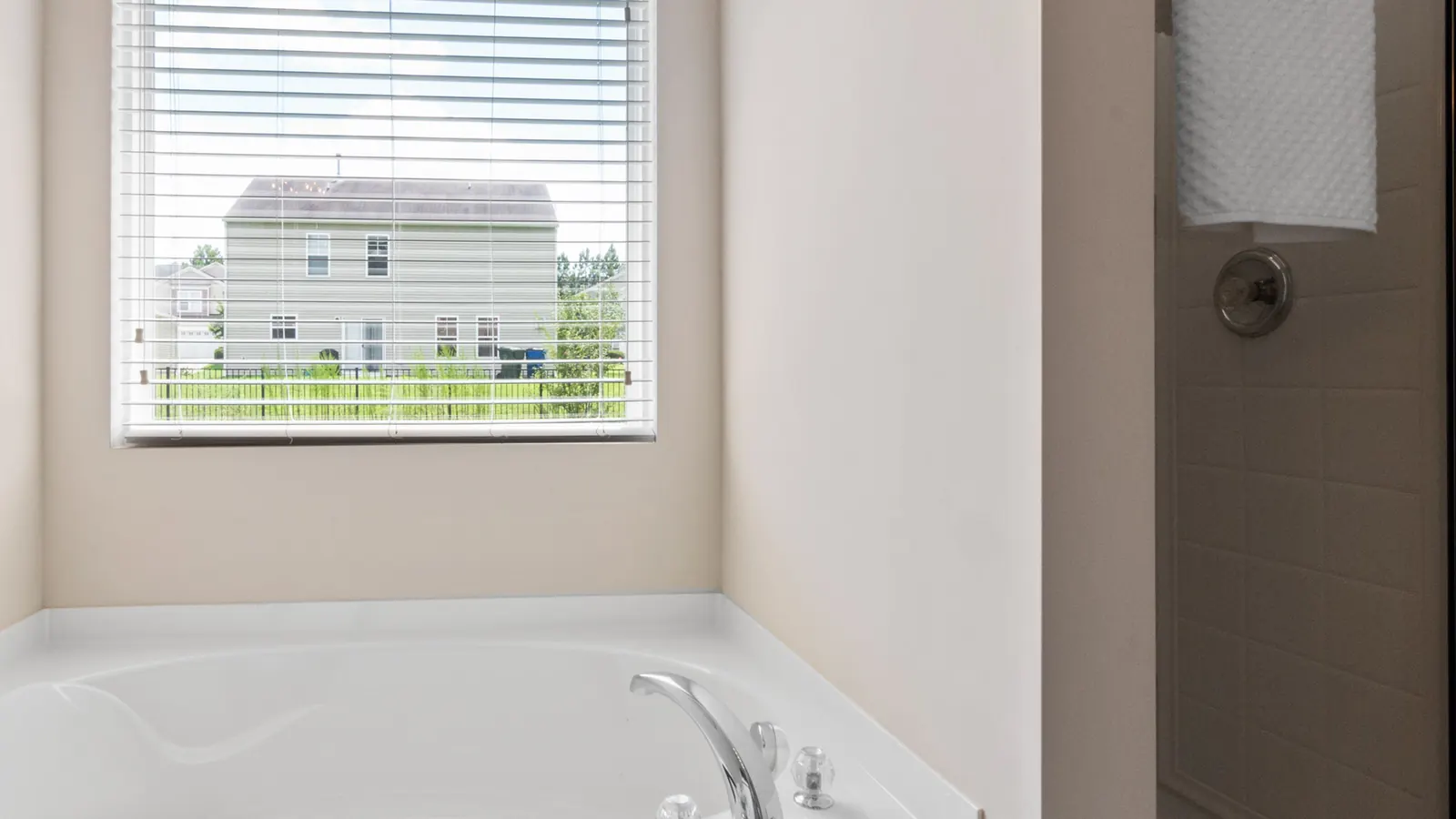
A powder room with no shower and a window a foot from the tub are different jobs, so look at yours after a normal shower. Does condensation bead on the glass or pool on the sill? Would the bottom rail rest on a wet ledge? Can spray reach it directly?
Those answers sort you into one of three situations:
- Humidity only (powder room, or a window across the room from the shower): most moisture-resistant blinds and wipeable shades are in play.
- Regular condensation (a window in a busy family bathroom): the slats or fabric will be wet often, so you want a surface you can wipe dry and hardware that tolerates it.
- Direct splashing (a window inside or beside the shower or tub): ask the maker specifically whether repeated water contact is allowed, and for which parts. Slats, headrail, cloth ladder tapes and controls can have different limits.
A blind does not fix a damp problem. If the window streams with water every morning, keep the fan running and the window operable, and treat the blind as decoration on top of good ventilation.
Materials that cope with steam
Faux wood
Faux wood gives you the warm, tailored look of a wood blind with slats you can tilt for daylight while staying covered. Compositions vary, so look for a stated moisture rating. Arlo’s guidance for its faux wood blinds describes them as suitable for moderate moisture and suggests wiping wet slats dry. That is a statement about Arlo’s product, so read the equivalent note for the model you pick.
Wide slats look calm and generous on a large window but can feel chunky in a narrow recess. Check that the slats have room to tilt and that the raised stack does not swallow the top third of a small window.
Metal
Aluminum mini blinds are slim, crisp and inexpensive, and some are sold specifically for bathrooms. “Aluminum” describes the slats, not the whole assembly, so ask about the finish, the headrail and how to clean them without kinking the slats. Thin slats dent easily, which matters in a tight room where elbows and towels brush past.
Wipeable roller shades
A roller shade swaps stripes for one smooth panel, which can look cleaner against busy tile. Watch the wording: wipeable, washable, moisture-resistant and waterproof are four different claims. Find out which one the maker actually makes for that fabric, and what cleaning it permits.
Wood, woven and soft fabrics
Real wood, bamboo, woven grasses and fabric Roman shades bring texture and softness, and they can work in a well-ventilated powder room. Close to a shower they are a gamble. Blinds.com’s bathroom guide leans toward moisture-tolerant materials and warns against real wood in humid rooms, which matches the general picture, though the final word belongs to the maker of the exact product.
Test privacy after dark
Privacy fails at night, from outside, with the lights on. A sample held to the window at noon tells you very little.
If you can do it safely and sensibly, step outside after dark with the bathroom lit and look from the places people actually stand: the yard, the sidewalk, a neighbor’s upper window. With slatted blinds, look at the slats tilted to the angle you will actually use, because a view from above and a view from the street are blocked by different tilts. With fabric, look for silhouettes as well as see-through. Then look at the edges and the strip under the bottom rail, which is the part people forget to check.
Two common traps:
- Solar shades are made to cut glare while keeping a view, and at night that view reverses. They are not a sole privacy layer for a bathroom.
- Frosted glass varies. Some films blur shapes well from a distance and much less up close or when the room is brightly lit.
A top-down bottom-up shade can cover the lower glass while letting sky light in above, which is lovely in a bathroom. It only works if nobody can see in through the open top from a stair, a raised deck or a second-story window. Tape a sheet of opaque paper at the proposed height and look from those angles before ordering.
Fit around the tub, tile and window hardware
Measure the opening, the usable recess depth and anything that sticks out: handles, cranks, locks, tile edges. Then picture the blind fully down and fully up. You should still be able to open the window and reach the sill without pushing the blind aside.
An inside mount looks neat but puts the slats or fabric close to wet glass. An outside mount sits farther from condensation and covers the edges better, but the brackets need solid wall around the opening and clearance from mirrors, cabinets and tile. Follow the ordering rules of the product you choose; width deductions differ between blinds and shades, and an old blind’s size is not a reliable template.
Think about reach too. A cordless rail is easy to lift in a showroom and awkward across a deep soaking tub. A wand, a lift pole or a motor can help; if you add power near water, make sure the system is approved for that location.
Cords and children
A bathroom offers a small child unusual ways up to the window: the tub rim, a closed toilet lid, the step stool by the sink. Window covering cords can strangle young children quickly and silently, so in homes with infants and young children the Window Covering Safety Council recommends only cordless coverings and keeping anything climbable away from windows. Look at the back of the blind for reachable inner cords as well as the pull cord.
Cleaning that suits the room
A bathroom blind collects hairspray, soap mist and dust that sticks to damp surfaces, so read the care instructions before you fall for a finish. If the maker allows only dusting, that blind belongs in the powder room, not beside the shower. If wiping is allowed, note which cleaner and whether the headrail must stay dry, and do not borrow a cleaning method from a different material. Leave enough clearance to unclip the blind for service later; a beautiful fit that hides the brackets behind tile becomes a nuisance the first time something sticks.