Bedroom Dressers with Mirrors: Fit, Storage and Mounting Choices
A tall dresser can leave its attached mirror too high to use. Measure the whole composition, test the reflection from where you stand and decide between attached and wall-mounted.
By DecoraMintPublished 7-minute readMore in Bedroom
In this guide
The most common mistake with a dresser and mirror happens before anything is delivered: a tall chest of drawers is paired with its matching mirror, and the glass ends up hanging somewhere above your face. You see the ceiling, the top of your head and the light fixture. So begin with the person, not the furniture. Stand where you will dress, note where your eyes fall, and work out whether the mirror will actually meet them once it sits on top of the dresser you like.
That one check decides most of what follows: whether an attached mirror suits you, whether a separate wall mirror would sit better, or whether the mirror belongs somewhere else entirely. The rest of the room is covered in our bedroom collection.
Attached, above or beside: three ways to compose it
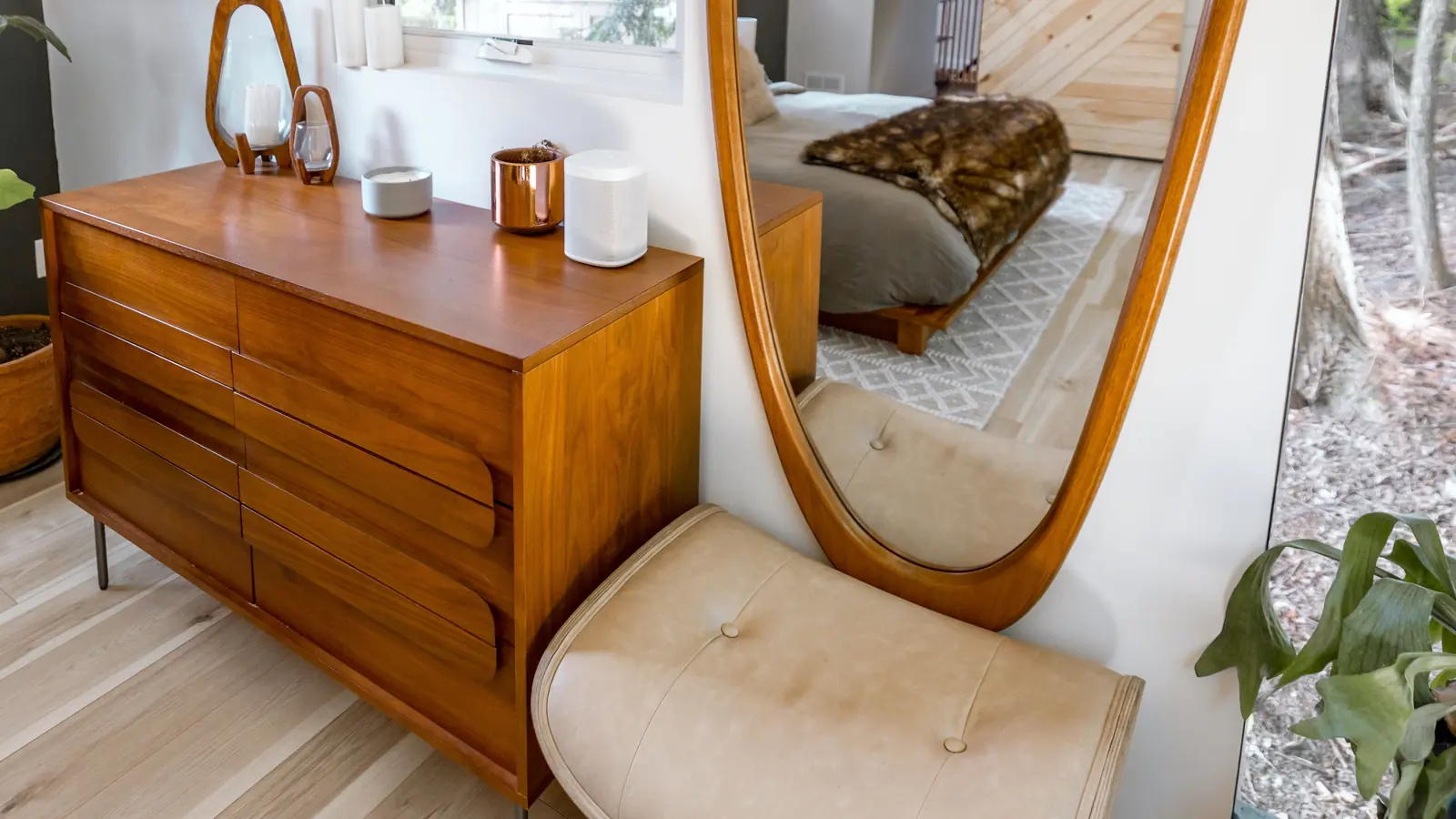
A matching mirror mounted to the dresser gives you a finished, coordinated look, the classic bedroom set silhouette of a long low case topped by a framed panel. It works best on a low, wide dresser, where the glass lands near eye level. On a tall six-drawer chest, the same mirror often climbs out of reach. Compatibility comes from the maker’s specified pairing and its supplied hardware; a similar finish or width on two independently bought pieces tells you nothing about whether they fit together.
A separate mirror hung on the wall above lets you choose shape and height freely. A round or arched mirror over a rectangular dresser softens all those straight drawer lines, and you can hang it exactly where your reflection lands. We like a mirror a little narrower than the dresser top, so the case reads as a base and the mirror as something resting above it, with a small gap of wall between them. The trade-off is that the mirror needs its own wall mounting, and it stays put if you ever move the dresser.
A tall mirror beside the dresser splits the jobs. The dresser handles storage at its natural height, and a floor-length mirror alongside it gives a head-to-toe view. This needs more wall, and both pieces need proper securing, but it often solves the tall-dresser problem neatly.
And sometimes the best storage wall has no good light or viewing spot at all. In that case, let the dresser just be a dresser and put the mirror near a window or inside a closet door.
A mirror simply propped on the dresser top, leaning against the wall, is a styling-photo arrangement. Install it the way its instructions describe.
Measure the whole composition
Take the dresser’s assembled width, depth and height, including feet, hardware and anything that projects from the back. Then add the mirror and the exact position its mount holds it in. Listings may quote the dresser alone, the mirror alone or the combined set, so be sure which figure you are reading.
Sketch the full outline on the wall with painter’s tape. This is where problems show up: a dresser that slips neatly under a window when an attached mirror cannot, a switch that disappears behind the frame, a sloped ceiling that cuts off the top corner.
Then pull a drawer fully open in your mind, or better, measure it. You need room for the open drawer plus you standing in front of it, and the walkway past the bed should still work. In a narrow room, a shallower dresser keeps that path clear but holds less bulky knitwear; a deeper one stores more but may leave you sidestepping an open drawer every morning.
Stand where you will use it
Decide what the mirror is for. A face-and-shoulders check before work, putting on earrings and judging a whole outfit are three different tasks, and they need different glass. Look at the actual glass area, too; a chunky decorative frame can make a mirror look much bigger than its reflective surface.
Remember that the dresser itself pushes you back. With a deep case between you and the wall, you cannot lean in close, which is why many people keep a small tabletop or vanity mirror for detail work and let the big one handle the overall view.
Then turn around. Whatever sits opposite becomes part of the picture: a doorway, a bright window, a laundry chair, the television. A mirror facing a window can bounce lovely daylight into a dim room, and from the wrong angle it can throw glare straight at the pillows. Check the view from the bed as well as from the dressing spot, at the times of day you actually use the room.
Judge drawers by what you own
Drawer count says little on its own. Sort your clothes into rough groups first: folded tees, chunky sweaters, small accessories, spare bedding. Shallow top drawers suit jewelry and socks; bulky knits need real interior height. Ask for interior drawer dimensions when a listing leaves them out, because the height of a drawer front is not the usable height inside.
Try the drawers in person if you can. Notice how they glide, where they stop and how the pulls feel. Never remove a drawer stop to gain reach; choose a design that already works for you.
Keep part of the top clear, too. If the mirror’s supports, a lamp and a display of objects take over the whole surface, everyday things end up piled in front of the glass. A small tray for keys and jewelry gives them a home.
Read the construction by component
A wood-grain surface can sit on several different constructions, and a fluted or grooved front describes the look of the drawer faces, not what the case is made of. Read the description piece by piece: case, drawer fronts, drawer bottoms, back panel and mirror frame.
As a real example, Ashley’s Parlayon dresser and mirror, item B3370B1, lists engineered wood and decorative laminate with replicated oak grain, six drawers and a mirror. That tells you it is not solid oak. It does not rank its quality, and it says nothing about other dark-wood dressers.
Hold finish samples next to the bed and the floor before you commit. Two browns or two whites from different makers rarely match, and a near-match usually looks less intentional than a clear contrast, such as a pale oak dresser against a deep walnut bed. For grooved fronts, think about dusting the channels; for glossy lacquer, look at how fingerprints show under your bedroom lighting.
Mirror mounting and dresser anchoring are two separate jobs
The mirror instructions Ashley links for the Parlayon listing show distinct dresser-mount and wall-mount arrangements using the supplied hardware in different positions. Follow the diagram for the setup you choose; there is no general rule for fastening any mirror to any dresser.
Anchoring the dresser itself is a different matter, and it is not optional. Dressers can tip forward when drawers are pulled open or climbed, and the CPSC’s Anchor It campaign urges securing furniture with drawers to the wall. Attaching a mirror to the dresser does not anchor the dresser, and a mirror on the wall does nothing to hold the furniture below it.
Under the federal STURDY Act rule, freestanding clothing storage units at least 27 inches tall, 30 pounds and 3.2 cubic feet of enclosed storage, manufactured after September 1, 2023, must pass stability tests with drawers open and loaded and must come packaged with a tip restraint, according to CPSC’s clothing storage unit guidance. That restraint only works once it is installed, so fit it right away, into the wall structure the instructions call for. If the wall construction or the attachment point is unclear, get qualified installation help, and never screw into a thin back panel or treat decorative hardware as structural. For a TV, CPSC tip-over advice is to place it on a sturdy, low base, or to anchor both the TV and the furniture it stands on.
Keep the instructions and part numbers with the furniture. When you move and reassemble, set it up from those documents, not from a photo of how it used to look.
The order and the delivery
Check that the price covers both pieces. Retailers often photograph a mirror above a dresser and sell them separately, or bundle them into a larger bedroom set. The itemized order is what counts.
Ask what delivery includes: carrying to the room, assembly, mirror attachment, anchoring. These can be separate services, and “white glove” does not always cover all of them. Compare carton sizes with your stairs and turns, find out how damaged glass or hardware is handled, and read the return terms before ordering something large and hard to repack.