Crib Mobiles: Choosing, Mounting and Knowing When to Remove One
A mobile is optional, and it comes with a removal rule. Check the mount, the crib it fits and when it has to come down before you look at colors or music.
By DecoraMintPublished 4-minute readMore in Kids' Rooms
In this guide
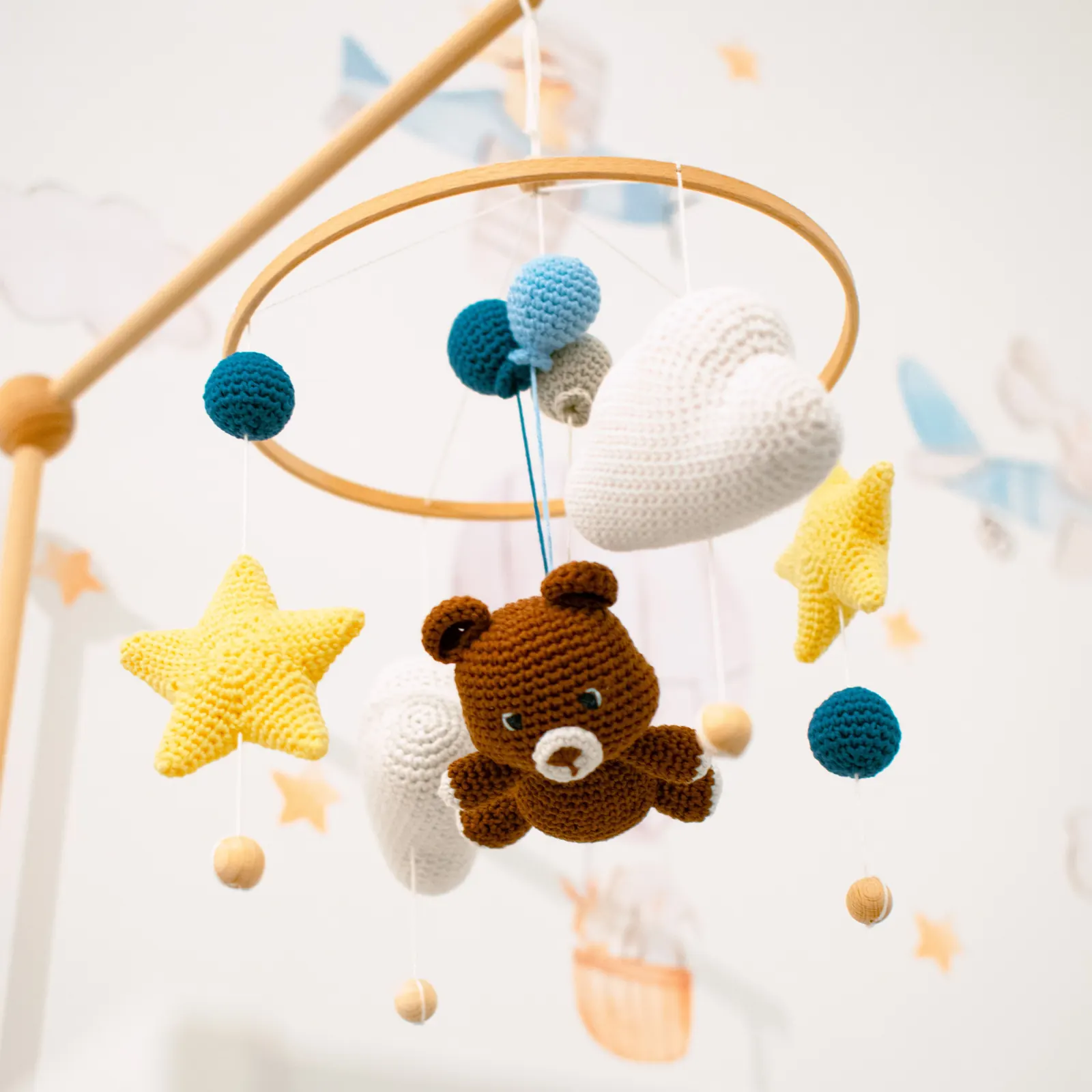
A mobile has a short working life over a crib: from the first weeks until the baby can push up onto hands and knees or turns five months old, whichever comes first. That is the American Academy of Pediatrics’ nursery checklist, which also says the mobile must be attached securely and hung high enough that the baby cannot reach it. Everything else about choosing one, from felt clouds to a wooden hoop with crocheted stars, is decoration inside that window.
Why the rule exists
A mobile is made of strings, ties and small parts hanging over a space where a baby sleeps. Once a baby can get up on hands and knees, those parts are within reach, and the AAP’s advice on the same page is to keep strings and cords from dangling in or near the crib. If your baby is already pushing up, take it down before the five-month mark. Tell everyone who cares for the baby which of the two conditions ends the mobile’s use, and take it down when either happens. If the maker gives an earlier limit, follow that one.
A damaged or loose mobile comes down at once. Get proper replacement parts from the maker instead of knotting a broken piece back together.
Choosing one that is meant for a crib
Shopping pages mix several things under one name: crib-mounted mobiles, ceiling or wall mobiles, battery-powered musical units and decorative hangings that were never designed for a nursery. A hanging ornament made for a wall becomes a crib product only when its maker says so. Choose a mobile from a maker that names the crib attachment it is designed for, gives instructions and states an age range.
Matching the mount to your crib is most of the work. Rail shape and thickness, and any panels beside the rail, decide whether a clamp holds firmly. If it does not fit, the answer is a different mobile; straps, cable ties and a mounting arm borrowed from another brand are exactly the improvisations that put a mobile over a baby’s face. Follow the maker’s installation sequence, and look at the finished setup from the baby’s position. The mobile has to stay out of reach there, not just in the product photo.
Allow for how you will use the crib. You will be lifting a baby and changing sheets under it, and a mobile that has to be swung aside each time tends to end up half-secured.
Where the pretty part belongs
If the mobile is a color moment in the room, let it be the soft one: pale felt or cotton shapes in two or three related shades, turning against a plain wall, with the sleeping area beneath kept bare. CPSC’s safe sleep guidance calls for a suitable infant sleep product with a bare sleeping area apart from a fitted sheet, and for placing babies on their backs. A mobile leaves that unchanged, so skip the pillows, plush toys and blankets that coordinated nursery photographs show in cribs.
The crib should also stay away from windows. The AAP page says cords from blinds or draperies can catch a child and cause strangulation, and recommends cordless window coverings where possible. A mobile hung near a window cord combines two cord hazards.
Motors, music and batteries
A powered mobile can offer music, movement, lights or a remote. Choose the controls you will use: a simple on and off you can operate with one hand in the dark is worth more than a long list of modes. Use only the batteries or adapter the maker allows, keep spare batteries and remotes out of the baby’s reach, and do not run a unit with a damaged battery cover. This guide does not recommend a volume, timer or lighting effect as a sleep aid, and a sleep-training claim on a box is marketing until shown otherwise.
Convertible and secondhand mobiles
Some mobiles convert into a floor or crib toy once the arm is removed, but only the modes in the instructions are intended. Mattel’s support page for its W9914 Crib-to-Floor Mobile lists different modes and ages, and identifies the product as discontinued. We cite it only as an example of mode-by-mode documentation. A hanging toy from a mobile should not be handed to a baby unless the maker intends that use. When the mobile mode ends, put the arm and hangings away, out of the baby’s reach, instead of leaving them up as decoration.
Buying secondhand adds two steps. Find the model label, and search CPSC’s recall database and the maker’s recall page for that model. The W9914 page says replacement parts are unavailable, a reminder that an old mobile with a missing piece may not be restorable even if its manual is online. Fabric characters, plastic housings and motors need different cleaning, and powered parts never go in water.
Skipping it is a good option
A mobile is optional. A nursery can feel finished with a wall color, a framed print and a lamp, and a bare crib is the simplest version of a safe sleep space.