Crib Sheets and Bedding Sets: Fit, Fabric and Safe Use
A crib sheet has one job: a secure fit on the exact mattress you own. Check the measurements and the fit after washing, then the fabric, and skip extras the sleep space does not need.
By DecoraMintPublished 5-minute readMore in Kids' Rooms

In this guide
A crib sheet that slides on easily out of the package can turn tight, or baggy, after a few washes. Shrinkage is one reason. The other is a measurement that is easy to skip: the mattress’s thickness, alongside its width and length. A full-size crib mattress can be no more than 6 inches thick under CPSC guidance, and some are thinner, so a sheet cut for a deep mattress can sit baggy on a slim one. The right crib sheet is the one that wraps your mattress snugly, stays put through a night of wriggling and still fits after it comes out of the dryer. Print and color come second.
The crib itself should hold nothing else. The Consumer Product Safety Commission’s current safe-sleep guidance calls for a sleep product meeting federal requirements, the baby on their back, and a bare space with only a fitted sheet. A coordinated bedding collection does not change that.
Start with the sleep product, not the sheet
Write down the maker and model of the crib, mini crib, bassinet or play yard, and find its instructions. They tell you which mattress belongs in it. Full-size cribs, mini cribs, bassinets and play yards each take their own mattress, and a sheet that stretches over the corners of one was not made for another. “Universal” on a package does not override the sleep product’s own instructions.
The mattress matters as much as the sheet. The American Academy of Pediatrics’ safe-sleep evidence review calls for the mattress designed for that particular product and a fitted sheet made for it that does not bend the surface out of shape or open gaps. The same review rejects softening toppers for infants under one year. Padding under a sheet is never a fix for poor fit.
Bought or inherited a crib without its manual? Find the correct manual and check the model for recalls before you shop for bedding. A new sheet cannot make an incomplete or recalled crib usable.
Reading a sheet listing
Look for the mattress size the sheet is designed to fit, including thickness, not only a nominal flat size. A fitted sheet has elastic pockets meant to wrap under the mattress, so its labeled dimensions and the mattress dimensions it suits are not always the same figures.
IKEA’s LEN white and beige muslin crib fitted sheets are a good example of the details worth finding: a two-pack, 100% cotton, with a nominal 27½-by-52-inch size, plus item-specific washing, drying and shrinkage notes and an instruction to wash before first use. Those details describe that sheet, not every crib mattress in the country.
If depth or compatibility is missing from a listing, ask the seller before ordering. Avoid sizing up and tucking the extra underneath, and do not choose a smaller sheet because it feels drum-tight: a sheet that strains to fit can pull the mattress corners up or pop off.
The fit check after washing
Wash the sheet as its label directs, dry it, and only then fit it. Then walk around the crib and look at every side, not just the one facing the room.
- The sheet is the intended size for this mattress.
- Every corner pocket is fully under the mattress and stays there when you press the surface.
- No loose folds, slack fabric or split seams.
- The mattress still lies flat and sits snug in the frame.
Recheck after the first few washes, since cotton can shrink and elastic can tire. When elastic goes slack or a seam opens, replace the sheet. Do not reach for clips, straps, ties or a second layer.
Fabric and feel
Read the fiber content, not just the collection name. Cotton is a fiber. Muslin is a loosely woven, airy cotton cloth with a soft, slightly crinkled hand. Jersey knit feels like a T-shirt and stretches around corners. Percale is crisp and smooth. Flannel is brushed and warm to the touch. Any of them can be printed or plain, and the print says nothing about what is underneath.
Choose by the feel you like and the laundry routine you can keep up. If the label asks for line drying or a cool wash and you wash daily in a hot dryer, an equally good sheet with easier care is the more practical buy. Treat “organic,” “breathable” and thread count as preferences, not safety features; none of them makes extra bedding appropriate. Stick to the heat and cleaners the label allows: hotter cycles or harsh stain chemicals can weaken elastic and fabric faster.
Crib bedding sets, piece by piece
A bedding set can bundle items with very different jobs. Sort them before you count them.
| In the bundle | Where it goes |
|---|---|
| Fitted sheet | In the crib, if it fits your mattress |
| Spare fitted sheet in the same size | Your laundry-day replacement, never a second layer |
| Quilt, comforter or loose blanket | Out of the infant sleep space |
| Pillow or decorative cushion | Out of the infant sleep space |
| Crib bumper | Not in the crib; padded bumpers are banned from sale under federal law |
| Wall hanging or other room accessory | Elsewhere in the room, installed safely away from the crib |
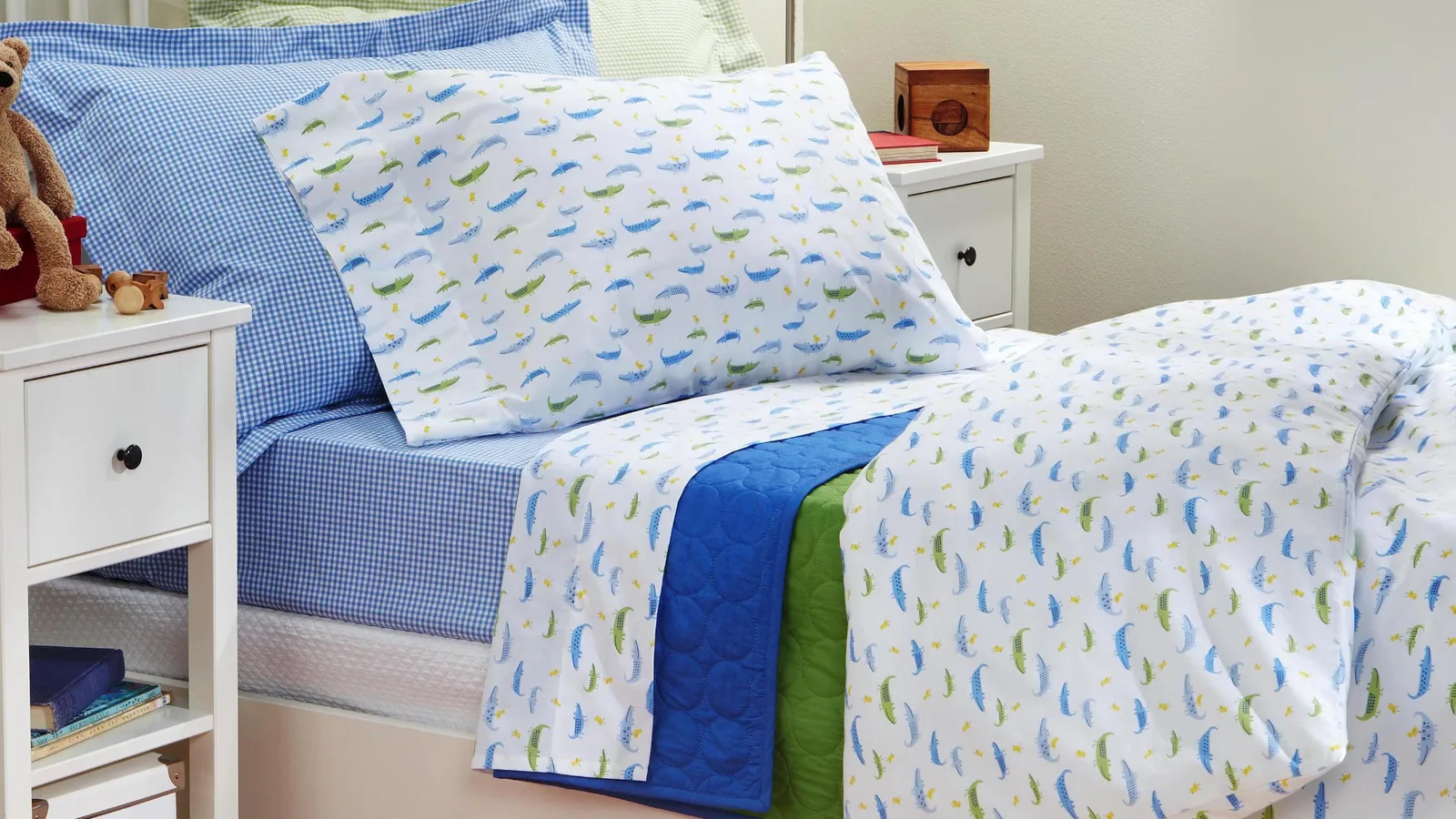
The NIH Safe to Sleep environment guide shows the reference picture: a firm, flat surface, a fitted sheet and nothing else. Keep that image in mind when a retailer photo shows a crib dressed like a guest bed.
Price a set by the pieces you will actually use. If most of the box will stay in a closet, a pack of good fitted sheets bought on their own may cost less. Check return terms after opening, too.
The nursery can still feel finished. Carry the bedding colors into curtains, a rug, a quilt hung on a wall rail well away from the crib, or a cushion on the feeding chair.
How many sheets
Count backward from your laundry schedule. You want a clean, dry, compatible sheet ready whenever the one on the mattress needs changing, including the middle of the night. Store them where the right size is easy to grab, and if you have a crib and a play yard, keep their sheets in separate stacks even when the prints match.
Can I use an adult fitted sheet if I tuck it in tightly?
No. The excess fabric can work loose, and an adult sheet is not designed for an infant mattress. Use a sheet made for the specific crib mattress.
Is a matching sheet enough to make a secondhand crib ready?
No. Find the manual, confirm the model and recall status, and check every part. Bedding cannot correct missing hardware, damage or the wrong mattress.