Curtains for Sliding Glass Doors: Access, Stack Space and Fit
Curtains on a sliding door have to clear the route, the handle and the moving panel, and gather somewhere when open. Settle the draw direction and stack space before the color.
By DecoraMintPublished 5-minute readMore in Blinds & Shades
In this guide
A sliding door is the busiest opening in most living rooms, which makes the curtain across it a piece of furniture everyone brushes past. It has to slide out of the walking line, clear the handle and have somewhere to gather when open. Settle the draw direction and the stack space first, then choose the color.
Walk the doorway before choosing fabric
Stand inside and find which panel slides. Walk through as you normally do, with a laundry basket or a tray if that is how the door gets used, and note where your hand goes for the handle and where you instinctively reach for the curtain. Then list what sits nearby: light switches, a radiator or heater, furniture, and the insect screen, which the curtain must never snag.
Three schemes cover most rooms, and each asks for different space.
For an asymmetrical, quiet look, hang one solid panel that gathers toward the less-used side. Pick a color already in the room, such as the stone gray of the sofa or the sage of a wall, so the closed curtain reads as part of the seating area, and judge the open bundle as part of the composition, because the doorway will spend most of its life with the curtain gathered. This is our choice for a narrow wall beside the door.
For a balanced frame, use a matching pair with the same fabric and heading on both sides. Symmetry is a finishing preference, so keep the more-used side easy to move and skip a heavy tieback where your hand needs to go.
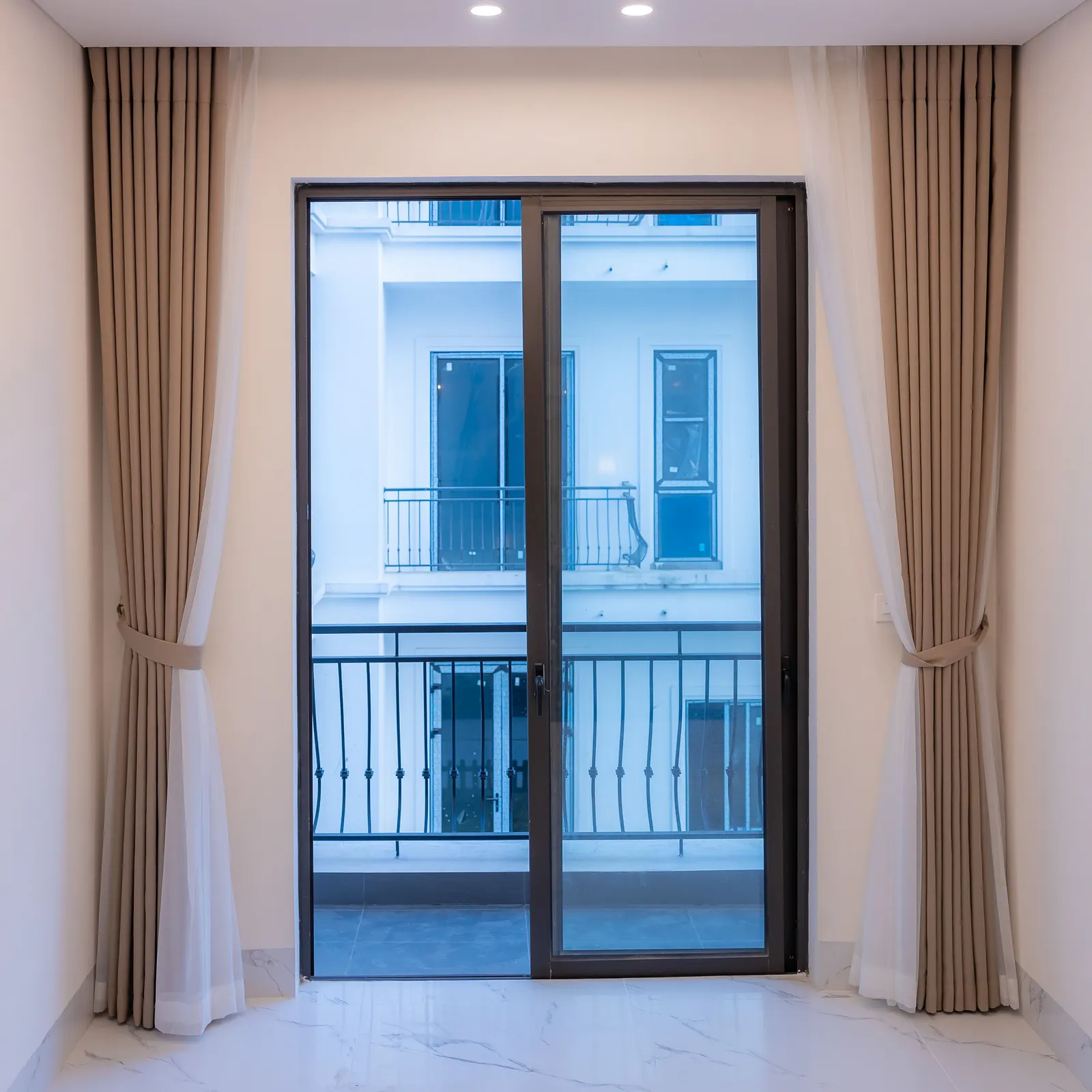
For a layered scheme, pair a pale sheer with an opaque outer fabric in the same color family but a different texture, a smooth linen-look sheer under a heavier woven panel, say, rather than two competing prints. Check all three states: both open, sheer drawn, and both closed. Each needs a resting position that does not block the door.
One-way, split or stationary
| Arrangement | Good when | Check |
|---|---|---|
| One-way draw | All the fabric can park on one side | Room for the full stack and access to the leading edge |
| Split draw | There is usable wall at both sides | Whether the center opening lines up with the active door |
| Stationary side panels | You want decorative fabric around another covering | They will not cover the glass |
| Sheer plus opaque | You want daytime diffusion and night coverage | Two tracks or compatible layered hardware with enough depth |
Hunter Douglas separates stationary side panels from working drapery. Side panels frame the door; another treatment is needed to close it, so a pair of narrow decorative panels will not stretch across the doorway. When wall beside the glass is short, the gathered fabric will cover part of the opening, which is fine over the fixed panel and a nuisance over the moving one.
Track span and stack are different measurements
Write down the door-frame width, the wall space on each side and the planned rod or track span as three separate figures. A track that runs past the frame lets more glass show, if the wall and mounting allow it. Then ask the supplier for the stack width of the exact fabric, lining, heading and draw arrangement: a lined pleat gathers far thicker than a light sheer, and a generic percentage cannot replace that number. Draw the stack on your plan against the moving panel, and do not count the same wall twice; a cabinet beside the frame blocks the stack as well as the walkway.
A listing may give flat fabric width, finished pleated width or the combined width of a pair, so identify which before comparing it with the track. A fullness multiplier applies to flat fabric and may not apply to a curtain sold by finished width, and headings vary in fullness. A common mistake is reading a pair’s total width as the width of each panel, so write the order out: number of panels, width of each, heading, lining, finished drop and draw direction.
Hardware for daily use
Look at how the heading travels the whole span. Rings, gliders and traversing tracks differ in support and joining, and a center bracket on an ordinary rod can stop one panel crossing the door unless the system is designed for it. IKEA’s VIDGA single-track set shows why specifications matter: it lists an 11-pound maximum load and a distance from the wall that clears handles. That figure belongs to that track alone. Add up the weight of fabric and lining before choosing, and settle compatibility for the span before ordering custom panels.
Drop and floor
Measure from the hardware’s attachment point to the hem, since a ring, hook or glider shifts the start. Fabric pooling on the floor drags into the walking route and the door track, so end the hem clear of both, measuring at several points because floors and ceilings are rarely parallel. If you will wash the curtain, look at the maker’s shrinkage information before hemming.
Light by day, privacy by night
A sheer softens light and view, yet people can see through it in some lighting, especially after dark with the lamps on. Hold a sample at the door in the evening. For stronger cover, compare fabric and lining, then think about gaps at the center, the sides and the top; blackout fabric can still let light past the edges of a doorway installation. Layering helps but adds stack depth, hardware and cleaning.
Cords
CPSC recommends cordless window coverings in homes with young children, and CPSC says cordless is the only option that removes the strangulation hazard. For a door, that means a wand or hand-drawn curtain rather than a pull cord, and no improvised tie-up that leaves a loop. Mark the proposed stack zones and hem line with tape, then check the handle, screen and walking route still work. Plan how you will reach a high track for cleaning.