Door Curtains: Plan the Mount, Movement and Everyday Access
Fabric on a glass door, panels above a doorway and a divider across an opening behave very differently when someone walks through. Pick the type, then the hardware and coverage.
By DecoraMintPublished 5-minute readMore in Blinds & Shades
In this guide
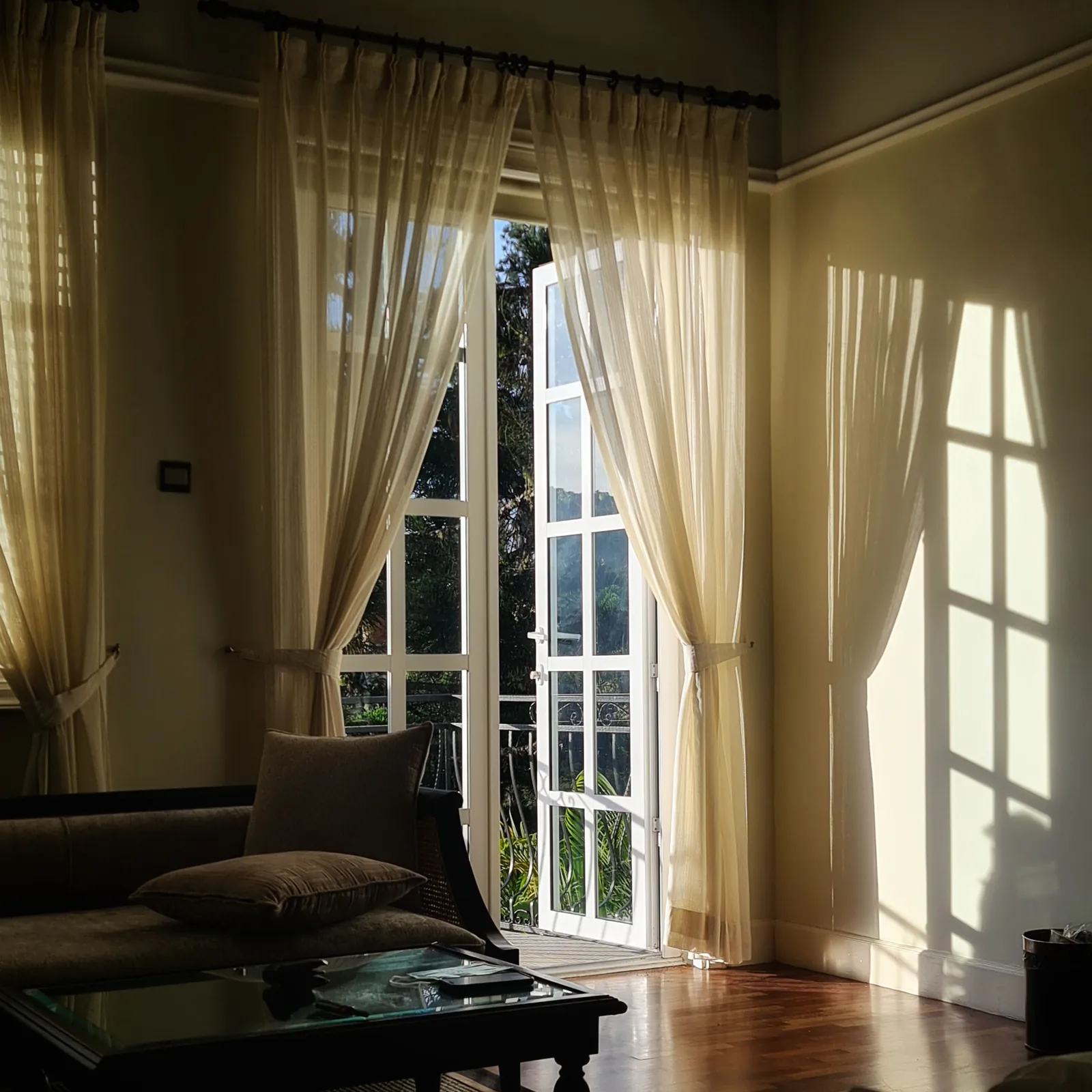
A pale panel stretched across the glass of a kitchen door, a pair of full-length curtains tied back beside French doors, a soft curtain drawn across a dressing alcove: all three get called door curtains, and they behave very differently the moment someone walks through. Pick the type first. For any of them, the door must still open, close and latch normally, and the fabric must stay where it belongs while it does.
Which kind do you need
Fabric mounted on the door swings with the door, so it must clear the handle, trim and nearby walls. Panels above the doorway stay put while the door moves beneath them, and the question is where they gather when the door is in use. A curtain across an open doorway is the divider itself, so people need to pass without snagging or dragging it. Curtains beside a pair of glass doors need the stacked fabric out of the swing.
A curtain cannot stand in for a door where you need a lock, a solid closure or a clear exit, and fabric or hardware must never get in the way of an emergency exit. Our window-treatment guides cover the wider range of options.
Measure the glass, the door and the frame separately
Write down the opening, the glass and the surrounding frame as separate numbers. A panel sized to the glass may need hardware outside the glass, and a rod that fits across an opening still needs somewhere solid to fasten.
Wood, metal, glazed and composite doors differ, so find out what the door is made of and how its maker allows things to be mounted on it. Never drill near the glass, and if the door and curtain hardware instructions do not clearly work together, ask an installer.
For panels above a doorway, look at the wall around it: trim, light switches and cabinets can leave too little room for the fabric to gather. In a rental, find out what you are allowed to do; “no-drill” hardware has its own weight limits, so read them against the fabric.
Sash rods and tension rods
For fabric on the glass of a door, a sash rod is one option to look at. Kirsch’s tension and sash rod specification sheet describes its sash rod for sidelights, doors and small windows with minimal projection, and its spring tension rod for inside a frame. Both are listed as stationary treatments, meaning they hold fabric in place instead of drawing open.
A slim profile still has to clear your door handle, and a tension rod made for a window frame needs its maker’s approval before it goes on a moving door, so read the current instructions for the exact rod before buying.
How each one looks
On a glass door, a gathered panel fixed top and bottom keeps a gently veiled look all day, and the door reads as a frame of light with a fabric center. A pale sheer changes the look of the door but may hide little once lights are on at night, so look at it after dark. Movable panels let you open the view when you want it.
A curtain across an opening can make a bedroom alcove or dressing area feel separate and cozy. Floor-length fabric in a heavier weave gives the strongest sense of a room within a room, and a lighter linen lets the light travel through. Plan where it bunches when open so the bundle does not crowd the doorway, and allow for carrying laundry or a tray through. A decorative curtain eases a divide, and any claim about sound, heat or smells needs the maker’s evidence for that product.
Beside a patio door in constant use, where the curtains rest when open matters more than how dramatic they look closed. Floor-length panels look generous when they stay out of the door’s path and obstruct when they sit in it.
Walk through the swing
Imagine the door closed, half open and fully open. Look at the handle, lock and hinges, and the point where the door meets a wall or the other door. With fabric mounted on the door, loose cloth can shift as the door swings, so fabric that catches needs a different mount or length. With panels above the opening, mark where the gathered bundle will sit, since it is bulkier than flat fabric suggests.
If you order custom curtains, sketch the door open and closed and photograph the handle and frame. A workroom can work from a photo and a tape measure far better than from “standard French door.”
Package and length
Find out whether the listing is one panel, a pair, a valance or a set, and whether the width given is one flat panel or the whole package. Styled photos often show more than you are buying.
Measure the length from the point the heading uses, because a rod pocket, rings and clips put the same panel at different heights. Where panels meet, allow for overlap when closed and the bundle when open; more fabric looks fuller and stacks bigger. Follow the maker’s sizing method for the heading you choose.
Two doors, two answers
A glass kitchen door starts with the handle and latch, then with how much glass needs covering. If cabinets fill the wall beside the door, long panels have nowhere to gather, so look at a panel fixed to the door itself, where the door’s maker allows it.
An open doorway to a dressing area starts with the clear passage and the side where the fabric can collect. Choose a heading that slides easily, and allow for the bundle when open as well as the closed curtain in a photo.
Taking it down to wash
Read the care label before shortening or ordering. Find out how the fabric comes off and whether the hardware stays in place, and do not keep loosening a mount that was not designed for it. After washing, check the length before rehanging, and replace damaged hardware with the right part instead of improvising.