Glider Chairs: Compare the Motion, Seat Fit and Room Clearance
A glider looks like an armchair and needs much more room. Try the motion as the adult who will use it, plan the moving footprint and read the exact manual before ordering.
By DecoraMintPublished 6-minute readMore in Furniture
In this guide
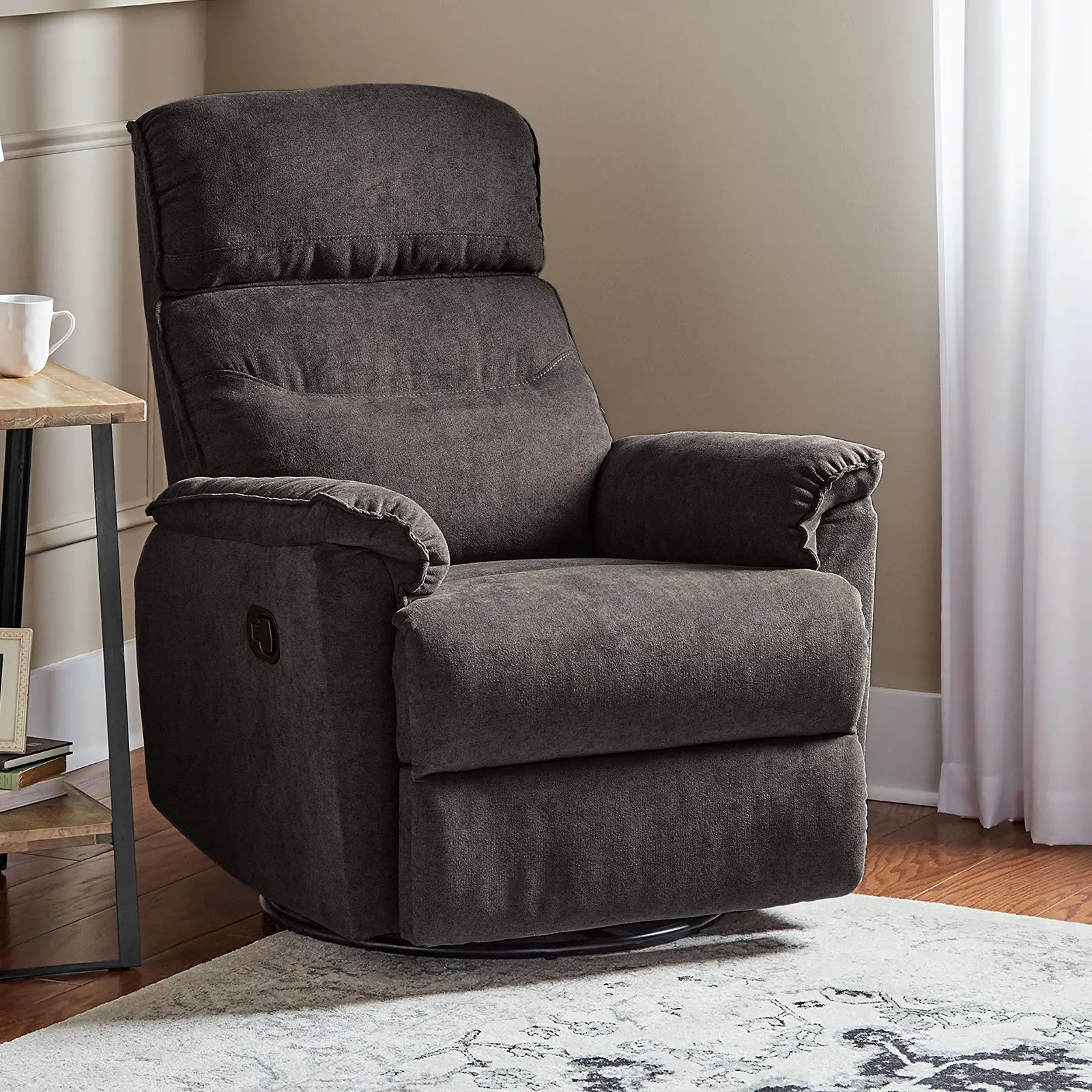
Sit in it before you fall for the fabric, and then measure it moving, not parked. A glider in a showroom looks like any soft armchair, a neat upholstered block beside a window. At home it becomes a seat that travels: forward and back on its base, sometimes swiveling toward the dresser, sometimes reclining until a footrest juts into the path to the door. The chairs that work are the ones whose motion you will actually use, whose seat fits the adults sitting in them and whose full moving footprint leaves the room easy to walk through.
Our furniture guides cover more seating and room-planning ideas.
Glide, rock, swivel, recline
Evenflo’s glossary defines a glider as a chair that moves back and forth on a gliding mechanism. Everything else is optional, and product titles often stack several terms together. DaVinci’s seating guide treats glide, rock, recline and swivel as separate movement types, which is the right way to read a listing.
| Function | What moves | What it asks of the room |
|---|---|---|
| Glide | The seat, on a fixed base | Clear space front and back through the full travel |
| Rock | The whole chair, often on curved runners | Floor contact and a longer arc than a glider |
| Swivel | The seat rotates on its base | Arms and back sweep toward nearby furniture |
| Recline | The back drops and a leg rest may extend | A much deeper outline when open |
| Separate ottoman | A footstool, fixed or gliding | Extra floor space even when the chair is upright |
Fewer movements are often better. For a reading corner where you want a gentle sway, a simple glider with no recline keeps a tidy silhouette and a small footprint. A swivel earns its place only if there is room to turn; against a wall, it adds nothing.
Fit the seat to the people using it
Seat width is one number among several. Depth from the front edge to the back cushion, seat height and arm height decide whether you sit back comfortably or perch. Plump upholstery can shrink the usable seat inside a generous outside width.
In the store, try the exact model and run through an ordinary sequence: sit back fully and see where your feet land, rest your forearms without hiking your shoulders, reach the control without leaning, return to upright and stand up. If another adult will use the chair often, have them do the same. A tall back that pushes your head forward, or arms set too wide for a smaller frame, will bother you long after the color stops mattering.
Buying online, compare the listed seat depth and height with a chair you already find comfortable at home. It is a rough guide, since cushion shape and firmness also count, and ask for any seat measurements the listing leaves out.
Mark the footprint in motion
Product dimensions usually show the chair upright. Ask for the fully reclined depth and any wall clearance the maker specifies, then tape both outlines on the floor with a tape that is gentle on the finish.
Walk the room around the tape. Can you reach the seat without stepping over the ottoman? Does the extended leg rest cross the only path to the door? If it does, turning the chair a few degrees or choosing a nonreclining model usually solves it better than pushing a table closer to the mechanism. Repeat the check next to a bed, a dresser or a window, with drawers and doors open, and swing a swivel chair through its turn to see where the arms reach.
Visually, a glider with a slim profile and exposed wooden or metal base reads lighter in a small room than a fully skirted recliner, even at similar sizes, because you can see floor beneath and around it.
Moving parts and small children
Every glider has gaps that open and close as it moves, and that matters in a nursery or a family room. In a 2011 recall of glider recliners with ottomans, the CPSC described an exposed gap between the moving chair and its base that toddlers and infants could get into, with two reports of children under 2 found trapped at the neck, and other moving parts that could pinch or crush fingers.
Look underneath and around the base before buying: covered mechanisms and guards are worth noticing. At home, keep toddlers from crawling under or behind the chair, check where small hands and pets are before you glide or close a footrest, and never let children ride on an ottoman while someone is gliding.
Controls, power and locks
Run the whole sequence, upright to reclined and back. A handle that opens the leg rest easily may be hard to close, so ask for a demonstration of the return.
On a powered model, find the outlet before settling the placement and read the cord-routing instructions. Ask what happens if the power cuts out mid-recline; a USB port does not mean the chair has a backup battery. If it has a lock, find out which motion it stops: a swivel lock does not stop gliding.
What the DaVinci Piper manual spells out
The DaVinci Piper M10887 manual, revised December 12, 2025, is unusually specific. It calls for two-person assembly, includes separate locking checks for two back attachments and gives a 300-pound maximum capacity. Its operating pages describe three leg-rest positions, warn against forcing the leg rest closed from its first extended position and ask owners to keep a clear path for moving parts with children and pets away from the mechanism. Those are Piper instructions. Before buying any other glider, get its own manual and match the model number to the listing.
The ottoman question
A separate ottoman gives your feet somewhere to rest without a built-in recliner, and a matching pair looks finished in a corner. It is also one more object to step around. Check whether it is included or pictured from a separate listing, whether it glides too and how the pair is meant to be spaced. Use it as a footrest only, not as a step or extra seat, unless the maker says otherwise.
Fabric that suits daily use
Look for cleaning instructions for the exact upholstery you are ordering, not the collection’s performance-fabric headline. A zipper does not make a cover washable. The arm tops and the crease at the back of the seat get the most wear, so judge a swatch with those in mind, beside your rug and curtains and under the lamp you will read by. Soft oatmeal and warm gray bouclé look restful in a bedroom; a mid-tone woven hides daily wear better than either extreme. Never spray a general lubricant into an unfamiliar mechanism to silence a squeak.
A glider is not a place for a baby to sleep
NICHD’s Safe to Sleep guidance says babies should not sleep on armchairs, alone or with someone else, and identifies falling asleep while feeding or comforting a baby in an armchair as particularly dangerous. Plan the crib or bassinet as its own space, with a firm, flat surface and only a fitted sheet. A recline or a nursery label does not make a chair an infant sleep product.
Getting it home
Measure doorways, turns and stairs as well as the final corner, and ask whether the chair arrives assembled and what delivery includes. Read the return terms before ordering, since assembly and return shipping can make a change of heart costly, and keep the model label for parts and support later.