Living Room Table Sets: Choosing Pieces That Work Together
A table set should give the sofa a surface, the chair somewhere for a drink and still leave a way through. Map the seats first, then check whether the set's layout fits them.
By DecoraMintPublished 5-minute readMore in Furniture
In this guide
The usual three-piece set, a coffee table flanked by two taller end tables, solves a sofa with open space at both ends. It solves nothing for a sectional with one open end, a doorway right beside the sofa, or two armchairs at different heights. Counting the objects in a styled photo is the quickest way to buy the wrong set, so begin with your seats, not the catalog.
Give every included piece a job and a position before you buy. If a three-piece package gives you two tables you need and one that blocks the room, a pair or individually chosen pieces may be the better purchase.
What a set can contain
“Table set” covers several arrangements, and lamps, trays and accessories seen in photos may not be included. Read the item list.
| Configuration | Works when | Fit question |
|---|---|---|
| Coffee table plus two end tables | A sofa has usable space at both ends | Do both end tables serve their seats without blocking a route? |
| Two coordinated side tables | Separate seats need their own surfaces | Do the heights suit different arms? |
| Nesting tables | Surfaces shift between everyday and occasional use | Where does each piece stand when separated? |
| Coffee table plus one side table | A sectional or lopsided room has one open end | Does the smaller set avoid an extra piece? |
| Tables from one collection | Different sizes with related finishes | Can the sizes be bought separately? |
Nesting describes how pieces slide together, not that every piece suits every job. It saves floor space in storage, but only if each piece has a usable spot when pulled apart.
Mapping the room
Draw the sofa, chairs, doors and walking routes, and mark where people actually sit. The unused corner of an L-shaped sectional needs no side table; the chair by the window does. Then assign purposes. A table holding a lamp needs room for the base and a sensible cord route. A drink table needs little top but must be reachable from its seat. A central table used for board games differs from one that mostly shows off a tray.
Imagine a sofa with a broad open stretch on the left and a doorway close to its right. Two identical large end tables would use that space unevenly. A larger table on the left and a narrow, separately chosen surface on the right would fit better. Aim for coordinated use, not symmetry at any cost.
Heights vary by seat. Measure sofa and chair arm heights independently, since one end-table height can feel right by a low sofa and awkward by a taller chair. Try a temporary surface at the proposed height and reach for it from the seat without stretching across an arm or around a lamp. Smaller tables do not always have lower tops, either: nesting designs use different heights and offset frames to slide together, so read the tallest point and any projecting base.
For footprint, tape every table’s outline where it will stand, and make a second plan with nesting pieces separated. A compact stored footprint says little about the space needed with all three in use. Two 20-inch tops overlapping or gapped will not add up to a neat 40 inches; sketch the actual outlines and walk the usual routes. If the set will move for guests, find its temporary parking spot now.
Two sets with different layouts
These examples use published product information and are not a tested ranking.
Ashley’s Tarica three-piece set holds a coffee table and two end tables. The listed coffee table is 47 inches wide, 31.13 inches deep and 17.88 inches high; the end tables are 23.63 inches across and 24 inches high. The tops are described as faux marble with metal bases. The taller end tables serve a different position from the central table, which is why each piece needs its own measurement.
Ashley’s Donnesta three-piece set is a nesting design in decorative laminate, engineered wood and metal. Its page lists a 46.13-by-22.13-inch coffee table, 16.25 inches high, plus two 25.13-by-18.13-inch end tables, 20 inches high. Compare those footprints nested and separated.
Coordinating without cloning
Matching sets look composed when you want one repeated finish and have space for the included sizes. They disappoint when matching forces the wrong shape into a constrained corner.
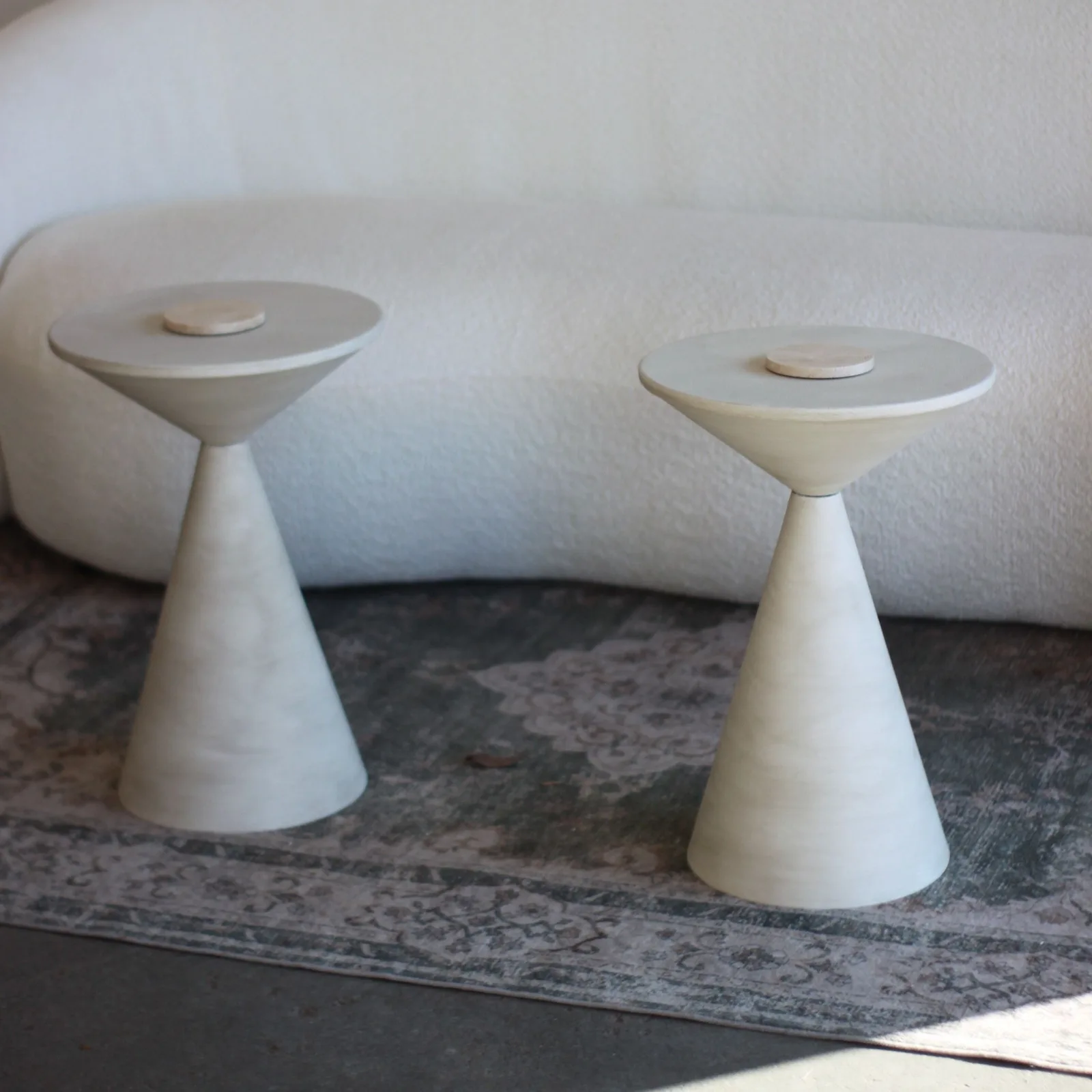
When buying separately, repeat one or two visible features, such as a metal tone, an edge profile or a wood undertone, and let the rest vary where the room requires. A round central table beside a rectangular side table can serve different spaces without looking accidental. A pair of low, pale pedestal tables in front of a white sofa reads airy and calm; the same pair in a dark finish becomes a strong graphic note. Look at finishes in the room’s light, because separately sold finishes may not match even when named alike. If they must match exactly, confirm that the finish names belong to the same current collection.
Surfaces differ in use: lamps and cups on end tables, food and games on the center table. Read the construction for top, shelf, frame and legs separately, and note that a “marble look” or “wood finish” does not identify the underlying material. Open shelves hold what you want nearby but add cleaning and can look busy when full. If a top is veneer, ask about the exposed edges and the cleaning method; for glass, get the care instructions rather than guessing its specification from looks. Follow the maker’s guidance on spills, heat and cleaning products, and expect the center table to wear differently from the end tables.
Buying the whole set
Count the cartons and assembly steps, and find out whether one damaged piece can be replaced alone. A low price may not include every object in the photograph or the delivery service you need. Check that the cartons can reach the room, and whether a return means sending back the whole set. Compare against a smaller group that fits your needs, since an unused third table still costs money and storage; piece count alone says nothing about fit. A complete set does simplify coordination when every piece has a clear role. Follow the assembly instructions for the exact item, and use tables only for their stated purpose: they are not stools or steps. Keep lamp cords out of walking routes. For related choices, see the furniture hub.