How to Clean Blinds Without Damaging Slats, Fabric or Controls
Wood, faux wood, aluminum and fabric can look alike from across the room and react very differently to water. Identify what you own, then clean it the way its maker allows.
By DecoraMintPublished 5-minute readMore in Blinds & Shades
In this guide
Run a fingertip along a slat and it comes away gray, and the wet cloth that rescues one kind of blind can ruin another. Aluminum shrugs it off, faux wood tolerates a lightly damp wipe, real wood objects to water, and fabric has its own rules. Identify the material and the rest of the job follows.
A label, model number or receipt usually settles it, and the label is often on the headrail or inside the valance. A wood-look composite and stained wood are hard to tell apart by eye, so when the material stays a mystery, dust it dry and leave it there.
The kit
You need two soft cloths, one for cleaning and one for drying, a vacuum with a soft brush or upholstery attachment, and a stable step stool so you are never pulling on the blind to reach it. A little mild dish soap covers most spots. Skip abrasive pads, stiff brushes and strong all-purpose sprays, and never mix cleaning products. Bali’s care chart warns against strong detergents and spot removers, and the same caution suits every blind in the house.
Aluminum and vinyl slats
- Lower the blind fully and tilt the slats nearly closed so you can reach the whole face.
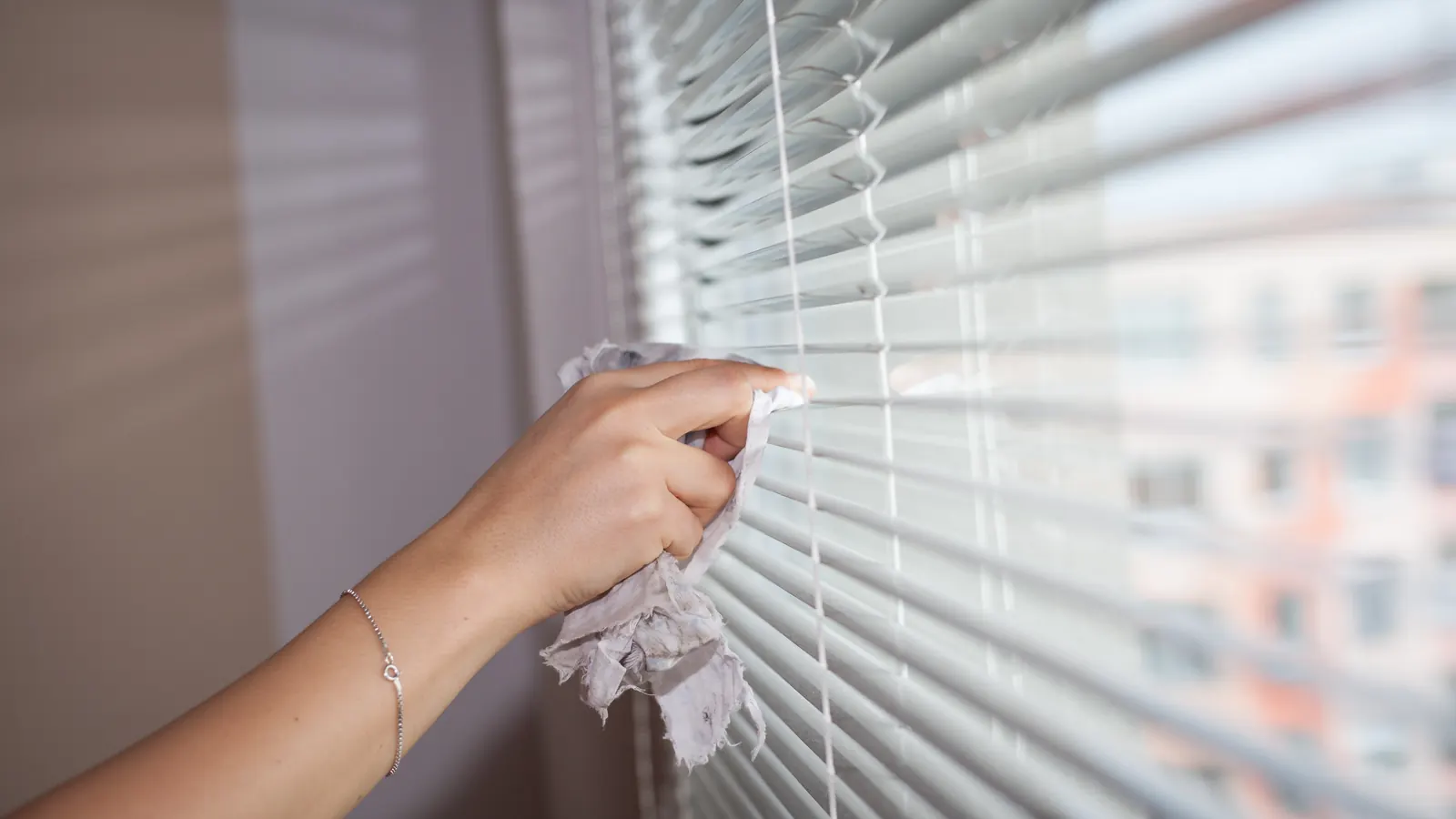
- Dust from the top down with a dry cloth, one slat at a time, supporting each slat from underneath so it does not bend.
- Reverse the tilt and dust the other faces.
- For fingerprints or kitchen grease, wring a cloth almost dry in warm water with a few drops of dish soap, wipe each slat, then go over it with a cloth rinsed in clean water.
- Dry with a second cloth and leave the blind lowered until all moisture is gone.
This is general guidance for metal and vinyl slats, which tolerate water better than anything else here, though a coating can still scratch under hard rubbing. Soaking suits only a blind whose maker says that model can be immersed, and steam stays off the list unless the maker names it. Hunter Douglas lists steam among the things to keep wood blinds away from.
Faux wood
- Lower the blind and tilt the slats almost closed. Hunter Douglas notes that this lets you reach where the slats overlap.
- Dust with a soft cloth or a dusting mitt, or go over the slats with a vacuum brush attachment.
- For marks, use a soft cloth that is only lightly damp. Levolor gives this method for its faux wood blinds and advises against washing them in the bathtub.
- Dry right away. Hunter Douglas says solvents and scrubbing cleansers will damage the product.
Slats may shrug off a splash, but the headrail and cord parts need to stay dry.
Real wood
- Dust or vacuum with a soft brush, as for faux wood.
- Keep water and steam away. The Hunter Douglas wood-blind page says to keep fine wood products away from steam, high moisture and sprinklers, and warns against ultrasonic cleaning, chemical solvents and scrubbing cleansers.
- For a stubborn spot, try your method on a hidden corner of a slat first, and stop if the sheen changes.
Makers disagree about finish products. Bali’s chart says painted and stained wood can be cleaned with a spray polish and a soft cloth, never water, while Hunter Douglas says stained blinds can be treated now and then with lemon oil or another wood preservative. A furniture polish that suits one finish can leave a film on another, so use only what your blind’s maker names.
Vertical blinds
Vinyl vanes are the forgiving ones. Bali says they can be taken off and immersed in water, and that a thin coat of mild detergent can reduce static. Fabric vanes are different: Bali says they should not be immersed or dry cleaned, and only a fabric its maker labels machine washable should go in a machine, on a gentle cycle, then hang to dry with the dryer left off. For ordinary fabric vanes, vacuum lightly with the upholstery attachment while holding each vane flat with your other hand, and spot clean only as the care sheet allows.
Cellular, roller and Roman shades
Dust and vacuum cellular shades monthly. Hunter Douglas’s care overview sorts its advice by product family and fabric, so a method for one type cannot be borrowed for another. For a topical spot on a cellular shade, Bali’s chart says to use a soft cloth or sponge with mild detergent and warm water, pat dry, and leave the shade fully open while it air dries. Deeper treatments such as ultrasonic cleaning belong to professionals, and Bali says it cannot guarantee the outcome of cleaning by an independent company.
For a roller shade, start with a dry feather duster or the vacuum’s soft brush, and keep window-cleaning products off the fabric. For a Roman shade, read the care sheet first, because the lining, rings and cords behind the face fabric limit what water it can take. If the fabric allows spot cleaning, press the spot with a cloth in place of rubbing it. Never put a shade through a wash to see what happens, and if you hire a professional, ask whether they handle your specific type.
Glass, sills and motors
Clean the sill and valance before the blinds, so grit is gone before it can drag across the slats. When you wash the window behind them, spray the cleaner onto a cloth and never at the glass; Hunter Douglas gives this advice for wood blinds, and it protects every finish. Switch a motorized shade off at its power source before cleaning near the headrail, and keep liquid away from controls and openings.
When a blind misbehaves
If it binds, tilts unevenly or shows a frayed cord, cleaning will not fix it. Stop using it and call the maker for service. For a persistent mark, photograph it with the product label and tell the maker what caused it and what you tried.
Routine care follows what you see on the slats. A kitchen blind collects grease and dust faster than one in a guest room, and a quick dry pass whenever you do the sill keeps the wet methods rarely needed.