Kids' Desk Chairs: Compare Fit, Adjustments and Desk Clearance
Raising a chair to a high desk can leave a child's feet dangling. Measure under the desk, check the fit during real homework and compare two chairs by their actual controls.
By DecoraMintPublished 5-minute readMore in Kids' Rooms
In this guide
How far is it from the floor to the underside of the desk? That one measurement, taken under the apron or drawer and not to the top, decides more about a kids’ desk chair than the age range on the box. A chair has to lift the child high enough to work at the surface, give their feet somewhere solid to rest and still slide in under that edge. Cornell University’s ergonomics group puts the children’s version simply: a chair should raise a child to the correct height for computer use, give their feet a stable platform and let them sit comfortably. Everything below is about getting those three at once.
These are notes for everyday homework and drawing at a full-height desk. Low activity-table sets are a different purchase, covered in our kids’ room collection. Nothing here is a fix for pain or a prescribed seating need; that calls for a clinician or therapist.
Measure the knee space, then the floor
Record the clear height under the desk at its lowest point, whether that is an apron, a pencil drawer or a keyboard tray, and the width between legs or a pedestal of drawers. A generous desktop can hide a narrow tunnel for knees and armrests.
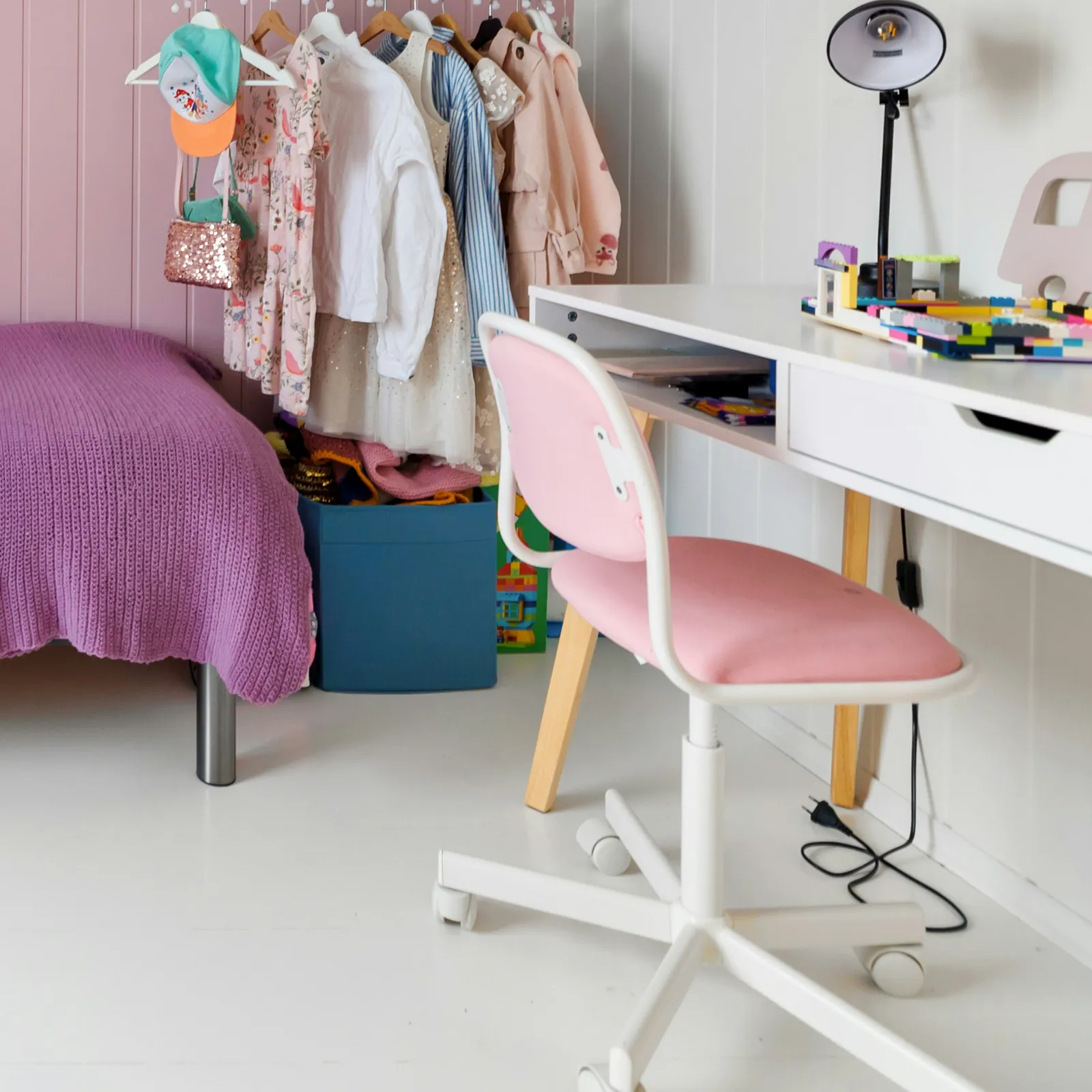
Then look down. A five-star base usually reaches past the seat cushion, and the child needs room behind the desk to roll back and stand up. In a small bedroom, that pull-out zone can run into the bed frame or a bookcase. Measure the base diameter from the listing and lay a string or a sheet of paper on the floor at that size; if it clips the bed, consider a narrower base or an armless chair.
Arms are the other clearance question. If they hit the desk edge, the child ends up perched forward, too far from the page. Armless chairs tuck in more easily, though that alone does not make one fit.
Watch a real homework session
If you can, have the child sit at the actual desk doing actual work: writing on paper, sketching on a large pad, typing. Each puts hands and materials in a different place.
You want to see the back resting against the backrest without the knees pushed up by the seat’s front edge, and forearms reaching the surface without shoulders hunching. Feet should rest flat, on the floor or on a footrest. Here is where high desks catch people out: raising the seat to reach the desk leaves small feet dangling. The answer is a footrest built for the job, or a chair with one; a stack of books slides. A seat that goes low enough but is too deep is just as awkward, because the child slides forward to bend their knees.
Age ranges are a starting point only. Two eight-year-olds can differ by a full chair size, and in how easily they can work the levers.
Two IKEA chairs, two ways of adjusting
The ORFJALL is the simple one. Its height changes by spinning the seat, with no lever, and its upholstered seat and back are care-labeled for vacuuming and wiping, not machine washing. Next to a desk used for markers and glue, that matters.
The VIMUND does more. IKEA lists adjustable height and seat depth, a footrest and a removable, washable cover. The assembly instructions, pages 13-15, show a lever for height and a separate knob for sliding the seat forward and back, and they reserve repair or replacement of the gas-spring height parts for trained personnel. Never take apart a gas cylinder to troubleshoot a sticking chair.
Read these as illustrations of two approaches, from the current listings. They are not a ranking, and a published test load does not tell you a chair fits your child.
Which adjustments earn their place
A lever is only useful if it changes something your child needs. At a fixed desk, seat height and foot support come first. If the seat is so deep the child cannot reach the backrest, depth adjustment matters more than armrests. For siblings sharing one desk, note each child’s settings; a chair that is technically adjustable but never readjusted serves only whoever used it last.
An adult office chair can work for an older child if it drops low enough, but compare seat depth before anything else: a seat built for adult thighs can stop a child from sitting back with knees bent at the edge, and adult armrests may hit the desk.
Make sure an adult understands how each control locks before the chair goes into use, using that model’s manual, not a lookalike’s.
Wheels, rugs and cords
Casters make sliding in and out easy and also make the chair a tempting ride. Some are load-sensitive and resist rolling when the chair is empty, by design. The listing will say which floors they suit. A thick rug edge, a loose mat or a charging cable across the path will catch them; if you use a chair mat, size it for where the chair travels when the child stands up, not just where it parks.
Rotation swings the seat back and arms into nearby furniture, so give the sides some clearance too. And a rolling chair is not a step stool: keep the books the child reaches for on shelves they can get to standing.
Living with it
Upholstery picks up crumbs, eraser dust and paint. A removable cover helps, but read its wash temperature and drying instructions; some shrink out of fit. Hard plastic seats wipe clean quickly. If you add a cushion for comfort, remember it also raises the seat, which changes how the child fits under the desk.
When budgeting, count a footrest or floor protector if the chair needs one, and if those add-ons are only papering over a poor fit, look at a different chair-and-desk pairing.
Keep the manual and model number somewhere findable for maintenance and recall notices. Then recheck fit when the desk changes or the child has a growth spurt, not on a birthday schedule.