How to Choose a Kids' Table and Chairs for Everyday Activities
A kids' table should be quick to set up and quick to clear, not a miniature dining set. Check how the child sits, the space the activity needs and how you will clean up.
By DecoraMintPublished 5-minute readMore in Kids' Rooms
In this guide
Pull a small table into the brightest corner of a playroom and the room reorganizes itself around it: the paper goes there, the crayon tin goes there, and snack time stops happening on the sofa. A kids’ table works when it sits at a height the child’s elbows and knees agree with, has a top big enough for the day’s project and can be wiped clear in a minute. The set you want is the one that does those three things in the room you actually have.
Seat height comes first
A child’s feet should rest on the floor, the knees should slide under the top and the work should be reachable without perching on the edge of the seat. Try the chair and table together if you can; if you cannot, read each maker’s age and size guidance separately, because a shop’s broad “toddler” label covers a lot of children. Do not fix a height mismatch with a stack of cushions or a wobbling step.
IKEA’s MAMMUT chair shows how specific the figures are: a listed seat height of 11¾ inches, and a recommendation in its advice document for ages three through seven. Those are the maker’s figures for one chair. The same document cautions against placing it near windows or window-covering cords. IKEA’s children’s table page covers foot support, chair pull-out space and the activity area in the same practical terms.
With siblings, judge each child’s seat on its own. Keep the high chair for any child who still needs one.
Size the top to the activity
Put the usual project on a kitchen table and look at the area it takes. A coloring page and a cup of crayons need little; a shared block city or a board game needs much more, and four seats around a small table that suits a snack may be crowded for four art projects. A smooth top suits drawing better than a deeply textured one, and seams and grooves collect crumbs. Extra chairs add places to sit but no tabletop.
Then measure the occupied set. Tape the table’s footprint on the floor and add the chairs pulled out. A set that looks tidy in a corner can block the closet once two children sit. Leave room for an adult to lean in to help or mop a spill without stepping over a chair. Our kids’ bedroom planning guide helps fit activity space around beds and storage.
Keep the set away from windows and their cords. CPSC advises that cordless coverings are the safest choice where young children are present, and furniture under a window gives children a way up to the cords. The set should also stand without rocking on your floor; skip random wedges under a short leg.
Sets, singles and what is in the price
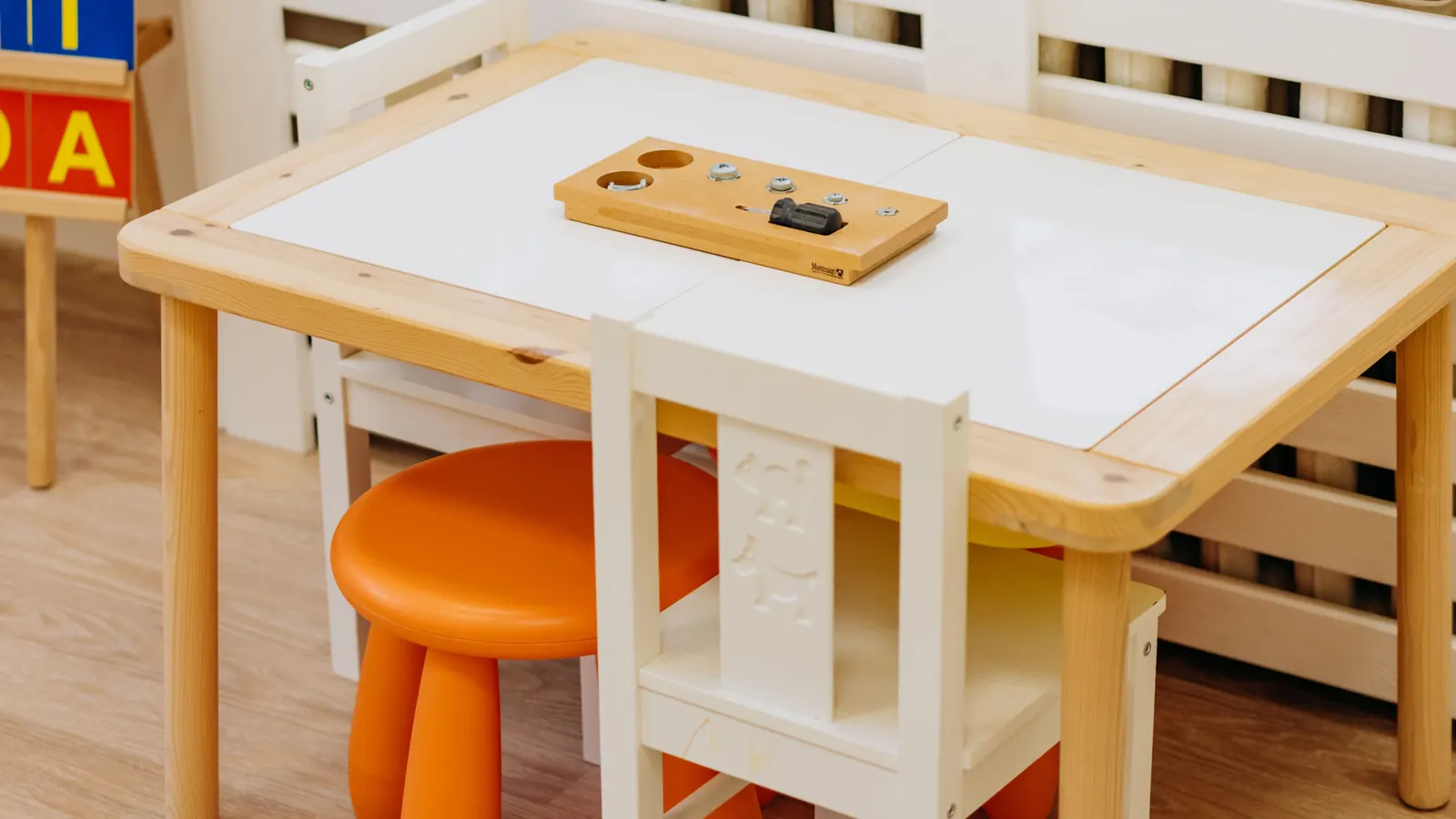
A packaged set simplifies the buying, but read what is included. IKEA’s US category lists LÄTT as a children’s table with two chairs and FLISAT as a children’s table alone, which changes any price comparison. Separate pieces give you flexibility on the number and height of chairs, at the cost of doing the fit check yourself: seat height, chair width, clearance under the top and whether chair arms fit beneath it.
FLISAT is also a good example of storage built into a top. Its listing shows two removable lids over space for compatible TROFAST boxes, and the assembly drawing shows those separate top panels; the materials list gives pine for the top and legs and fiberboard for the lids. The boxes and chairs are separate purchases. Top-access storage has a catch: a building project can sit on the lid and block it, and for a project that stays out overnight, open shelving nearby may be the better home for supplies.
Wood, plastic and padded seats
Solid pine, veneer and engineered panel can all look the same in a photo, so read which part is which, and see how the edges are finished. Look at the finish for scratch resistance, and treat outdoor use as something the maker has to state. A light plastic set moves easily, and a plastic chair designed for indoors may not survive weather outside. Padded seats are comfortable for longer activities, yet they stain with paint, marker and food, so look for a removable cover and a wipeable surface. Dry-erase marker and washable paint wipe cleanly off some top finishes and not others, so a protective mat is worth having when paint comes out.
Color and finish set the mood more than the shape does. Pale wood or a white top with chairs in one saturated color reads as furniture rather than a pile of plastic, and against plain walls it carries the whole corner. Pine under a clear finish shows its grain and warms a cool room; a glossy white top throws back daylight and makes a small corner feel larger. Put the set where the light is good, so paper and paint read true, and keep one low shelf of supplies beside it so the table stays the focus.
A folding table has to fit twice
Measure a foldaway table open, with chairs pulled back, and again folded, including feet, handles and latches. A compact top can have projecting legs that use more floor than expected, and a folded table that fits in a closet may still be awkward to carry through a doorway. If it stays out most days, folding adds little. If it comes out for visits, an adult should be able to open, close and store it per the instructions, with children kept clear, and without leaving it propped in a walkway.
Get the manual for the exact model and look for the sequence that confirms each lock or brace is engaged. Stop using the table if a lock is damaged or its operation is unclear, whatever the top looks like. For folding chairs and stools, CPSC’s guidance addresses their locking mechanisms and stability; it covers chairs and stools, so the companion table falls outside it.
Secondhand and adjustable sets
For a used set, find the model and manufacturing information, locate the right instructions and search CPSC’s recall database. A missing label or an improvised replacement brace makes the history hard to trace. Adjustable-height furniture needs the settings changed while it is empty, following the maker’s method, with the finished setup inspected before a child returns to it.
Keeping it going
After assembly, go over the whole set, and tighten fasteners as the manual directs, especially after a move. Children should not stand on a small table unless the maker designed it for that, and adults should stay within the chairs’ stated limits. Store cleaning products and adult craft tools away from the children’s supplies.
On shape, a rectangular top sits along a wall and suits paper work, while a round top lets children face each other. Buy for the child using it now rather than a larger table to grow into, since a top that is too high makes everyday drawing awkward.