King-Size Mattresses: Standard King, California King or Split King?
Is your problem width or length? Standard king, California king and split king solve different ones. Choose the format first, then compare constructions within it.
By DecoraMintPublished 4-minute readMore in Bedroom
In this guide
A standard US king measures 76 by 80 inches. A California king measures 72 by 84. That four-inch trade, narrower and longer, is the whole decision for most buyers, and a split king (two twin XL mattresses side by side) adds a third option for couples who disagree about firmness.
| US format | Typical dimensions | What it gives you |
|---|---|---|
| Standard king | 76 × 80 inches | The broadest shared width |
| California king | 72 × 84 inches | Four inches narrower, four inches longer |
| Split king | Two 38 × 80-inch twin XL mattresses | Two surfaces in a standard king footprint |
Saatva’s US size information lists these dimensions and describes split king as two twin XL mattresses. Saatva also lists a split California king, two 36 by 84 inch halves, on only some of its models. Imported, custom and specialty mattresses can differ, so take the finished measurements of the exact model you are considering.
Width or length
A standard king keeps the 80-inch length of a queen and adds room across, which suits two people who want space between them. California king suits a tall sleeper or a narrow room. The nominal surface areas are close, 6,080 square inches against 6,048, so California king changes the proportion of the bed rather than enlarging it. A tall person who shares with a partner may want length; two light sleepers who roll may want width.
Extra width does nothing for a disagreement about how the surface feels, so talk through movement, temperature and firmness before you shop for size.
Where it sits in the room
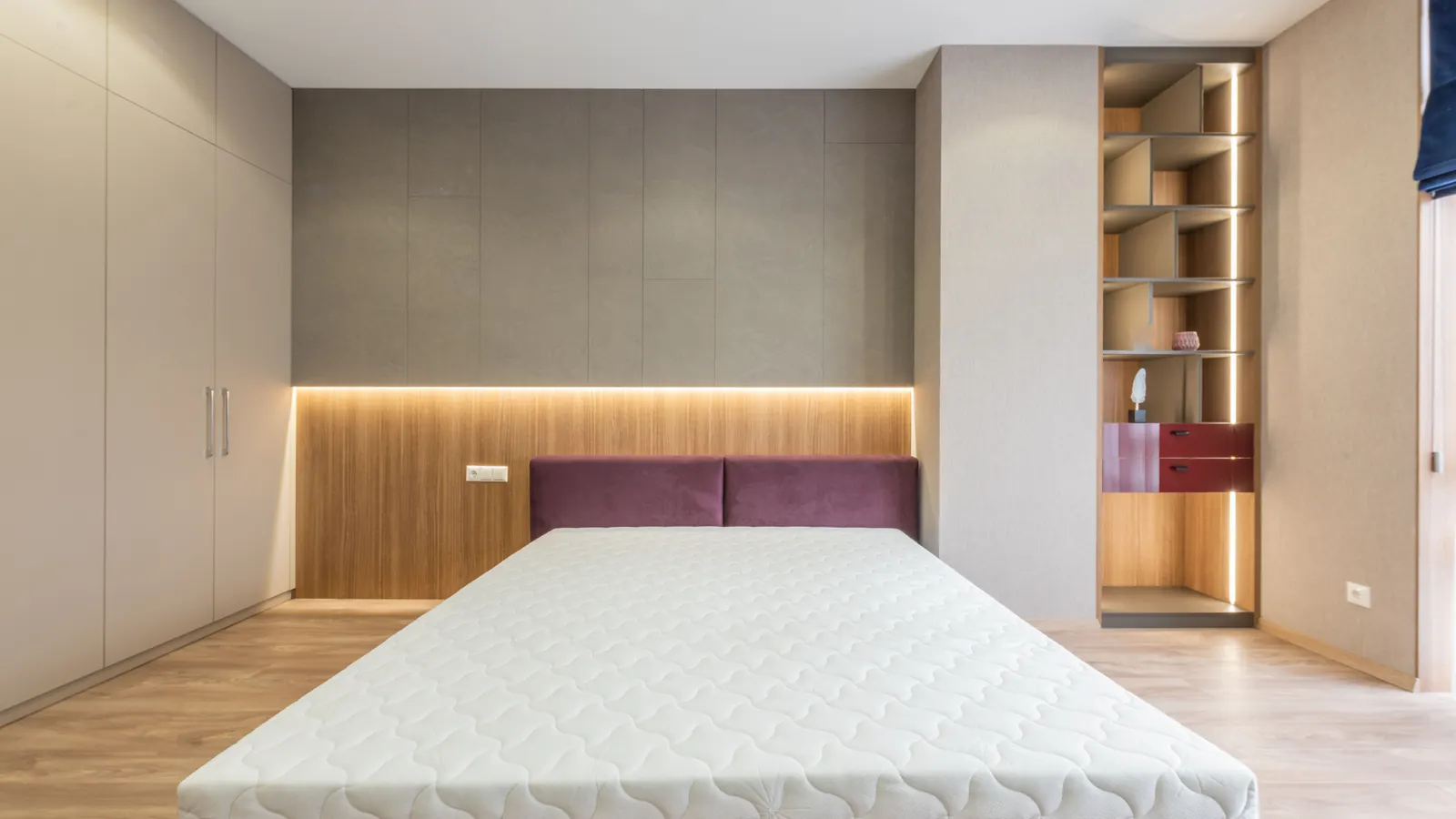
A king is also a large visual mass. Dressed in white, it recedes into a pale room; in dark bedding against a pale wall it becomes the focal point of that wall. Centered on the longest wall or under a window it looks planned, and pushed into a corner to save floor it looks wedged. The bedroom collection shows how other rooms handle the proportions.
A king mattress sits inside a larger object. Upholstered frames, side rails, headboards and footboards run past the mattress edge, and bedside tables and any drawers that open near the bed add more. Draw the assembled bed, then check that you can make it and reach windows and closets. A frame that fits between walls can still make the room awkward to use. If a king forces out storage you need, a lower-profile frame or a smaller mattress may suit the room better than the widest bed on offer.
Single or split
A single king is one surface. A split king is two mattresses meeting along a center line, which changes both bedding and daily handling: fitted sheets can be separate, but the top layers still need choosing. Two firmness levels are possible if the retailer allows two different twin XL models, so ask, and compare the heights. Do not assume the center line disappears under a sheet.
Adjustable bases need more care. Two mattresses, two base sections and the controls must all be compatible, and the words “split king” do not guarantee that any mattress works on any base.
Ordinary twins will not stand in: two 38 by 75-inch twins give 76 by 75 inches, five inches short of a king’s length.
Construction within the size
Once the format is settled, compare the layer descriptions, surface options and foundation requirements. A coil count, a foam name or a cooling label is only one piece of the picture. Try the exact configuration where you can, and when you test a showroom model, note its height, firmness, base and any added topper so you know what you were lying on. Two sleepers with different tastes can each list their preferences first, then look for a combination, whether one bed with a topper on one side or a split.
Support and finished height
Read the mattress maker’s base or slat requirements, since a frame sold as king may still have the wrong supports. Add mattress, foundation and frame to estimate the finished sleeping height, then think about getting in and out and the height of bedside furniture you plan to keep. A topper or an old mattress laid under a new one is no fix for damaged or unsuitable supports; correct the base first.
Getting it in the door
A king mattress is a big load for a stairwell or tight corner, even when the finished bed fits the room. Look at the package size, the handling method allowed and the delivery service for your address. Fold a mattress only if its maker permits it. A split king gives two smaller pieces to carry, but also two items and a junction to manage, and return terms apply to both.
Bedding sizes differ too. King and California king sheets are not interchangeable, and pocket depth is a separate measurement. Price the complete purchase: base, bedding, delivery, removal and return or exchange fees. We have not tested or ranked king mattresses.