King Size Wood Bed Frames: Materials, Support and Fit
Wood finish is easy to judge in a photo; support, outside dimensions and included parts are not. Confirm which king you need and look under the mattress before choosing.
By DecoraMintPublished 5-minute readMore in Bedroom
In this guide
A king frame has to carry two sleepers for years, so the wood it is made from is worth a look before the color. On the Janka scale, which measures the force needed to press a steel ball halfway into the wood, black walnut rates 1,010 lbf, white oak 1,350, hard maple 1,450 and eastern white pine 380. A frame at the low end will dent under a dropped bracelet or a rubbing trunk, and some people like the worn-in look that follows. A frame at the high end keeps its edges for years of ordinary knocks.
Species is the first of four things worth sorting out before a king frame goes in the cart: the wood and finish, the structure under the mattress, the outside footprint, and how the pieces get into the room.
Which king, and what the frame actually holds
A standard king mattress is 76 by 80 inches and a California king is 72 by 84 inches, according to Casper’s sizing chart. The California king is narrower and longer, so a frame built for one will not take the other. Frames also state their own opening. IKEA’s king TARVA listing, for instance, gives a mattress width of 76 inches and a length of 79 1/2 inches, which is the frame’s spec and can differ a little from the nominal mattress. Compare the opening with your mattress’s actual measurements, and confirm that the size you picked carries through to the cart, since the collection photo stays the same when you switch from queen to king.
Reading “wood” component by component
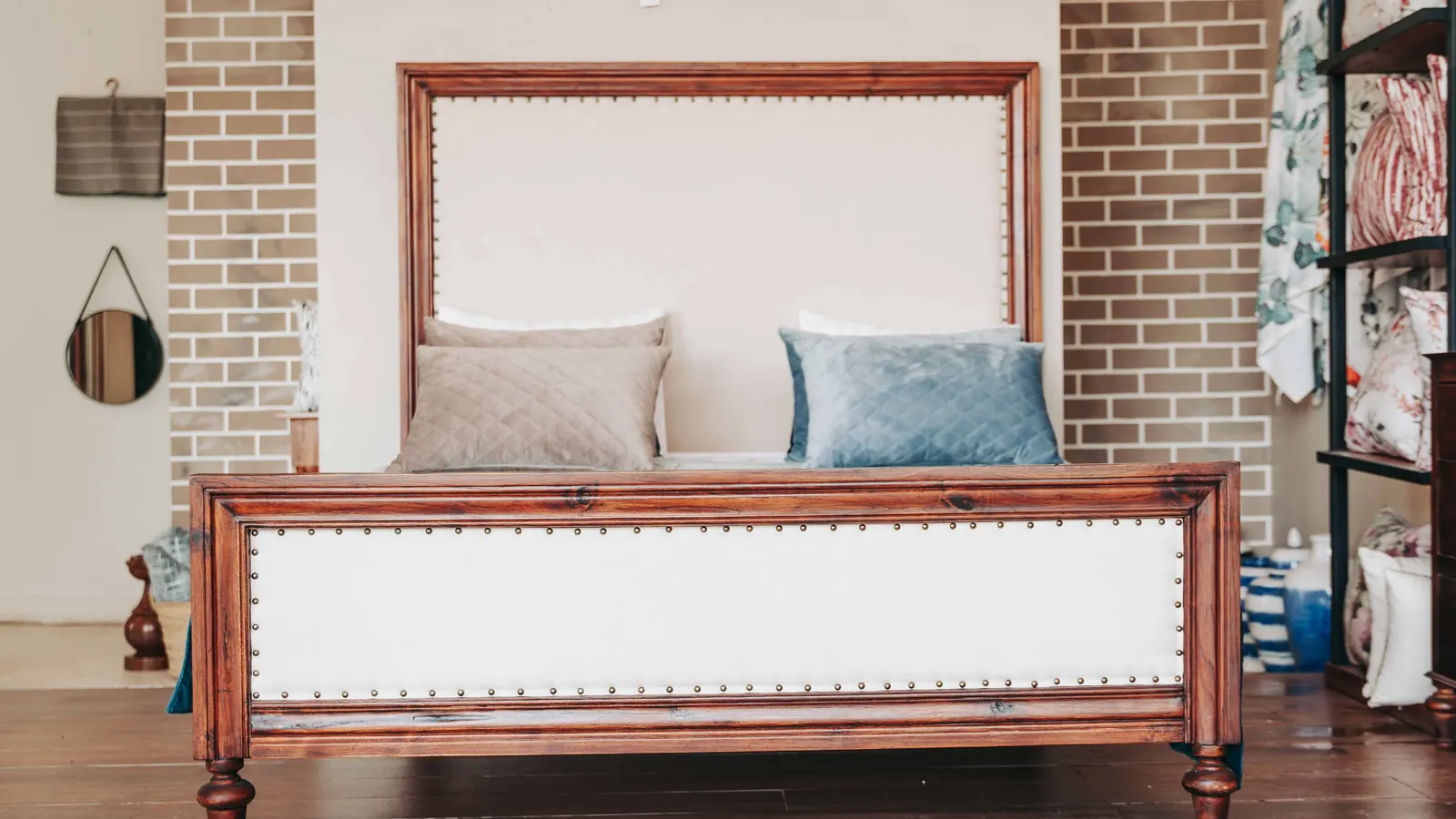
Headboard, footboard, rails, legs and hidden supports are often different materials. Solid wood rails with a veneered headboard are common, as are upholstered panels on a wood frame and metal brackets under a wood finish. A listing that only says “walnut,” “espresso” or “rustic oak” is naming a color. Good listings name the species per component, and say whether a headboard is solid wood, veneer over a panel, or engineered board.
The finish matters as much as the species. IKEA sells the TARVA frame as untreated solid pine and says oil, wax, lacquer or stain makes the wood more durable. That is useful if you want to choose the tone yourself and unhelpful if you expected a finished look on delivery.
What is under the mattress
This is where kings go wrong. A king covers a lot of area, so the support has to span it.
- Slat gap. Puffy, a mattress retailer, suggests in its slat-spacing guide a gap of no more than 3 inches on a platform bed, and calls 2 inches excellent for foam, latex or hybrid mattresses. Your mattress’s own instructions set the limit that counts, and a frame with wider gaps than that is the wrong frame.
- Center support. The IKEA king listing says its center beam is “required for the stability of the bed frame and to keep the mattress in place.” It ships in a separate package from the frame, so it is easy to miss. A king frame should show a center rail, ideally one that reaches the floor on its own leg.
- Base type. Tempur-Pedic’s support guidance separates suitable bases and foundations from traditional box springs. Match the base type to what your mattress maker lists; a frame that lacks it needs a separate foundation, which adds to the price.
The IKEA listing also sells slats separately, and recommends a slatted base no thicker than 1 5/8 inches if you want it hidden in the frame. A frame price that excludes slats is a different purchase from one that includes them. As for weight capacity, the IKEA page does not state one, only shipping weights. Look for a stated load in pounds for the king size, described for the whole bed, and treat a missing number as an unanswered question for a bed two people will share.
We have not tested the TARVA frame; these details come from IKEA’s listing and its assembly manual.
A wood frame in a bedroom
Wood sets the temperature of the room. A pale ash or oak frame against white walls and a light floor makes the bed almost an outline, and the bedding does the talking. A dark walnut-toned frame with a tall headboard becomes the heaviest object in the room, which suits a bedroom with high ceilings and a pale wall behind it, where the dark mass has somewhere to land. In a smaller room the same frame will crowd the walls and look like a block of furniture, so a lower profile in a medium tone is easier to live beside.
The floor decides more than the wall does. When the frame and floor are nearly the same brown, the bed melts into it, and the result looks like a mistake. Either go clearly lighter or darker than the floor, or put a rug under the bed that is a third tone. We would test it with a large finish sample propped against the wall, because a small chip cannot show what a king headboard does across half the wall.
A frame does not have to match the nightstands. A deliberate difference, such as black metal bedside tables beside a wood bed, looks planned. Three near-matching browns look accidental. The bedroom collection gathers bedside options in other finishes.
Footprint, height and getting it home
The outside footprint is bigger than the mattress. Thick rails, a curved footboard and a projecting headboard add inches on every side. Tape the frame’s listed length and width on the floor, then walk to the closet and the door with the nightstands in place. Look at the foot of the bed in particular, where a thick footboard narrows the way to a closet.
Sleeping height is the support height plus the mattress, so compare the total with your nightstands. A headboard that looks tall in the photo can sit in front of a switch or window trim.
Delivery sets the limits of the plan. A king headboard is a wide flat panel, and rails are long and narrow. The IKEA frame arrives in two packages, with a frame box listing 55 lb 3 oz, so even a modest king frame comes in heavy cartons. Measure the stair turns and the bedroom doorway against the largest carton, and ask whether in-room assembly is included.
Hardware from a different model will not substitute for the original bolts and brackets, so bag and label them if the bed ever comes apart for a move.