Mattress Pads: Compare Fill, Fit, Protection and Laundry Needs
Some pads cushion, some protect and some do both, and the name rarely says which. Read the shell, fill and skirt separately, then measure the pocket depth and plan the laundry.
By DecoraMintPublished 5-minute readMore in Bedroom
In this guide
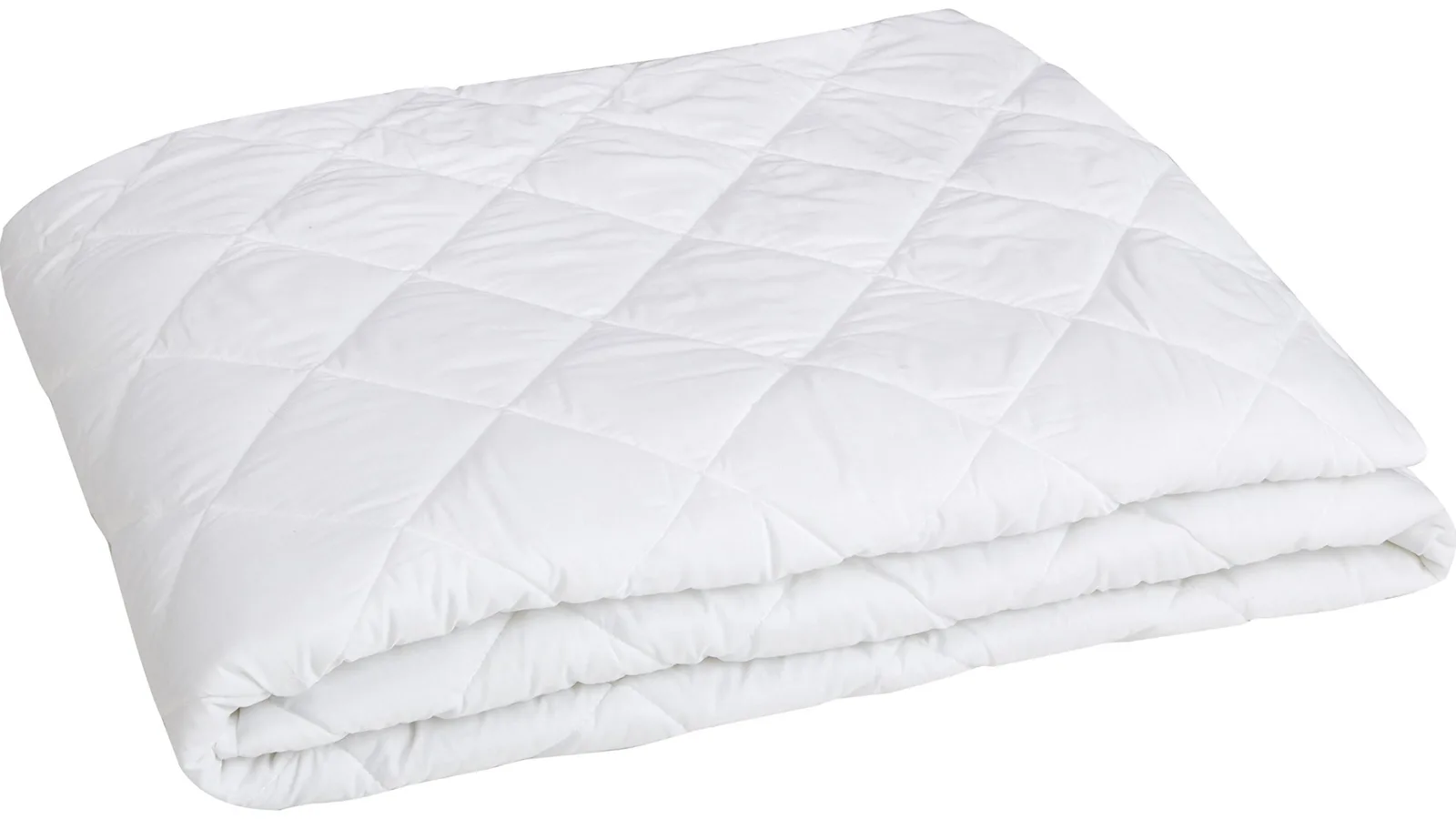
Strip the bed on laundry day and the mattress pad shows whether it was a good buy. A good one peels off in a single pull, fits in the machine, dries by evening and goes back on with its corners snug and its quilted top lying flat. A poor fit fights you at every corner, wrinkles under the sheet and takes a day to dry. A pad is the washable, lightly cushioned layer between the fitted sheet and the mattress, thinner than a topper and softer than a bare protector, and its fit and laundering decide how much you will like it.
Pads come in a few distinct kinds, and the right one follows from what your bed needs most.
Start with the pocket depth
Every pad is sold by bed size, but what keeps it on is the pocket, the depth its skirt can wrap. The Company Store’s Legends Hotel waterproof pad, 11204A-F-WHITE makes the point clearly: its standard version has an 11-inch pocket for mattresses up to 12 inches deep, and its deep-pocket version an 18-inch pocket for mattresses up to 20 inches. The skirt measurement and the mattress depth it fits are two different numbers, and the second one is what you need.
Measure your mattress’s real height. If a protector sits under the pad, add it; if a topper will go on top of the pad, leave it out. Then choose a pad whose stated fit range comfortably covers the total. On a pillow top or a tall hybrid, the deep-pocket version may be the only one that will grip.
A well-fitted pad hugs the corners while the quilted top lies flat. If the skirt pulls the top out of shape, or the corners pop free when you sit on the edge, the size or depth is wrong, and washing will not relax it into place. Do not stack extra layers or remove the mattress’s own cover to make a pad fit unless the mattress and bedding makers allow that arrangement, and never force an incompatible size. Fitted skirts need access to all four corners, which matters for a bed pushed against a wall; on an adjustable or split base, a single wide pad may fight two independently moving halves, so look for one sized to each section.
If spills are the worry
A waterproof pad adds a barrier film inside the padding. On the Legends Hotel pad, the barrier is a thin thermoplastic polyurethane (TPU) layer sandwiched between two layers of cotton jersey, under a 400-thread-count cotton damask shell with recycled polyester fill. That combination gives you quilted softness on top and liquid protection underneath in one layer.
What a waterproof top does not guarantee is waterproof sides. Find out where the barrier ends, because the skirt may be plain stretch fabric. The same pad’s care calls for a gentle wash, non-chlorine bleach only and a low tumble dry, with no ironing; follow the label on yours, since barrier care varies. If mattress protection is a condition of your warranty, read what that warranty requires.
If the bed only needs a softer skin
Plenty of beds feel right and just want a cushioned, washable surface to take the wear of nightly use. For that, a plain quilted pad is enough. Company Cotton’s Deep Pocket Twin pad, 11001C-T-WHITE lists each part separately: a cotton top, a jersey-knit cotton skirt and a fill of 98% cotton and 2% other fiber. Its selected size is 38 by 75 inches with an 18-inch skirt, and the overview gives a separate fit range for the deep-pocket options, so confirm the size you pick.
Read the top, the fill and the skirt as three separate materials, because a cotton face can hide a polyester fill. The quilting matters too. Small, close stitching tends to hold the fill evenly and lie flatter under a sheet; larger channels or boxes look puffier and give the fill more room to shift. If you want the bed noticeably softer, though, a pad is too thin for the job, and a topper is the better tool.
If you sleep warm
A “cooling” pad is still a thin textile layer. It can change how the surface feels against your skin, and it cannot chill the bed the way a powered system circulating water or air does. Slumber Cloud’s two pads show how constructions differ.
Slumber Cloud’s Performance Mattress Pad specifies a lyocell top with an Outlast phase-change coating, polyester fiberfill and a polyester skirt, used under a fitted sheet. One marketing heading mentions down, but the detailed materials list polyester fill. Its care calls for a cold gentle wash, no fabric softener and low tumble drying.
| Selection | Published construction | Consider it if |
|---|---|---|
| Core Mattress Pad | Top of 40% Outlast viscose and 60% cotton, coated polyester lining, polyester fill | You prefer a cotton-blend face and its laundering routine |
| Performance Mattress Pad | Lyocell top with phase-change coating, polyester fill, elastic skirt | You like a lyocell face and can skip fabric softener |
These are the maker’s specifications; neither pad’s overnight cooling has been measured for this guide, and the Performance name and higher price prove nothing about a cooler night. Slumber Cloud lists both as one-quarter inch thick, with an attachment range up to 20 inches deep. Bedding above the sheet often matters as much, so look at our guide to cooling blankets for hot sleepers too.
The “T” on the label
Mattress pads fall under the same federal cigarette-ignition standard as mattresses. According to the CPSC’s business guidance, pads are subject to 16 CFR part 1632, and a pad treated with a chemical flame retardant must be labeled prominently with the letter “T,” along with instructions for protecting that flame resistance through cleaning. If your pad carries a “T,” follow its laundering directions to the letter. An electric mattress pad is different equipment altogether, with its own controls and instructions.
Making laundry day easy
A king-size pad has to fit your washer and dryer, so check the drum before ordering the largest size. Dry it completely, including the thick seams and skirt edges, before remaking the bed; a surface that feels dry can hide damp fill underneath. If the whole point is frequent washing, buy two and rotate them, so the bed is never bare while one dries. At each change, look over the seams, the elastic and any barrier layer, and replace a pad whose barrier or skirt has given out. The pad always goes under a fitted sheet, never in place of one; for the rest of the bed, see the bedroom collection.