Pendant Lights for a Kitchen Island: Plan Size, Spacing and Light
Two large shades or three small ones? The number depends on fixture width and the island's length. Work out spacing, hanging height and sightlines before ordering.
By DecoraMintPublished 4-minute readMore in Lamps
In this guide
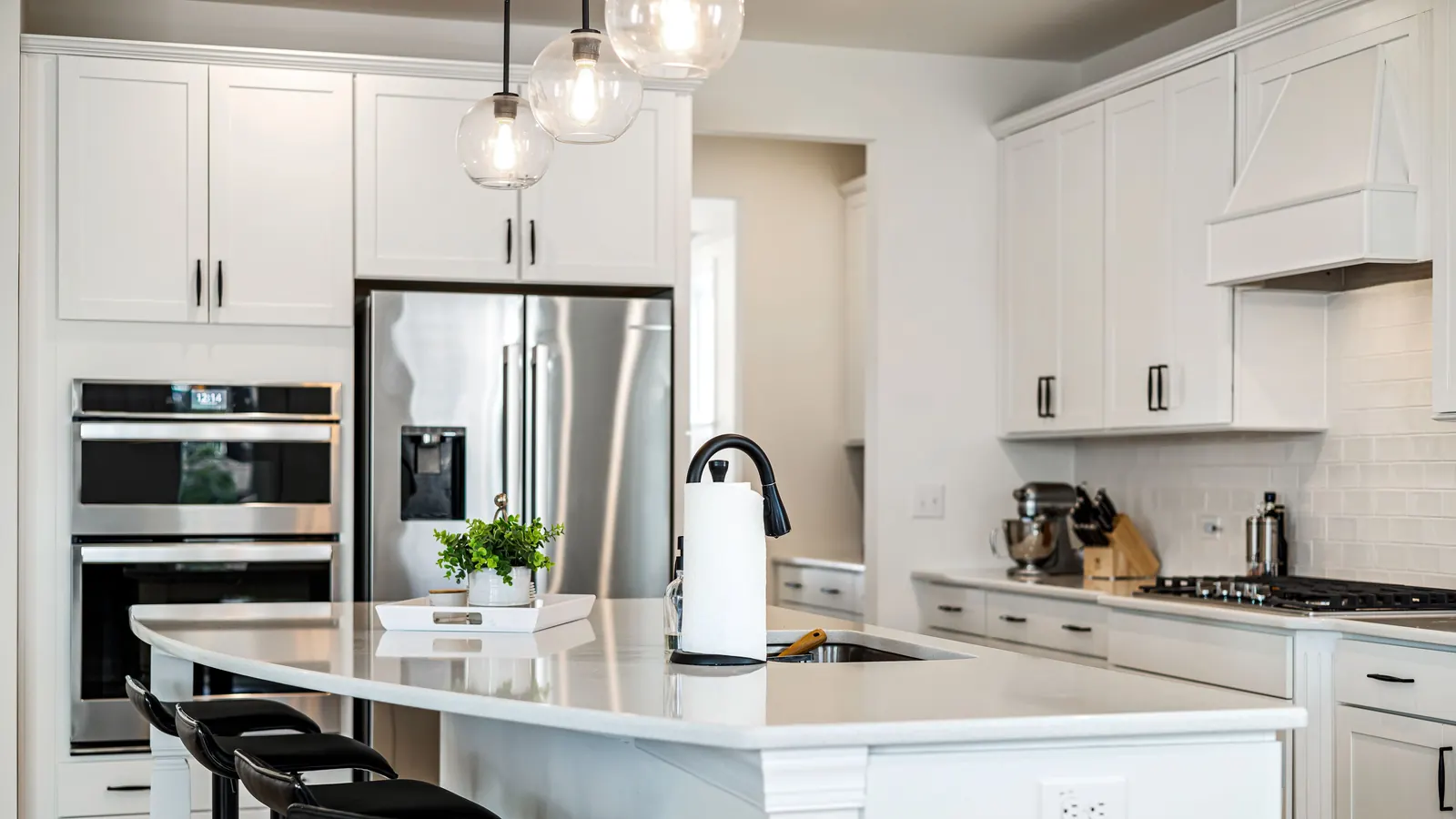
Hang island pendants with their bottoms about 36 inches above the countertop, keep the outer shades at least 6 inches in from each end of the island, and leave 12 to 24 inches between the widest points of mini pendants, with more room as the shades get bigger. Those figures come from Kichler’s pendant planning guide, which also makes the point that the count depends on the size of the island and the size of the pendants. Kichler notes that odd numbers generally look best, that two large pendants can suit a large island, and that four can complement a large square one. The rest of the decision is about what the lights are for, how they look from the stools, and what the ceiling can support.
Decide what the light must do
Sketch the island and mark three things: where food is prepared, where people sit, and the line of sight from the island to the rest of the room. A pendant that is mostly jewelry can leave the counter to under-cabinet or ceiling light. A pendant meant to light the worktop needs a shade that sends light down.
The two usual shade types behave very differently. An opaque dome throws a defined pool of light onto the counter and hides the lamp from anyone on a stool, which suits a cook who works at the island every evening. A clear glass globe with an exposed lamp glows in every direction and becomes the focal point of the kitchen; it looks light and airy, but the filament or LED is visible from a seated position and can bounce off a glossy stone top. Two shades of identical outside size can light the counter quite differently, because the opening, the interior finish and the lamp position set the spread.
Two, three, a bar or a single statement
Two large pendants keep a composition quiet and suit a long, wide island where three would crowd the shades. Three smaller pendants give a longer island a rhythm and spread the light along its length, at the cost of more shades to clean and more ceiling boxes to wire. A single linear fixture with several lights reads as one object, so check where its canopy sits and how long it is against the island. One sculptural pendant can anchor a compact island, though it then leaves the task light to something else.
For the arithmetic, work with center-to-center spacing and the gap between shades as two separate numbers. The clear gap equals the center distance minus the width of one shade, so a wider shade at the same centers closes the space between them. Draw the fixtures to scale and read three distances: center to center, shade edge to shade edge, and the outer edge to the end of the island. Then walk to the end of the island and look at the group; a shade that fits along the length can feel oversized when seen from the narrow side.
Height, sightlines and glare
Kichler’s pendant guide says 36 inches and its kitchen guide allows 30 to 36, so a household with tall cooks or a low ceiling can settle anywhere in that range. Test with paper cut to the shade’s outline held at that height, standing at the sink, working at the counter and sitting on a stool, then look across toward the window or the living area. A big shade at the right height can still sit exactly where people look when they talk.
Check the fixture’s minimum and maximum drop before falling for it. Cable pendants adjust at installation; rods and chains come in fixed lengths, and a sloped ceiling needs a canopy made for it. Raising a pendant afterward to fix a view problem usually takes it out of the zone where it lights the counter.
Brightness, color and dimming
Compare lumens for brightness and kelvins for color separately; the Department of Energy’s lighting fact sheet explains that lumens measure light output while the Kelvin scale describes how warm or cool the light looks, with lower numbers warmer. Wattage only tells you how much power a bulb uses. Match the pendants’ color to the lighting around them, since a cooler pendant beside warm under-cabinet strips shows on white cabinets and counters.
Island pendants on a dimmer earn their place: full brightness for homework and cleanup, a low setting for the evening. The same fact sheet encourages using dimmers where you have them and points out that specialty dimmer-compatible LEDs exist for dimmable fixtures. A bulb labeled dimmable still needs a dimmer it works with, and flicker or buzz at low settings usually means a mismatch; take the dimmer model to the retailer or the maker’s compatibility list before buying the bulbs. Integrated-LED pendants can need a specific driver and control, so ask what the replacement path is if the module fails.
What the ceiling decides
If you are replacing existing fixtures, find the electrical boxes first. A different count or spacing can mean new boxes, new support and new wiring, and that work belongs to a qualified electrician who will also confirm the supports can carry the fixture’s weight. Give the installer the product sheets, the island dimensions, your intended centers and the dimmer you plan to use. We would let the box positions narrow the options before shopping for shades, because every new box adds electrician time to the budget.