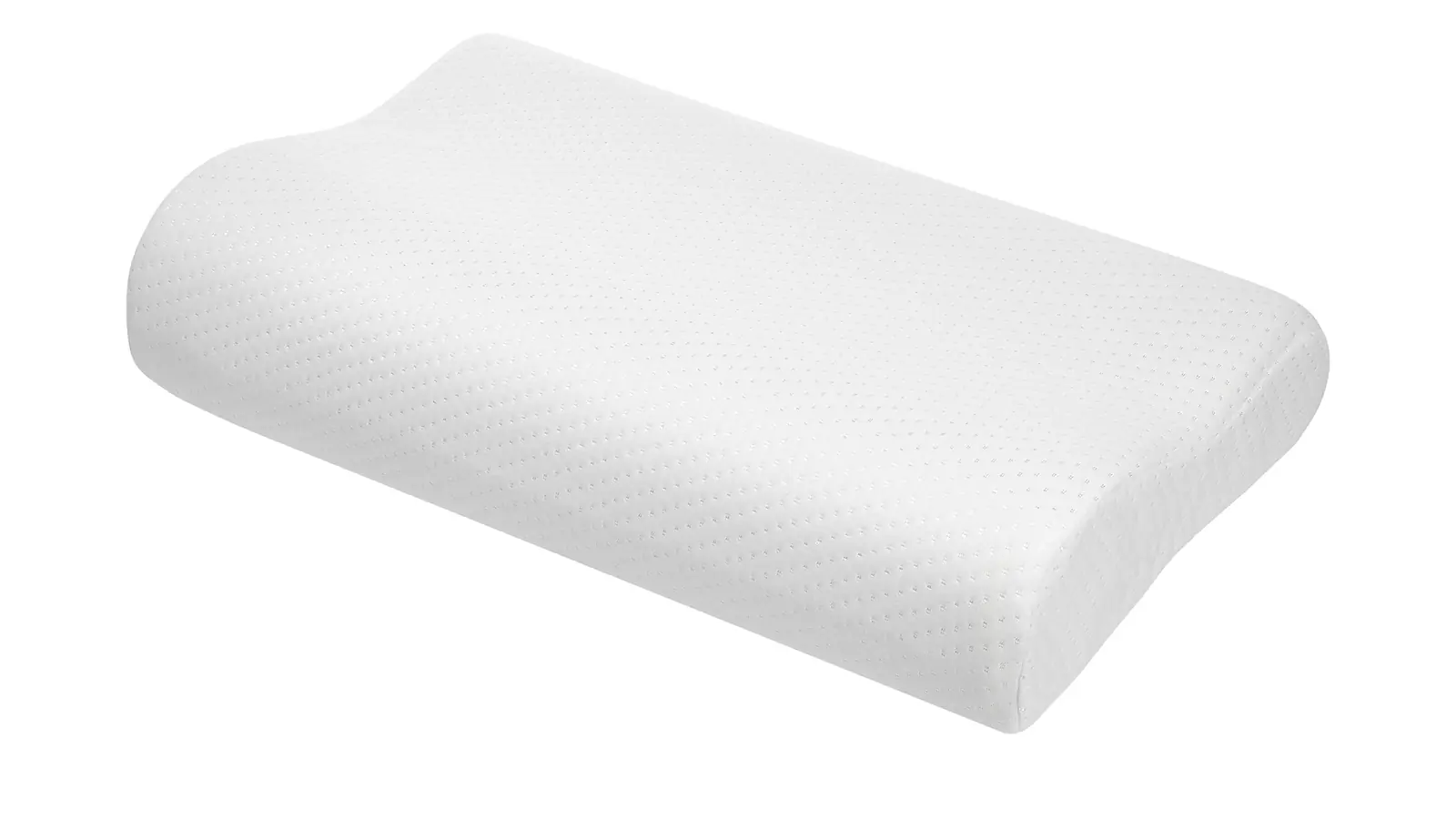
How to Choose a Pillow for Side Sleepers
A shoulder cutout or a side-sleeper label can narrow the search, but neither guarantees a fit. Describe what you want to change, then compare height under use on your own bed.
By DecoraMintPublished 4-minute readMore in Pillows

In this guide
A common workaround for side sleepers is folding a flat pillow in half, or stacking two, to make up the height. The stack shifts and slumps as you move. What you are trying to do is simple enough to state: when you lie on your side, there is a gap between your ear and the mattress, as wide as your shoulder, and the pillow’s job is to fill it.
Loft is the number that matters
Sleep Foundation’s side-sleeper pillow guide says most side sleepers need a medium to high loft, usually a pillow at least 4 inches thick, and that broad shoulders may call for more than 6. It adds that a very thick pillow can tilt the head up as awkwardly as a flat one lets it drop. Those figures come from one publisher’s testing, and it notes that deep sinkers may find even 4 inches too high, so treat them as a starting range.
Three things move your own number. Shoulder width is one, since a broader shoulder makes a wider gap. The mattress is another: on a soft bed the shoulder sinks and the gap shrinks, while on a firm bed it widens. And pillow compression matters, because a high pillow that flattens under your head fills less than its listed height suggests. Published loft is measured unloaded, and a soft down pillow and a dense molded one can start at the same height and settle very differently.
That is also why an adjustable pillow can suit a person who is unsure. Saatva’s Latex Pillow comes in Standard and High Loft versions, which shows how a single design may be offered in two heights; whether the taller one is right for you depends on that gap.
Shapes and what they change
A cutout or crescent edge reshapes the outline near the shoulder so the pillow can sit closer to it. Coop’s Original Adjustable collection offers Classic, Crescent and Cut-Out versions, with the last two aimed at side sleeping. A shaped pillow has a right way round, so it only helps if you will use it that way and keep it there when you turn over.
Adjustable pillows let you remove or add fill. Sleep Foundation names shredded memory foam and buckwheat as fills that suit this, because you can tune height to your shoulder. Only open a pillow whose maker designed it to be opened, and never cut into a sealed core. A zipper on the outside is often just the cover.
| Design | What it gives you | What it asks of you |
|---|---|---|
| Fixed rectangle | Familiar shape, no orientation | You must pick the right height up front |
| Molded or contoured | Defined edges and a fixed outline | Right-way-round placement; harder to flip |
| Removable fill or layers | Tunable height | Storing spare fill and re-fluffing |
| Cutout or crescent | Closer fit at the shoulder | A case that fits the shape |
On the bed
A side-sleeping pillow is often a taller one, and it changes how the bed looks in the morning. A lofty pillow standing at the head of a made bed sits proud of the headboard line, so a plain white case in a smooth percale keeps the look calm, while a heavily textured or piped case adds bulk to something already tall. If you also use decorative pillows, put them away at night, since two stacked layers on a high-loft pillow lift your head too far.
If you want a long pillow to hug or to place between your knees, that is a different tool; our body pillow guide covers it.
Trying one at home
Before buying, settle what you want to change, such as less height than your current pillow, a washable cover or a shape that turns over easily. Then judge it on your usual mattress in your usual position, with the pillowcase you will use. Notice whether you keep the pillow centered without folding it, whether the edge presses on the shoulder, and whether the filling stays under your head. If the pillow differs from your old one in both height and material, you will not know which change you are feeling, so change one thing at a time where you can. A cooling cover mostly changes the first touch and cannot fix the wrong height.
Read what a trial actually allows. A return window for unopened bedding is different from a sleep trial, and a third-party retailer may follow rules unlike the maker’s. Care labels differ by part: the cover may be washable while the core is not, and a certification applies only to the component it names.
Neck and shoulder symptoms
Pillow shopping cannot tell you what causes neck pain. A 2021 systematic review looked at pillow designs and neck-related outcomes, which is a different question from which pillow currently on sale suits you, and its abstract gives no basis for naming a best pillow for neck pain. MedlinePlus lists arm or hand weakness, numbness or tingling as reasons to contact a health professional. If a pillow is uncomfortable, stop using it, and see a clinician about pain that persists or keeps returning.