Runner Rugs: How to Fit a Hallway Without Blocking the Way
The longest runner that fits between two walls is not always the right one. Follow the route people walk, check door clearance and corners, then choose width and construction.
By DecoraMintPublished 6-minute readMore in Decor
In this guide
We may earn a commission from links on this page, at no extra cost to you. Affiliate disclosure
A good runner reads as a path. In a hallway it draws the eye from the front door toward the room beyond, with a ribbon of bare floor along each side to frame it; in a galley kitchen it lines up with the cabinet fronts and gives the sink a cushioned place to stand. Run it wall to wall and the frame disappears. Stop it well short of both ends and it looks like a bath mat that wandered off. Proportion and footing matter more here than pattern.
Proportion in the hall
Measure the clear width between baseboards, then note everything that narrows it: a console, a radiator cover, a door that opens into the hall. To find the floor that will show on each side of a centered runner, subtract the runner’s width from the clear width and halve the result. A 24-inch runner in a 36-inch hall leaves 6 inches a side, a 30-inch runner in a 42-inch hall also leaves 6, and in a 48-inch hall it leaves 9. That is arithmetic for one placement, and in a hall that is already tight, leave a little more, because a runner that nearly meets the baseboards looks cramped. A console can pull the visual center away from the wall center, so decide whether the walking route or the architecture should guide the rug, then look from both ends of the hall.
Length follows the same logic. Ruggable’s runner guide lists runners of 7, 10 and 12 feet in 2.5-foot widths, which is one maker’s range. Measure your own hall and choose the nearest length that leaves floor showing at both ends. A slightly shorter runner often looks better than the longest one that fits, particularly if it stops before a busy door instead of putting an edge in the swing. Ending at a doorway or a change of floor level gives the rug a natural stopping point; it never has to continue through every threshold or touch the living-room rug.
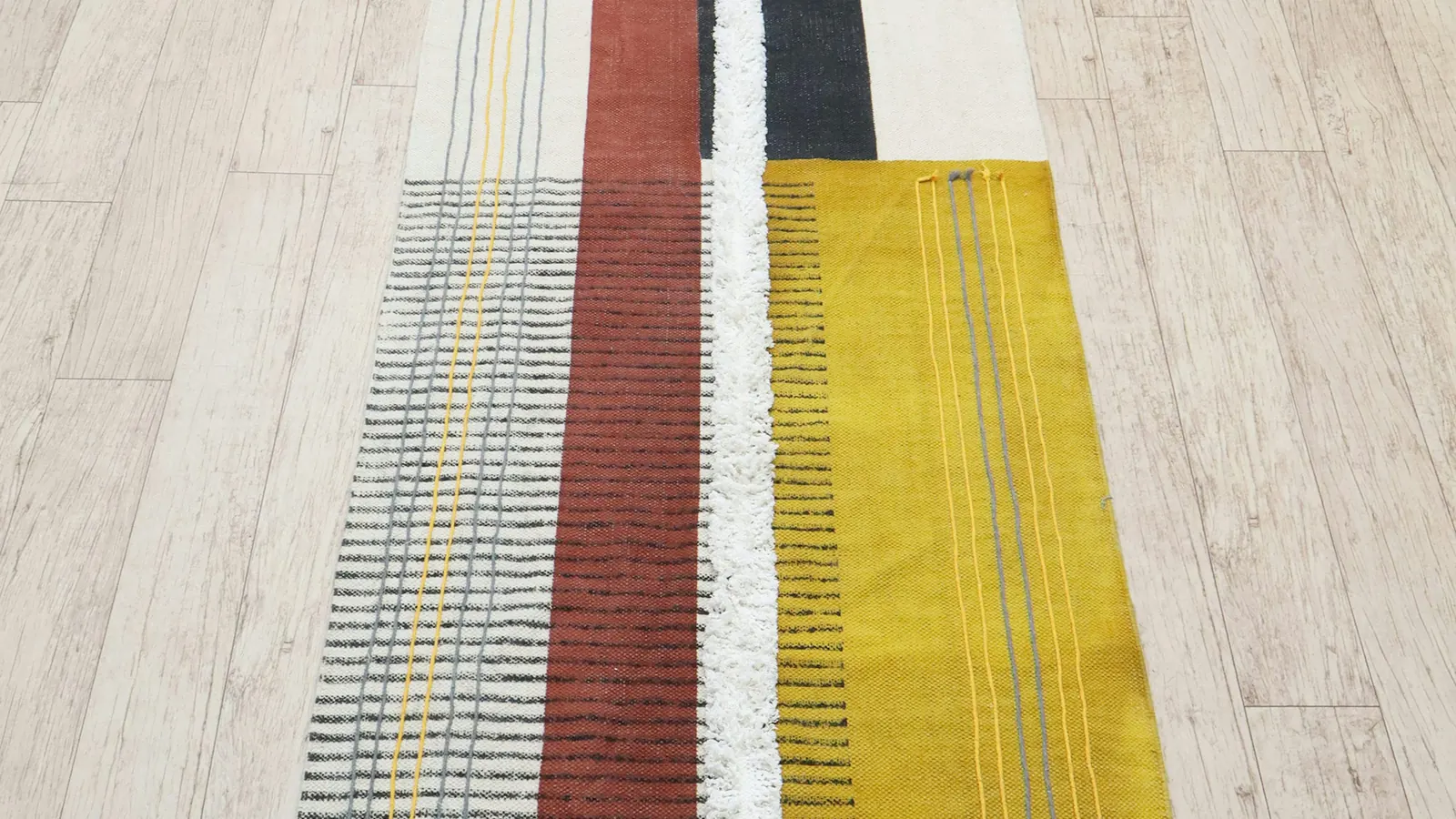
Made-to-order runners tie width to length, which changes the arithmetic. On BENI’s runner pages, the 2.5-foot width runs from 5 to 8 feet long and the 9- and 10-foot lengths come only 3 feet wide. A 30-inch runner leaves the 6-inch frame in a 42-inch hall, but the longer 36-inch pieces need a 48-inch hall to keep the same band of floor on each side; BENI’s own guidance for entries suggests at least 4 inches between rug and wall. BENI’s Runners collection shows the range in hand-woven wool, and its construction labels matter more than the photos: Zahara flatweaves about 0.4 inch thick, designs offered in either Zahara or Atlas Low (a knotted pile of about 0.75 inch), and many in the full Atlas pile of about 1.25 inches, which the door test below may rule out. A lengthwise stripe in the flatweave pulls the eye down the hall toward the far door, while the knotted pile softens the light along its surface and reads as a warmer, heavier strip against pale boards. For a hall longer than the standard sizes allow, BENI handles custom sizes by email. Each runner is woven to order, with 14 to 18 weeks quoted for Zahara, and orders are final 24 hours after purchase, so tape the outline before choosing a length.
Doors, corners and the turn
Tape out the footprint with painter’s tape and walk it, opening every door through its full arc. Pile height understates what a door meets, since backing, pad, fringe, raised pattern and any curled edge all add height, and a door that clears at the hinge may catch farther along its swing. A rug will not flatten with use enough to rescue a marginal fit. Where clearance is tight, choose a flatter weave, move the rug or leave that stretch bare. Keep the pad the maker requires, and leave the door alone. Test closet doors from where you stand to dress, because a hall can look roomy with everything shut.
An L-shaped hall calls for one runner per leg with a gap at the turn, or a single runner along the longer leg and a bare corner. Outline two runners before buying and watch where people change direction; an improvised overlap makes a ridge across the route.
The kitchen runner
Run the rug parallel to the counter, a short distance from the cabinet bases, so it shows beyond a person’s feet at the sink and stove. Open the dishwasher and oven doors over it before you commit, since a door dropping onto a rug is a snag. A flat weave suits the room because it lies low under the doors and copes with the occasional wash. For rooms beyond the hall, our rug-size guide covers proportions.
Stairs
Keep loose hallway runners off steps. A stair runner is made to be fixed to the treads, so follow the installation instructions for the product you buy and treat the fitting as part of the purchase. The same caution applies at a landing, where a loose rug at the top or bottom of a flight is the one most likely to cost someone a fall.
Footing
The National Institute on Aging’s fall-prevention advice for older adults recommends avoiding small throw rugs and fixing carpets firmly to the floor. Where a runner stays, make it behave:
- Use the pad the rug’s maker names, or a gripper sized to sit just inside the edges, and make sure backing and pad suit your floor, including any curing period on a newly finished surface. A gripper sold as nonslip can still be the wrong one for your finish, so follow its instructions for use and removal.
- Press corners flat. A curling corner is where toes catch, so fix the pad rather than nudging the rug back each week.
- Keep the run clear of clutter, and if anyone uses a walker or wheelchair, leave a bare route.
Pattern, pile and washing
On a long, narrow shape, stripes and repeating patterns lead the eye along the hall, while a plain flat weave lets floor and trim carry the room. A directional pattern makes the route read as continuous, so decide which way it should face before placing furniture, and a boldly patterned runner can be the hall’s main decoration and spare a narrow console from crowding. Low pile suits traffic and doors. A deeper pile feels good underfoot but needs more clearance, and fringe and raised or carved patterns are worth testing against how the route is actually walked. Choose color last.
A washable runner suits a hall that takes muddy shoes. Ruggable’s care guide separates its all-in-one rugs, washed whole, from its two-piece rugs, where only the cover goes in the machine (cold, delicate cycle) and the pad is spot cleaned and air dried. It puts runners in the group needing about one dryer cycle of 45 to 60 minutes on low, and says a rug that slides after washing may still be damp. Think through the whole routine before ordering: moving furniture, lifting the runner, washing the right piece, drying it fully, laying it back flat. Spot cleaners that suit the floor may harm the rug’s fibers or backing, so follow both makers’ advice, especially where moisture could sit underneath. Keep the hall passable while the runner is off the floor, with no loose pad or curled edge left where people walk.