Sliding Door Blinds: Choose by Access, Stack Space and Light
Whatever you choose has to let people use the door every day. Compare vertical blinds, panel tracks and vertical cellular shades by draw direction, stack space and privacy.
By DecoraMintPublished 5-minute readMore in Blinds & Shades
In this guide
A window covering only has to look good and manage light. A sliding door covering has a third job that outranks both: getting out of the way, many times a day, so people can walk through. That is why the best choices for patio doors move sideways with the door, vertical blinds, sliding panel tracks and vertical cellular shades, and why the real decision is where all that material sits when it is open.
Get the stack on the fixed pane and the door feels effortless. Put it over the opening side and everyone ends up brushing past fabric on the way to the deck.
Watch how the door gets used
Stand inside and note which panel slides and which stays put, where the handle is, and which way people walk out. Then look at the walls beside and above the frame. A treatment that stacks off the glass needs wall space to land on; without it, the open stack covers part of the view.
Blinds.com’s patio door guide groups the options that move horizontally with the door, a sensible starting shortlist. From there, it comes down to three practical things for your opening: the stack width when fully open, the draw direction, and whether the wand or control sits where you can use it without stepping into the path of the sliding panel.
Vertical blinds: the adjustable classic
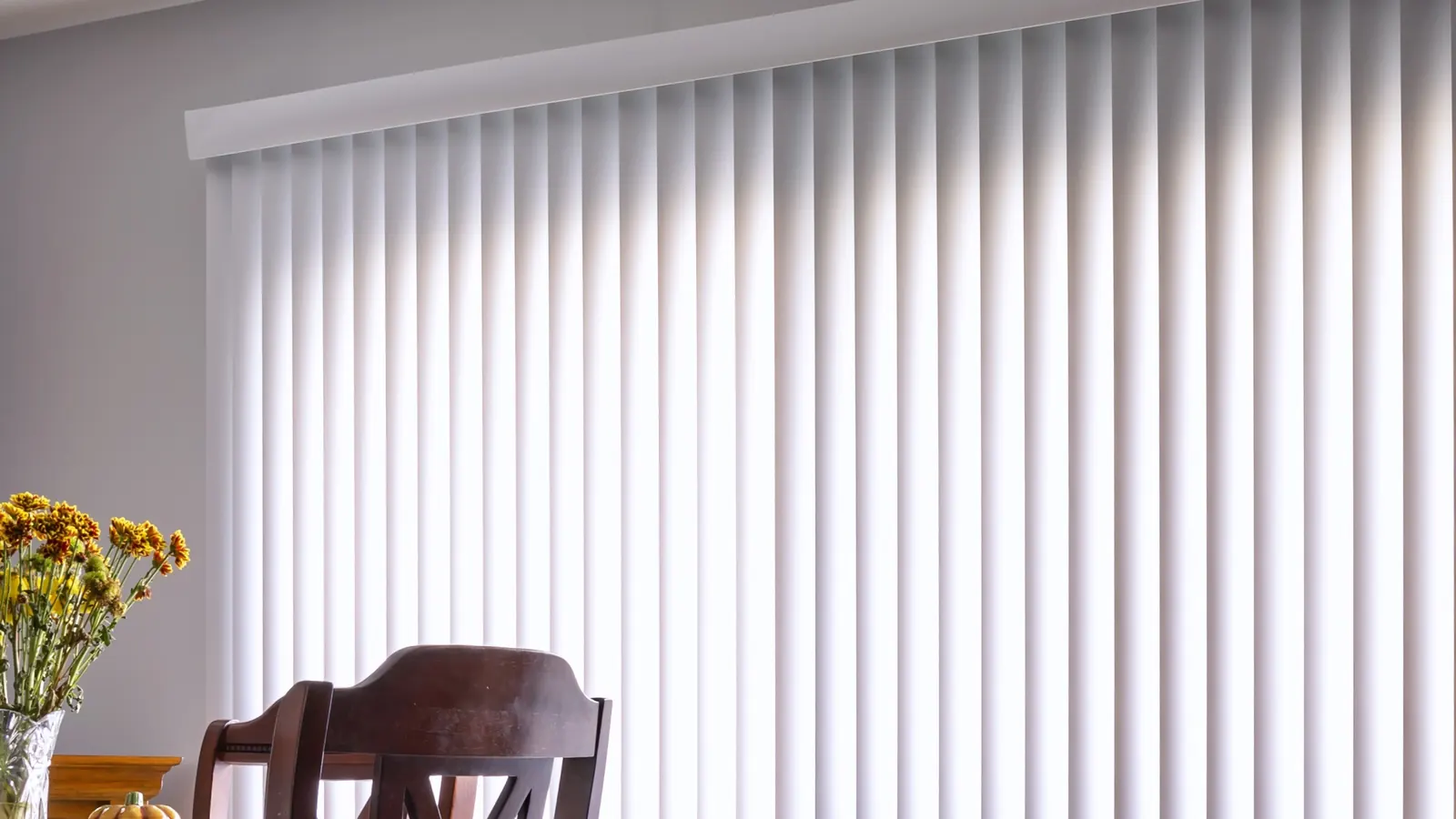
Upright vanes tilt to angle the view and cut glare without uncovering the whole door, then draw aside for access. On a west-facing slider in late afternoon, that tilt is genuinely useful: turn the vanes and the sun is blocked while light still reaches the room. Fabric vanes soften the look considerably compared with the shiny vinyl many people picture, so look at real samples before writing the style off.
They are also the easiest to repair on a busy doorway, since a single damaged vane can often be replaced. Turn the vanes open before drawing the blind if your instructions call for it; dragging closed vanes across can damage the carriers.
The control is the part to choose carefully. Vertical blinds, and some panel tracks, are still sold with a continuous loop of cord or bead chain, and on a patio door that loop hangs at a child’s height right beside the handle. Window covering cords can strangle young children. The Window Covering Safety Council recommends only cordless coverings where infants and young children are present, keeping cribs, beds and furniture away from windows, and permanently anchoring any continuous-loop cord on draperies or vertical blinds to the floor or wall. A wand that turns the vanes and draws the blind is the simpler answer at a door.
Panel tracks: wide, calm planes of fabric
Panel tracks hang broad flat panels that slide past each other on a multi-channel track, like Japanese screens. Across a big expanse of glass they look clean and architectural, and the wide panels show off a textured weave or a bold print. That same scale means a strong color becomes a very large block when closed, so pick fabric with the whole wall in mind.
Overlapping panels still need space when open. The figure that matters is the fully open stack width, not the track length or the number of panels; check also where the bottom edges sit relative to the threshold and any rug.
Vertical cellular shades: soft and continuous
These turn a honeycomb shade on its side so the pleated fabric glides across the opening. When closed, you see one uninterrupted soft surface instead of separate vanes, which suits a bedroom or a quieter, more tailored room. Light-filtering and blackout fabrics both exist, but the options depend on the product. If insulation is your reason for choosing one, ask for ratings on the exact door-sized product; numbers quoted for small window shades do not transfer automatically to a full-height door.
Check how much space the operating rail needs next to the handle and how the shade stays aligned across the full width.
Curtains on a track
Traversing curtains bring the most softness and color to a large sheet of glass, and can be layered with a sheer behind them if the hardware allows. Fullness is their cost: drawn aside, a generous curtain takes real wall width, and a rod that barely extends past the frame leaves fabric over the glass even when “open.” Ask for the stack width for your chosen fabric, lining and heading.
Keep hems off the floor and well clear of the door track and handle. A puddled hem is pretty at a window but a nuisance at a patio entrance used with muddy shoes or a dog, and a washable fabric earns its place on a route the dog uses daily.
Roller shades, used with care
A roller rises and falls, so a single shade across a busy door must be raised every time someone goes out. That can be fine for a door you rarely use. Two separate rollers, one over each panel, let you raise only the access side, at the price of a visible gap between them. Check that the door frame leaves room for brackets and controls, and remember that solar-screen fabrics keep the view by day but offer little privacy once the lights are on inside.
Draw direction
Left draw, right draw and split draw decide where the open stack ends up. Describe the direction as seen from inside the room, unless the seller says otherwise, and confirm it on a sketch. Stacking toward the fixed panel is usually the logical choice, since it keeps the opening clear, but a nearby wall, light switch or sofa can change that, so look at the whole wall before deciding.
For very wide openings or doors with more than one moving panel, get a drawing of the fully open and fully closed arrangement at your size, not a photo of a smaller door. Once everything is installed, run the door and the covering through their full movement together: nothing should catch the handle or lock, and nothing should drag.
Measuring
Sketch the door and label the fixed and moving panels. Record the width and height, the mounting space above, the clear wall on each side and how far the handle projects. Then use the measuring instructions for the treatment you choose, because vertical blinds, panel tracks, curtains and cellular shades each use different deductions. The quote should state the finished headrail or track width, the drop and floor clearance, the open stack width, the bracket projection and the control location.
Light, color and evening privacy
A patio door is the biggest dark mirror in the house once the lamps come on, and from the garden every gap shows. Sheers and open weaves cut glare by day but are not a privacy layer at night. Blackout fabric stops light through the material, yet light still leaks between vanes and around tracks, so a media room or bedroom slider may need a curtain on top.
Color matters more on a door than on a window simply because there is so much of it. Hold a sample against your floor and walls, in daylight and under your usual evening lamps, and favor a shade that relates to the floor or wall rather than fighting both.