Vertical Blinds: Choose Vanes, Controls and a Useful Open View
Vertical blinds rotate for light and slide away for a clear opening. Decide which you need, draw where the vanes stack and choose controls people can reach.
By DecoraMintPublished 5-minute readMore in Blinds & Shades
In this guide
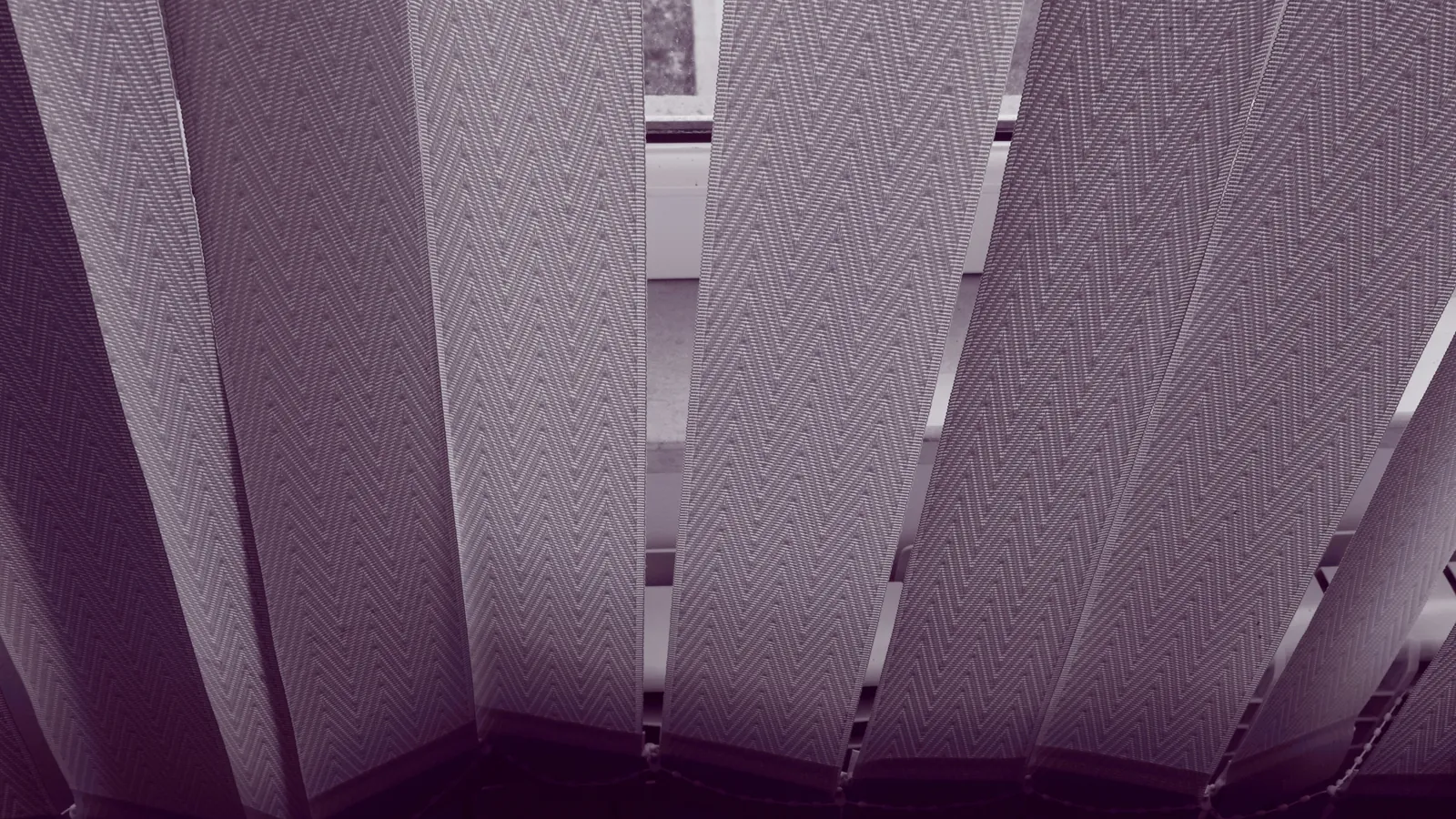
Vertical blinds are the common blind that tilts and then draws sideways like a curtain, and that one fact drives every decision about them. Where the vanes gather, how you turn and slide them, and what the stack hides all matter more than the finish. A tall hanging vane also reads very differently from a horizontal slat: the eye runs up and down the window, so it can make a low ceiling feel taller, and a strong pattern repeated across dozens of vanes becomes the loudest thing in the room.
This is a selection guide built from published information, without hands-on testing or a ranked list. Our window treatments collection shows other ways to dress the same opening.
Rotation, a clear opening, or both
Think about your daytime position and your fully open position separately. A living-room window may stay covered most of the day, with the vanes turned a little as the sun moves. A window over a garden may be uncovered whenever possible. The first routine cares about how the vanes look when angled and closed. The second cares about where the stack lands.
Sit where you usually read or watch a screen and note which stretch of glass gives the view you value. A stack over a blank strip of wall-side glass costs little; the same stack over the only garden view is a daily irritation. On a sliding door the moving panel and walking route matter as well, so keep the handle and doorway usable and do not copy a window layout onto a door.
LEVOLOR’s installation instructions illustrate one-way, dual and center stacks, so the choice is wider than left or right. Sketch the window, shade the area where the opened blind would gather and ask the supplier for the stack size at your width. A photograph of someone else’s window will not tell you.
Vanes as a visible surface
A single sample shows color; several vanes hung side by side show how a pattern reads. A narrow stripe, an embossed motif or a reflective finish can turn much louder when repeated. Look at the sample from the sofa as well as at arm’s length, then compare it with the biggest nearby surfaces, the wall, sofa and floor, instead of matching a small accessory.
A living room with a warm white wall, a gray sectional and pale oak flooring suits vanes in a woven-look cream with a faint texture which soften the glass, fade into the wall when closed and throw a gentle stripe of light across the floor when angled. In a home office with a dark desk and a monitor, narrow gray vanes in a matte finish cut glare without adding a pattern to look at all day, and the clean vertical lines sit well beside a bookcase.
Names such as linen, oak or brushed metal often describe a look, not a fiber or a real wood or metal, so ask for the composition if you specifically want PVC or fabric. Check what the other side of the vane looks like, since the street sees it. Light-blocking depends on the whole installation: gaps between vanes and at the sides remain, so a darkened bedroom needs more than an opaque sample.
Mounting and measuring
Inside mounting keeps the trim visible, and outside mounting changes how the blind sits against the wall and the opening. Either needs a surface that can take the headrail, with room for it to clear handles, a deep sill or a cabinet. Ask the supplier to state which dimensions it manufactures from, because a recess measurement, a finished blind height and a replacement-vane length are three different numbers. Look at the quoted headrail or valance too; a sample of hanging vanes hides what the top of the window will look like.
Controls and cord safety
Try the control from where you will stand. A wand beside a deep desk or behind a large chair can be awkward even though it fits. Controls come as a wand, which turns and slides the vanes with no loop at all, or as a looped cord or chain. The CPSC’s window-covering guidance recommends cordless coverings and keeping beds, cribs and furniture away from windows, because cords can strangle young children. Where a looped chain or cord is used, the CPSC says to anchor it to the wall or floor with a hold-down device so it stays taut but still works; that reduces the hazard without removing it, so a wand is the cleaner answer wherever children live or visit. Open the vanes before drawing them across and do not force the control; LEVOLOR’s instructions require this. Look over the finished blind for any other accessible cord or chain, including one joining the vane bottoms, before you hang it.
Furniture and doors in the swing zone
Vanes need room to turn, so leave space beside a desk for them to swing without brushing papers, equipment or plants on the sill. In a dining area with a window or patio door nearby, check the chair positions when occupied and pulled back, because a blind should not depend on everyone keeping a chair in one exact spot. At a door, test access with the door moving as well as with the blind open, which are separate actions.
Cleaning and repair
Care depends on the vane material, so choose a finish you can keep clean in that room. Before buying, find out whether replacement vanes are sold separately with an identifying number or profile; a yes, and a range that is still current, is what you want. A part that merely looks similar may attach differently. When the headrail still works and only a few vanes are damaged, replacing those is often more sensible than buying a whole blind.
What a quote should include
Put collection and color, composition, finished size, draw and control arrangement, expected stack, headrail or valance, mounting requirements, installation and care on one page. A price for vanes alone is not comparable with an installed treatment, and a standard configuration may not suit an unusual opening.
For a wide span behind a sofa, we would choose a wand control and a split stack, so nothing hangs where people walk and the sofa stays clear.