Weighted Blankets: Compare Weight, Size and Construction
Choosing a weighted blanket is more than picking a pound rating. Make sure you can move it comfortably, compare size and construction and plan how it will be washed.
By DecoraMintPublished 6-minute readMore in Bedroom
In this guide
We may earn a commission from links on this page, at no extra cost to you. Affiliate disclosure
Before thinking about pounds, ask one question: could you push this blanket off and get out from under it easily, half asleep, in the dark? A weighted blanket is meant to feel like a firm, even pressure across your body, the sensation some adults describe as being tucked in tightly. It only works as comfort if it never feels like being held down. Choose a weight you can lift, fling aside and carry to the laundry without strain, then compare size, construction and cleaning.
This is adult bedding. The CPSC’s safe-sleep guidance says infants should not use weighted blankets or weighted swaddles, and this guide sizes blankets for adults only; for any child, ask a pediatrician first. Weighted bedding must never be used as a restraint.
What the weight does, and does not do
Separate the pressure from the warmth. A weighted blanket adds both, but if what you mostly want is a warmer bed, an ordinary quilt or throw gives that without the bulk. And a weighted blanket is not a treatment. The Royal College of Occupational Therapists’ guidance describes mixed and limited evidence for weighted blankets and stresses individual assessment. If a health condition affects your breathing, circulation, temperature regulation, movement or alertness, talk to a clinician before using one; Northwestern Medicine advises against them for people with certain heart, lung or mobility conditions.
The 10 percent rule, as a starting point
The figure you will see everywhere is about 10 percent of your body weight. Northwestern Medicine calls it a general rule of thumb and notes that preference for a lighter or heavier feel can shift it. Treat it as a place to begin comparing, never a target to exceed: if you are between two weights, the lighter one is the safer bet, and the RCOT guidance recommends following the maker’s weight and size instructions. If you feel trapped, uncomfortable or short of breath under it, stop using it. Do not pile other heavy blankets on top to add weight, and do not combine a weighted blanket with a heated blanket, which Northwestern Medicine also advises against.
Size changes how the weight feels
The same total weight feels different over different areas. A compact blanket concentrates its mass over a smaller surface; a larger one spreads the same pounds thinner. Some weighted blankets are sized to cover one person on top of the bed, others to span a mattress, and RCOT advises avoiding overhang during use, so a blanket that drapes over the sides like a comforter is the wrong fit. Read the finished width and length, not just a “queen” or “throw” label, and lay out a tape measure on your bed or sofa to see the actual coverage.
For a shared bed, two personal blankets usually make more sense than one heavy one. Two people can easily want different weights or coverage, and adding two body weights together to choose a shared blanket only makes it harder for either person to move it.
Quilted bead pockets or a chunky knit
Quilted blankets hold glass beads or similar fill in a grid of stitched pockets, so the weight stays spread out instead of pooling at one end. The surface is flat and smooth, like a padded quilt, and it often comes with a separate removable cover. Check how the cover attaches, with ties or loops at the corners, and that it is cut to the blanket’s exact size. When it arrives, inspect the seams; if beads leak or a pocket splits, stop using it and contact the seller instead of repairing it yourself, and keep loose beads away from children and pets.
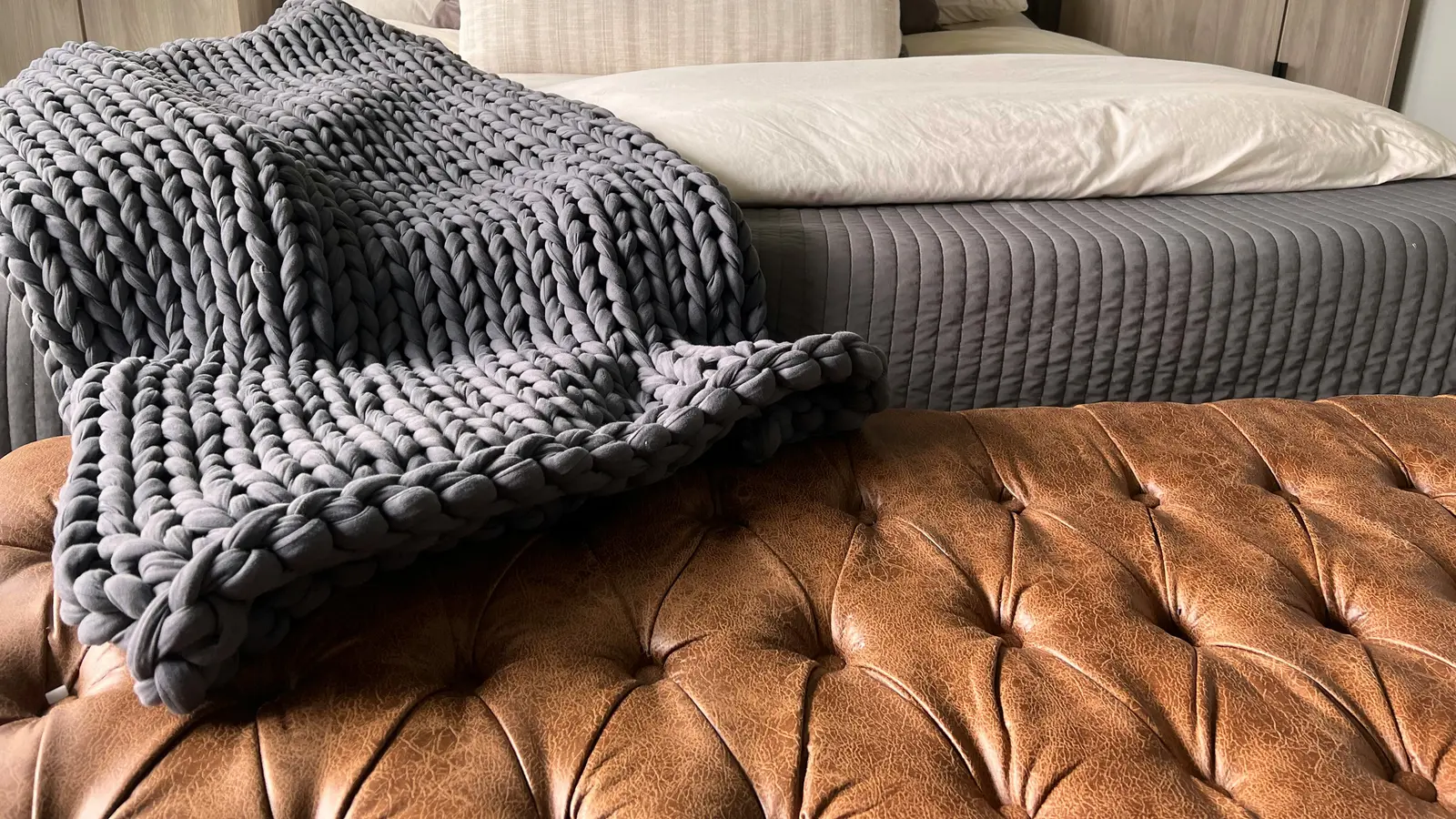
Knitted blankets get their weight from thick, densely knitted yarn and no loose fill. They look like an oversized cable throw, with deep loops that look good draped over the foot of a bed (in use, avoid overhang), and the open knit lets air through. That texture suits a sofa as much as a bed. Care varies even within one brand: the Bearaby FAQ describes machine washing for some of its ranges and different recommendations for its velvet versions.
If you run warm, look at the whole bed: a weighted blanket on top of a duvet and a warm room adds up quickly.
So the split comes down to two things. A quilted blanket keeps the weight even across a flat surface and usually lets you wash a cover more often than the insert; it reads as a tidy, padded layer on a made bed. A knit has no loose fill to leak and lets air through its loops, but it is washed as one heavy piece and its chunky texture dominates whatever it lies on. If you run hot, the knit is the construction to look at first, even though this guide has no knit to link to; if even pressure and an outer layer you can wash on its own matter more, look at quilted, and check whether the cover is included.
One quilted option to compare
ZONLI is an advertiser available through this site’s affiliate links, and we may earn a commission if you buy through them. Its BalanceFlow Weighted Blanket listing describes glass beads in high-density stitched pockets, double-lined in cotton padding, with a mesh face on one side and ribbed microfiber on the other, so you can choose between a smooth, cooler-feeling surface and a softer one. The maker’s description offers no evidence of a sleep benefit, a measured cooling result or long-term durability, and we have not tested it.
Run the sizes and weights through the earlier sections before ordering. The listing offers 15- and 20-pound weights and 48-by-72-inch and 60-by-80-inch sizes; check that the exact combination you want is available. By the 10 percent rule of thumb, 15 pounds is the starting point for an adult of about 150 pounds and 20 for about 200. If you weigh noticeably less than that, 15 pounds is already above the starting point, so ask the retailer whether a lighter weight is offered or look at another brand rather than rounding up. On size, 60 by 80 inches is the full surface of a standard queen mattress, so on a queen it reaches the edges and on a full or twin it hangs over; for one sleeper, lay out the 48-by-72-inch footprint with a tape measure before assuming the larger one is better.
The listing also suggests the blanket as a gift for family members including children. This guide’s weights and sizes are for adults; for a child, the pediatrician advice at the top of this guide applies.
Will it fit your washer?
A heavy blanket can exceed what a home washer or dryer is built for. Read the blanket’s care label and your machines’ load limits together; Bearaby specifically advises checking washer and dryer capacity for its heavier blankets. A removable cover can usually be washed far more often than the weighted insert, and its instructions may not apply to the insert. If neither fits your machine, factor a laundromat’s large-capacity washer or professional cleaning into the cost, and decide where the blanket will dry flat if it cannot go in a dryer.
As an example of what to read, the BalanceFlow listing says the blanket itself is machine washable in warm or cold water, with dry cleaning if necessary, and can be hung dry or tumble dried on low. It also recommends a removable duvet cover for easier cleaning, but the product page’s options are color, weight and size only, so budget for a cover separately. At 15 or 20 pounds dry, and heavier wet, compare that weight with your machine’s rated capacity before the first wash.
The push-off test
On arrival, check the weight and size label against your order and keep the instructions. Then judge it against the reason you bought it: do you enjoy the pressure, can you reposition it easily, is the fabric pleasant against your skin? If you keep pushing it off, it is too heavy or too hot for you, and a lighter weight is the fix to try.
The picks
Prices and availability update from the retailer feed.

Quilted glass-bead blanket, reversible
ZONLI BalanceFlow Weighted Blanket
Glass beads sit in high-density stitched pockets over cotton padding to spread the weight evenly. One face is a mesh the listing calls cool and breathable, the other a ribbed microfiber, so you choose by season. It is machine washable, and the listing recommends a removable cover, sold separately.
Price as of