Blackout Roman Shades: Linings, Fold Styles, Light Gaps and Safe Lifts
How blackout Roman shades are made (lining, blackout fabric or separate liner), how fold styles differ, where light leaks, stack height, cordless lifts and measuring.
By DecoraMintPublished 8-minute readMore in Blinds & Shades
In this guide
We may earn a commission from links on this page, at no extra cost to you. Affiliate disclosure
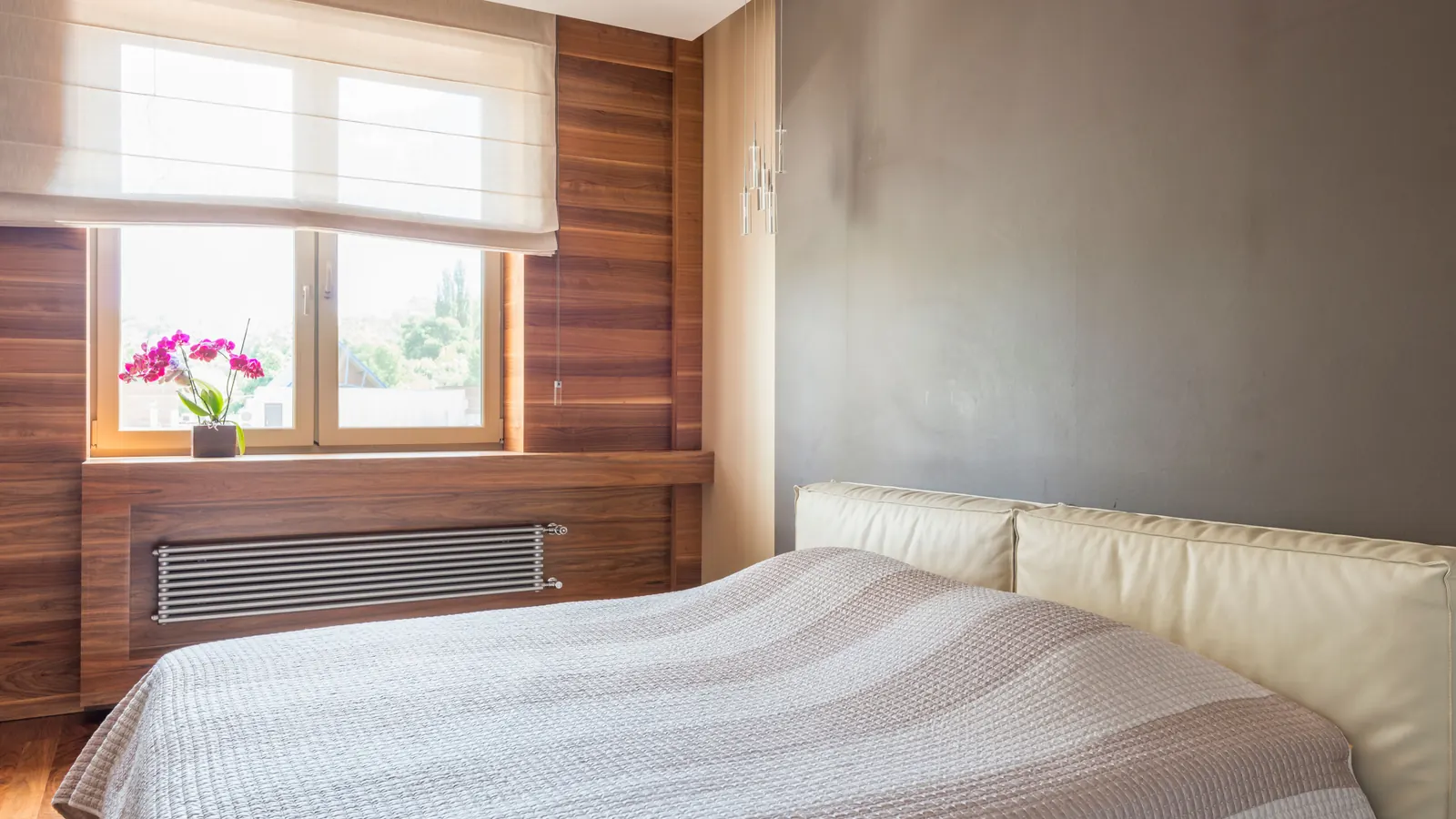
Picture a bedroom at 5:30 on a June morning: the sun is already up, and a soft linen Roman shade glows at the edges like a lampshade. The fabric may be completely opaque, yet the room is not dark, because light is coming around the shade and through tiny stitch holes. A blackout Roman shade can give you a properly dark sleeping room that still looks tailored by day, but only when it is ordered as a whole system.
The darkest version to order
If sleep is the reason you are buying, this is the specification to ask for:
- A flat fold, which lowers into a smooth panel with a straight bottom edge that meets the sill.
- A sewn-in blackout lining behind the face fabric you love.
- Folds attached without stitching through the lining, or as few penetrations as the maker offers.
- An outside mount overlapping the frame by about 2 to 3 inches on each side, a common guide.
- Mounted a few inches above the frame, so the raised stack sits on the wall instead of the glass.
- A cordless or motorized lift.
Each choice closes a different route for light, and each has a look-or-practicality cost. The sections below explain them, and when you might trade one away.
Light around the shade
Blackout fabric stops light passing through. It does nothing about light going around, and that is where most morning glow comes from.
An inside mount, with the shade tucked within the window frame, looks crisp and architectural. It also needs a little clearance to move, so a thin bright line runs down each side, and light can slip above the headrail too. Even a maker that works on that gap leaves one: the size table for Persilux’s cordless Roman Blinds lists 0.43 inch under “gaps on both sides”, and the page says its metal fittings are there to keep the gap small. Small on paper, it is still a bright line at 5:30 in June. An outside mount fixed to the wall or trim and made wider than the opening covers those gaps. If the sill is out of level, a strip can still show under the bottom rail; layering curtains over the shade solves that and adds a soft frame to the window at the same time.
So the inside mount is the one to trade away first. Keep it for a room where neat lines matter more than total darkness, such as a nursery nap room that only needs dimming, or a living room.
Light through the shade
“Blackout” on a product page can describe three constructions. A sewn-in lining puts an opaque layer behind any face fabric, so a textured linen or a print can face the room; it adds bulk. A blackout fabric is opaque in itself, coated or very dense, which keeps the shade slimmer but narrows your fabric choice. A separate liner hangs behind the shade on its own and can sit closer to the glass, at the cost of more hardware.
The sewn lining is the most flexible, with two details to watch. On some shades the rings or rods that form the folds are stitched through it, and each stitch can show as a pinprick of light, so ask how the folds are attached if the room must be truly dark. And the lining is what the street sees: white or off-white linings keep the outside of the house looking even from window to window.
Persilux happens to sell Romans built both of the first two ways, which makes the difference easy to see. On its Roman Blinds the blackout is a lining: a Lining Type option offers no lining, a privacy lining or a blackout lining, which the retailer says block about 40 to 50%, 60 to 80% and 100% of light, behind a face the page describes as natural ramie. Those are fabric figures; the room result still depends on the mount.
Its linen-blend Roman and woven bamboo-look Roman take the coated route: their pages describe the blackout version as the light-filtering fabric with a blackout coating on the back. The lining route gives three steps of darkness and eleven colors on one face; the coated route gives two steps, standard or blackout, in four linen colors or three woven ones, and it makes sense when the linen-blend weave or the woven grain is the reason you want a Roman at all. The back is also where the two coated shades differ. On the woven one the coating is white behind cream and khaki and brown behind brown, so a brown blackout shows a brown back to the street. The linen page repeats that wording but names colors it does not sell, so ask which back each linen color gets before you mix them across the front of the house.
When a different fold makes sense
The flat fold wins on darkness, but it is not the only good-looking choice.
A hobbled or soft-fold shade keeps loops of fabric in place even when fully lowered, a generous, slightly traditional look that suits a guest room or a classic bedroom. With a lining, though, its raised stack gets noticeably bulky. A relaxed shade has a gentle curve along the bottom edge; it is charming over a kitchen sink or in a living room and less suited to a bedroom, since the curve can leave uneven coverage at the sill.
Whichever fold you like, look at a photo of your chosen fabric fully lowered before ordering.
The stack, and how it changes the window
When the shade is raised, its folds gather at the top into a stack. A blackout lining makes that stack deeper, a long drop deepens it again, and a heavy face fabric plus lining makes it deepest of all. For a slimmer stack, pick a lighter face fabric and let the lining block the light.
On an inside mount the stack always hides the top of the glass. Mounted outside and a few inches above the frame, most of it sits on the wall, so the window looks taller and lets in more light by day. Ask the retailer for the stack height at your drop before you fix the mounting height; it changes how the window looks in daylight more than any other number. Persilux’s three Roman pages give widths and heights but no stack height, so that question goes to its support before the order.
Measuring and ordering
- Decide the mount. Outside for maximum darkness.
- Outside mount: measure the area to cover, add the overlap on each side, and add height above the frame for the stack.
- Inside mount: measure width at the top, middle and bottom and height at the left, middle and right, then use the product’s guide to choose which readings to submit. Make sure the recess is deep enough for the headrail.
- Use the retailer’s convention. Some want the opening size and make their own deductions; others want the finished size.
Persilux follows the first convention: its guide asks for the opening size, says it makes the deductions itself, and for an outside mount suggests adding 4 to 6 inches to the width, which matches the overlap above. Its linen and woven Roman pages give more than one minimum depth for an inside mount (1.1 inches in the measuring guide, 1.8 inches in the size table for the wood track), so plan on the larger figure or confirm it before ordering inside.
Made-to-measure shades are often non-returnable, so order a fabric sample if color matters and look at it against your wall and bedding in morning light.
The Persilux details on this page come from its product pages, checked on October 27 and November 4, 2026. We have not tried the shades, the light-blocking figures are the retailer’s, and prices vary with size and options, so see the retailer’s site for current pricing.
Lifts, cords and a heavier shade
A lined Roman shade is heavier than an unlined one. A cordless lift is raised and lowered by the bottom rail, and a “free-stop” version holds wherever you let go; motorization earns its cost on wide or tall windows and ones you cannot reach, provided there is a reachable power or charging point. Make sure the lift you want is offered at your width and drop. On Persilux’s three Romans the cordless version is made from 16 to 86 inches wide and up to 94 inches long; the linen and woven size tables add a motorized version, up to 98 inches long.
Roman shades have a particular cord history: the inner cords that run down the back to lift the folds can form a loop a child can pull out, and window covering cords can strangle young children. The Window Covering Safety Council recommends cordless coverings in homes with infants and young children, with cribs, beds and climbable furniture kept away from windows. Under the ANSI/WCMA standard, stock coverings sold in the US have had to be cordless or have inaccessible cords since December 2018, and a 2022 revision, which applies to custom products made from June 1, 2024, removed free-hanging cords from them. Choose the cordless lift on a made-to-measure order, and ask how the inner cords are kept out of reach.
Keeping it clean
Care is mostly dusting with a vacuum brush on low suction, where the label allows. Find out whether spot cleaning with water is permitted before trying it, and do not machine-wash a lined or coated shade unless the maker says so: the lining can shrink at a different rate from the face fabric, and coatings can crack. For a kitchen or humid bathroom, read the care instructions before buying.
If a Roman is not quite right
A blackout roller is the slimmest when raised, though its fabric is narrower than the roller hardware, which widens the edge gaps. A blackout cellular shade can help with insulation but has a pleated, less fabric-like look. For the wider choice, read how to choose window shades, or browse more window treatments.
The picks
Availability updates from the retailer feed. Where our copy of a price is out of date, the retailer’s site shows the current one.
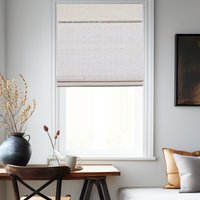
Choose from three lining levels
Roman Blinds
Lining Type is a choice: no lining blocks 40 to 50% of light, privacy lining 60 to 80% and blackout lining 100%, per the product page. It lists eleven colors and a cordless free-stop lift.

Linen blend, blackout version of each color
Linen Fabric Roman Shades
A cordless Roman shade in a polyester and linen blend. The product page lists four colors, each as a standard and a blackout version, and describes the blackout version as the same fabric with a blackout coating on the back, not a separate lining.
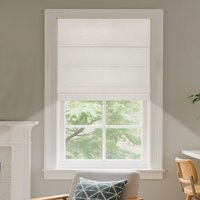
Bamboo-weave look, blackout or light filtering
Natural Woven Linen Roman Shades
Described as a bamboo-weave fabric made from polyester fibers, with a cordless lift. The product page sells it as blackout or light filtering, in cream, khaki and brown; the blackout version is coated on the back, white behind cream and khaki and brown behind brown. A woven texture instead of linen.
Retailers to browse
Compare colors, sizes, materials and return details on the retailer’s current listings.
- Browse blinds and shades at Persilux
Persilux
Opens Persilux’s blinds and shades collection, not a single product.