Cooling Weighted Blankets: What to Check Before Buying
A cooling weighted blanket is still a weighted blanket. Separate pressure from warmth, compare open knits and covers, and check the size and washing before choosing a weight.
By DecoraMintPublished 6-minute readMore in Bedroom
In this guide
We may earn a commission from links on this page, at no extra cost to you. Affiliate disclosure
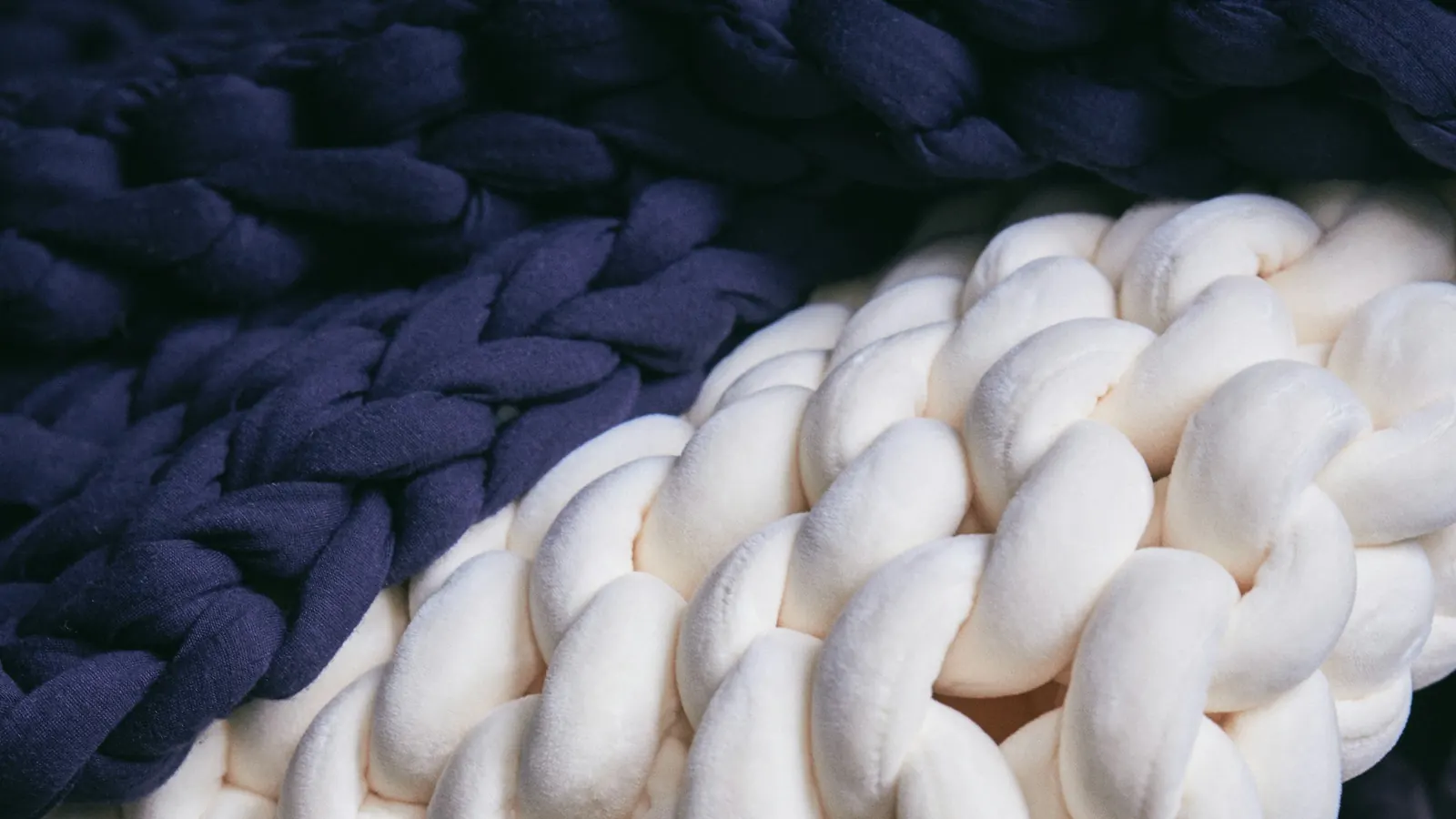
A chunky open-knit throw and a quilted blanket full of glass beads can weigh exactly the same and behave nothing alike on a warm night. One lets air through the gaps between its loops; the other spreads its weight evenly under a closed shell. That is the real choice behind the “cooling weighted blanket” label: you are still buying weight, and the cooling part comes down to how that weight is wrapped. Settle how much pressure you want first, then pick the construction that carries it with the least warmth.
If what you really want is simply a lighter top layer, skip the weight altogether and look at a conventional cooling blanket. Weight solves a different wish.
Who it is for, and who it is not for
This is adult bedding. The CPSC’s safe sleep guidance tells parents not to use weighted blankets or weighted swaddles with babies, and Penn State Health Children’s Hospital advises against weighted blankets for children under 2, with a pediatrician’s input for older children. Zippered covers carry their own risk around kids: the CPSC’s Pillowfort recall covered about 204,000 children’s weighted blankets after two girls, ages 4 and 6, became trapped inside the zippered cover and died of asphyxia; it was announced in December 2022.
For adults, Northwestern Medicine advises against weighted blankets for people with heart, lung or mobility problems and says never to combine one with a heated blanket. If you have a relevant condition, ask your clinician before buying. And treat it as a comfort purchase: it is no substitute for having persistent sleep trouble looked at.
How the weight is carried
| Construction | Where the weight comes from | What it means on a warm night |
|---|---|---|
| Sewn pockets with beads | Small fill sealed into a grid of squares | Even pressure; the shell fabric decides how warm it feels |
| Chunky knit | The mass of the knitted yarn itself | Visible open gaps; the whole piece is usually washed as one |
| Weighted insert plus cover | An inner blanket inside a separate duvet-style cover | Two layers of fabric, and two care routines |
| Reversible pocketed blanket | Beads, with a different fabric on each face | You can flip the feel, but both faces stay on the bed |
Photographs mislead here. A chunky cream knit draped over a bench may not be weighted at all, and quilting tells you nothing about the type or amount of fill. Read the specification for the exact size and weight in your cart.
On a pocketed blanket, run a hand along the seams when it arrives and again after each wash. If fill starts escaping, stop using it and follow the maker’s instructions; a split pocket only gets worse.
Reading the word “cooling”
Sellers mean different things by it: a fabric that feels cool when you first touch it, a mesh face, the airflow of a knit, or a lighter cover. Those are separate design choices, and none of them is a promise about your temperature at 3 a.m. If a listing cites a test, notice whether it covers the whole blanket or one side, and whether the conditions resemble a bedroom.
A mesh face is the most common version on pocketed blankets. ZONLI’s BalanceFlow Weighted Blanket is a clear case: its listing calls the mesh side cool, breathable and quick-drying, and the ribbed microfiber reverse soft yet warm. The product page also calls the glass beads “temperature-regulating”. It cites no test and gives no temperature figure for either, so read “cool” there as a description of the fabric against the hand, not of the night.
The rest of the bed matters as much as the label. A breathable knit under a thick down duvet is no longer a breathable arrangement. In summer, picture the weighted blanket as the top and only layer over a cotton or linen sheet; if that sounds too heavy for your room, choose a lighter weight or an open knit.
Choosing a weight you can live with
Northwestern Medicine gives roughly 10 percent of body weight as a rule of thumb and notes that personal preference can push it lighter or heavier. Treat that as a starting point, not a prescription. The practical test is simpler: you must be able to push the blanket off and get out from under it on your own, without effort.
Think about the rest of its life too. You will lift it into the washer, carry it to a sofa and wrestle it into a cover. If the heaviest option would make any of that a chore, size down. When you are unsure whether you like the sensation at all, put the return policy ahead of the weight chart. Stop using it if it feels restrictive or too warm.
Size it to the sleeper, not the bed
A weighted blanket is usually meant to cover one person, not to drape over the mattress edges like a comforter. Two blankets with the same weight can spread it over very different areas, so compare width and length in inches, not “queen” or “twin.”
Lay a tape measure where you sleep and check the footprint against your usual position. A heavy blanket hanging over the side tends to slide off and drag the rest of the bedding with it. For two sleepers with different tastes, two smaller blankets usually work better than one shared weight. On a sofa, a long one pools on the floor and gets underfoot when you stand.
Visually, a weighted blanket reads as a neat slab on the bed, so let a lighter throw or quilt handle the decorative drape and keep the weighted layer folded at the foot during the day.
A reversible option to compare
Set the BalanceFlow against an open knit and the difference shows from across the room. The knit is all gaps, lamplight coming through the loops; the BalanceFlow is a flat, closed slab. The listing describes glass beads held in high-density stitched pockets and double-lined in cotton padding, so the weight lies evenly from edge to edge, but every square has fabric and padding on both sides of the beads.
That makes it a sensible one-blanket answer for a bedroom that is warm in July and cool in January, when you want the same even pressure all year and would rather turn it over than store a second blanket. It is the weaker answer for a room that is hot most nights: the microfiber and padding stay in the stack even with the mesh facing up, and an open knit, which this guide does not link to, lets more air through by construction. We have not tested it. The product page sells it at 15 or 20 pounds and at 48 by 72 or 60 by 80 inches, so check the weight and size of the one in your cart against the sections above, and the return terms, before ordering.
Washing before you buy
Read the care label for the exact blanket, then check whether your washer can take that weight; a home machine’s capacity is part of the decision. Ask whether the cover and insert wash differently. A removable cover makes routine cleaning easy, but use any ties or loops supplied so the insert does not bunch in one corner. An ordinary duvet cover works only if the maker allows it and the size and attachment points match; an oversized one lets the insert slide around.
Air drying needs a flat place where a heavy blanket can dry completely without staying folded and damp. If your home cannot manage the care routine, a different construction is the better buy, however appealing the first one looks. Keep a photo of the care label, since product names change.
For the BalanceFlow, the listing says the blanket is machine washable in warm or cold water, can be hung dry or tumble dried on low, and recommends a removable duvet cover for easier cleaning. The product page’s options are color, weight and size only, so a cover is a separate purchase.
The picks
Prices and availability update from the retailer feed.

Mesh side for warm nights, microfiber for cool
ZONLI BalanceFlow Weighted Blanket
One face is a mesh fabric the listing calls cool, breathable and quick-drying, and the reverse is ribbed microfiber it calls warm, so you can flip it by season. Glass beads sit in stitched pockets, and it is machine washable. The listing gives no temperature figures.
Price as of