Cordless Heated Blankets: How to Choose Battery-Powered Warmth
How battery-powered heated blankets work, how to read heat settings and run times, and which wearable and throw-style designs suit the sofa, the patio and the stands.
By DecoraMintPublished 5-minute readMore in Blankets & Throws
In this guide
We may earn a commission from links on this page, at no extra cost to you. Affiliate disclosure
The blanket is the easy part of a cordless heated blanket. The battery is the product: it sets how long the warmth lasts, how heavy the pocket feels and how you charge it. Two models can look identical on a sofa and behave very differently by the second hour, so the figures to read are the battery, the run time at each heat setting and the size, in that order.
Here is where each kind suits. On a drafty sofa or a cool patio at dusk, a throw-style blanket that drapes like any other is the natural pick. At a desk or in the bleachers, a wearable with a belt, strap or vest conversion stays on when you stand. For sharing, or for covering your legs while seated, size up. For long evenings, pick a listing that names a compatible spare battery.
What the battery tells you
Run time depends on how much usable energy the battery holds, which heat setting you pick and how cold it is outside. A capacity in mAh cannot be compared across batteries at different voltages, so look for the voltage as well, or for a listed run time on a named setting. The ZONLI wearable described below is a typical case: its listing gives 10,000 mAh and “up to 5.5 hours” but no voltage and no setting for that figure. A claim such as “up to 5 hours” is normally quoted at one setting, usually the lowest, so expect less on high. If you want longer evenings, look for a listing that names a compatible spare battery by exact model.
Heat settings are worth reading closely. More levels give finer control, but “low”, “medium” and “high” have no shared scale from one maker to the next, so compare the run time stated for each setting, and whether the maker gives a temperature range, instead of counting levels.
Use only the battery and charger the blanket was made for. A higher-voltage pack does not promise faster or more even heating. Washington State Patrol’s lithium-ion battery safety guidance says to charge with the cord that came with the device, unplug once the battery is full, avoid charging on beds, sofas or under pillows, charge only in moderate temperatures (not below 32°F or above 105°F) and store batteries cool and dry away from flammables. It also says to use only batteries designed for the specific device. As general battery practice, stop using any pack that swells, leaks or runs hot.
Throw or wearable
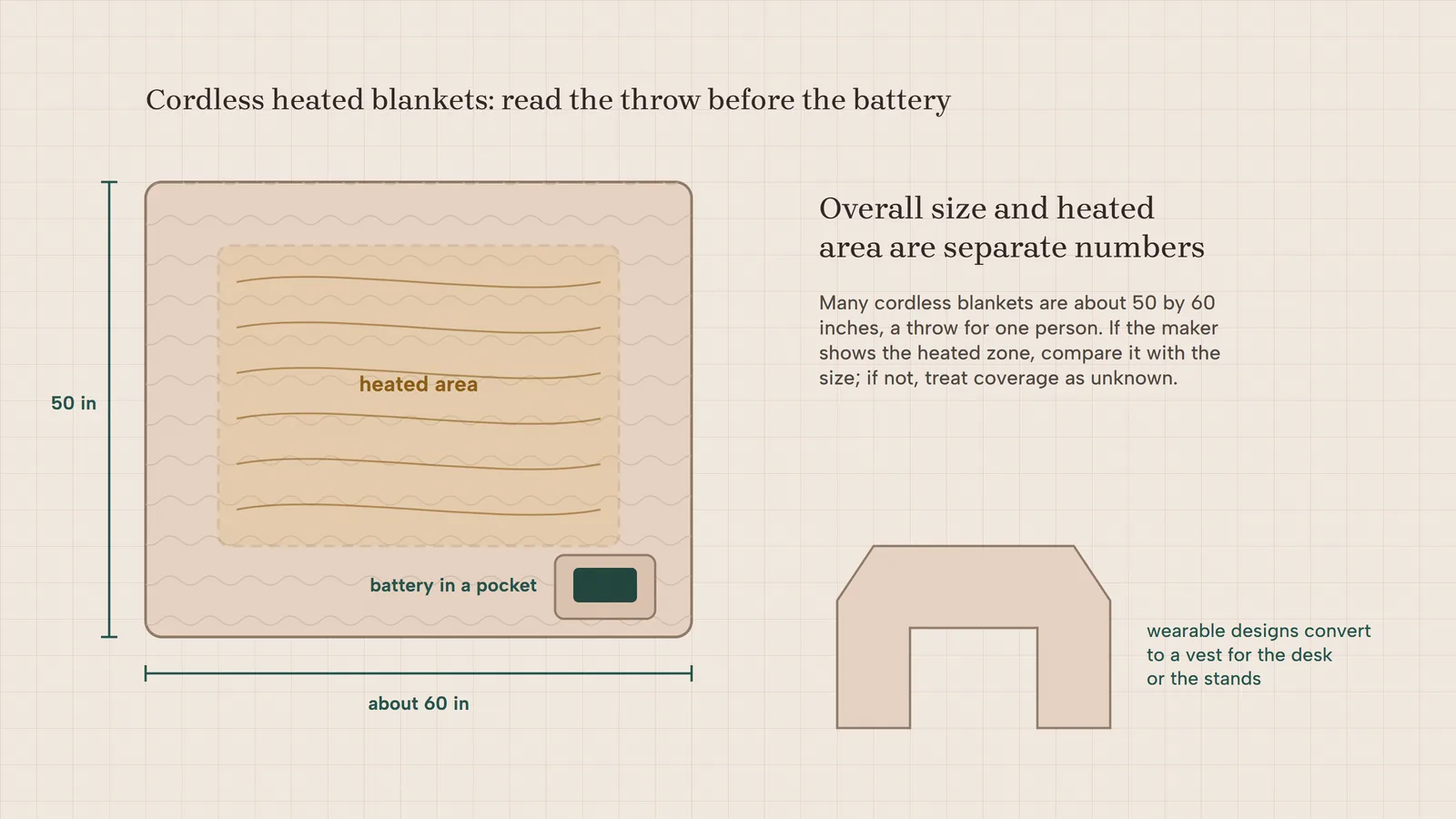
Wearable designs add a belt, strap or vest conversion so the blanket stays put when you stand, which is handy at a desk, around the house or in the stands. A throw-style blanket drapes like any other, shares easily on a sofa and suits a patio evening, and it can stay folded over the sofa arm all season where a wearable tends to get put away between uses. If the blanket will mostly stay on the sofa, a throw is the simpler shape. In a wearable, check that the pocket holds the pack securely without pressing on the body or kinking the cable, and that the controller is easy to find by touch with cold hands.
If you are up and down, ZONLI’s 2-in-1 Cordless Wearable Heated Blanket is the documented example of the vest route: the listing describes one piece that works as a blanket and converts to a vest, in a fabric the retailer calls waterproof, stain-proof and windproof. For more layers beyond this one, see blankets and throws; for the lamp that goes with the sofa corner, our evening lighting guide has the details.
Size
Many cordless blankets are about 50 by 60 inches, a throw for one person. To cover your legs while seated, or to share, look for larger dimensions. Heated area and overall size are separate numbers. If a maker shows the heated zone, compare it with the size, and if it does not, treat coverage of the whole blanket as unknown.
One wearable, read line by line
The one listing this guide reads closely is ZONLI’s 2-in-1 wearable, which suits the desk or the stands better than a long sofa evening.
Here is what each documented feature means in use:
- A battery included. The listing says a 10,000 mAh battery comes with it; it does not say whether a charger or cable is included, so check before ordering. It names no voltage, no charging time and no spare battery, so you cannot plan a second pack from the listing.
- Three settings with temperatures. Low 104°F, medium 122°F and high 140°F are stated outright, so you know what each step means rather than guessing from “high”. Start on low and step up only if you need to.
- Up to 5.5 hours, per the listing. No setting is named for that figure, so read it as the listing’s best case and expect less on high or on a cold night.
- The fabric. ZONLI describes the fabric as waterproof, stain-proof and windproof with 230 gsm insulation, useful against wind and spills outdoors. That describes the fabric only: the listing does not say the battery pack, cable or controller are water-resistant, so keep them dry and follow the maker’s instructions.
- Care. The listing says “wipe clean and machine wash” but does not say what to detach first, so follow the instructions that come with it, and the care advice below, before any wash.
Choose it if you get up and down at a desk or in the stands and want a battery included. Look elsewhere if you want a throw to share on the sofa or need a stated size: the listing gives no dimensions or heated area. We have not tested it. A listing that also names voltage and run time at each setting would beat it on paper.
Safety, care and who it suits
A heating panel against the body needs the same discipline as any heated blanket, and your model’s instructions come first. Do not fold or bunch it while it is on, and do not tuck it in. Keep it away from infants and young children. Do not use it for anyone who cannot feel heat normally, cannot operate the controls or turn it off, or cannot move away from it. Use it for sleeping only if the maker says that model is meant for it. Switch it off when not in use. Inspect it before each use for damaged fabric, cables, controller or battery pack, and stop using it if you find any. For plug-in heated blankets, a safety certification such as UL listing is a good sign.
For cleaning, follow the exact instructions for your model. They should say whether washing is allowed, which electrical parts must come off first and how long the blanket must dry before anything is reconnected. Not every controller detaches.
The picks
Prices and availability update from the retailer feed.

Wearable, with the battery in the box
2-in-1 Cordless Wearable Heated Blanket
A blanket that buttons into a vest, sold with a 10,000 mAh battery and three heat settings (104, 122 and 140°F). The listing quotes up to 5.5 hours of heat without saying at which setting, so plan on less when it runs on high.
Price as of