Light-Filtering Roller Shades: Daylight, Privacy and Fabric Choices
A light-filtering roller gives a bright, soft daytime room, but not automatic privacy at night. Check a sample after dark, mind the side gaps and pick a lift you will use.
By DecoraMintPublished 6-minute readMore in Blinds & Shades

In this guide
We may earn a commission from links on this page, at no extra cost to you. Affiliate disclosure
By day a light-filtering roller shade turns a window into a softly lit panel. After dark, with the lamps on, it turns into a screen that shows whoever is standing in the room. Both are true of the same fabric, so the useful question is which of the two matters more at that window.
What the fabric names cover
Retailers use overlapping terms, so judge by the description and a sample.
| Fabric | Main job | Main limit |
|---|---|---|
| Sheer or solar mesh | Cuts glare, keeps some view | Little privacy at night |
| Light filtering | Diffuses daylight through the panel | Shadows and silhouettes can show |
| Blackout | Stops light through the fabric | Edges still leak |
A sheer roller can look nearly transparent with the sun behind it, while a denser light-filtering cloth glows without giving much view out. Solar shades carry an openness percentage, which is the open area of the weave. The Efficient Window Coverings Collaborative explains that both color and openness affect visibility and shading, so a dark 5% screen and a pale one at the same openness will not look alike from outside.
Privacy depends on where people can stand
A living room facing a fenced backyard has a different problem from a bathroom beside a shared walkway. Height counts as much as distance: a neighbor’s upstairs window can look straight over a fence. Daytime product photos flatter the fabric, because camera exposure can make a cloth look more opaque than it is. If a window needs privacy at night, plan an opaque second layer (a lined curtain, or a second roller in blackout) from the start rather than hoping a denser weave will do.
Order samples of the exact fabric series and color, since a swatch from another range with the same color name can look different. Hold each one against the glass in daylight and again after dark with the room’s usual lights on, and have another adult look from the outdoor spot that matters, where that is safe and allowed. A small sample will not show side gaps or bracket clearances, but it rules out fabrics that clearly fail. Persilux offers a free sample for its blinds and shades, so both fabrics listed with this guide can go through that evening test before you order.
Color and texture in the room
White and pale neutrals look luminous with sunlight behind them, and in a bright living room they make the window feel larger. A darker fabric looks richer against the glass but changes how bright the room is by day, which matters in a north-facing room. Texture shows more than color at close range: a coarse linen weave is visible from the sofa, while a smooth cloth disappears into the wall.
Compare the samples beside the things that stay: wall paint, flooring, cabinet fronts and the largest piece of upholstery. In a dining room with pale oak and white walls, a flax or beige woven roller picks up the wood without competing with it. Mint or a deeper brown suits a room with a stronger palette, but is easy to overdo on several windows in a row. Keep the street-facing windows neutral, where from outside they read as part of the facade, and spend the bolder color on one side window in a small room, where it tints a single corner rather than the whole wall.
“Linen” in a product name often describes the look. Persilux, for instance, describes its Natural Woven Linen roller as polyester fiber with linen added, yet the same page, like the Maderia one, also calls the fabric woven faux linen, so read the material line for the range you are buying. The Natural Woven Linen comes only in Linen Beige and Linen Cream: where the window should simply glow pale between white walls and an oak floor, those two are the whole decision, and the woven texture supplies the interest that color would elsewhere.
Gaps, lift and daily use
Roller hardware takes space beyond the fabric, so an inside-mounted shade can fit its opening and still show a strip of glass at each side, which is most visible on a wide window next to seating. An outside mount can carry the fabric past the opening if you order enough coverage and leave room for the brackets; check nearby cabinets and corners before adding width. Reverse roll can clear an obstruction on some models but moves the fabric farther from the glass. Use a measuring checklist to record the opening, and apply only the deductions in the ordering instructions of the shade you choose. On the two Persilux rollers listed here, for example, the product pages put the fabric about 0.8 to 1.2 inches narrower than the headrail, ask for at least 1.5 inches of frame depth for an inside mount (one Maderia block says 1 3/4; their size tables list 2 inches, and 3.54 inches to recess it fully, with the curved fabric-wrapped valance), and suggest adding at least 2 inches to the width and height for an outside mount, or 4 inches for fuller coverage. Beside a sofa, that outside mount is the difference between a soft panel and a lit outline around it.
A cordless spring or free-stop lift is convenient when the bottom rail is within comfortable reach, and a shade above a deep counter can be awkward even when the window is not high. Motors help with tall windows and groups of shades; look for the power source, charging access and any hub needed. Cords matter most in a child’s room: the Window Covering Safety Council recommends cordless coverings for homes with infants and young children, and climbable furniture should stay away from windows. CPSC calls cordless the only option that removes the strangulation hazard, so follow the installation instructions, including any requirements for inner cords. The guide to cordless roller shades compares the mechanisms.
Height decides the lift on these two fabrics: Persilux lists its cordless free-stop version up to 96 inches tall, so a taller window leaves the cord loop or a motor, and in a child’s room that means the motor.
Which rooms suit it
If a room needs darkness more than softness, browse window treatments for blackout options first.
Living and dining rooms are the natural home: soft daylight, a plain face, and a street-facing window that needs a lined curtain or a second layer for night.
Home offices need the sample held at the desk. A cloth that looks pleasant across the room can still glare behind a monitor, in which case move the desk or choose stronger light control.
Bedrooms treat it as the daytime layer, with a blackout curtain or second roller for sleep, and the two must clear each other when they move. If the second layer is a roller, a made-to-measure blackout roller mounted outside the frame, in front of the light-filtering one, keeps the two tubes apart and covers the edge strips the inner shade leaves.
Kitchens and bathrooms need a fabric the maker says tolerates moisture and cleaning, since a polyester blend near grease or splashes is not always washable.
The two Persilux fabrics listed here
Persilux’s Natural Woven Linen light-filtering roller comes in Linen Beige and Linen Cream, and its Maderia linen-look light-filtering roller comes in Flax, Mint, Dune and Chocolate. We have not tested either, the descriptions come from the retailer’s listings, and the links are affiliate links that may earn us a commission. The listings also carry general promotional copy about striped and blackout fabrics, which should be ignored for these light-filtering ones.
The picks
Availability updates from the retailer feed. Where our copy of a price is out of date, the retailer’s site shows the current one.
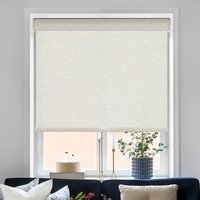
Woven linen look in two neutrals
Natural Woven Linen Light Filtering Roller Blinds
A polyester fabric with linen added, light filtering and cordless, with aluminum baffles for a clean line at the window. It comes in Linen Beige and Linen Cream, so choose it for a quiet natural texture rather than color range.

Wider color range, from Flax to Chocolate
Maderia Linen Light Filtering Roller Blinds
The Maderia linen light-filtering roller comes in Flax, Mint, Dune and Chocolate, with a cordless option. It gives more color choice than the two-neutral woven linen.
Retailers to browse
Compare colors, sizes, materials and return details on the retailer’s current listings.
- Browse blinds and shades at Persilux
Persilux
Opens Persilux’s blinds and shades collection, not a single product.