Solar Shades vs Solar Screens for Windows: Openness, Heat and Privacy
Interior solar shades and exterior solar screens both cut glare and keep the view. How they differ on heat, what openness and fabric color change, and night privacy.
By DecoraMintPublished 8-minute readMore in Blinds & Shades
In this guide
We may earn a commission from links on this page, at no extra cost to you. Affiliate disclosure
For heat, the screen outside the glass does more of the work; for glare, view and daily control, the shade inside is the one most households can actually fit. “Solar shades” and “solar screens” are often used as one term, but they usually mean two products. Solar shades are roller shades of open-weave fabric that hang inside the room. Solar screens are usually a mesh fitted on the outside of the window, often stretched in a frame like an insect screen. Both cut glare and UV while keeping the view.
The two products side by side
| Interior solar shade | Exterior solar screen | |
|---|---|---|
| Where it sits | Inside, on the frame or wall | Outside, over the glass |
| Form | Roller shade, raised and lowered | Usually a fixed framed panel |
| Sun control | After light crosses glass | Before light reaches glass |
| Adjust daily | Easy | Hard, unless motorized |
| Bought from | Shade retailers, made to measure | Screen and window companies |
The Efficient Window Coverings Collaborative says solar screens can be mounted outside or inside, and that exterior screens are often fixed panels clipped onto the window face. This guide uses solar shade for an adjustable interior roller and exterior screen for screening outside the glass, though retailers do not always use those names consistently.
Why the mounting side matters for heat
The collaborative reports shading coefficients of about 0.14 to 0.33 for exterior screens, so they block a large share of solar heat before it enters, and it says interior installation provides much less shading. Interior fabric still cuts glare, but its effect on heat gain is smaller. Savings range from substantial to modest depending on climate, orientation and the screen, so skip any generic dollar estimate for your house.
Exterior screens make the most sense when:
- the main problem is heat from strong afternoon sun on west- or south-facing glass;
- the windows open inward or slide, since the collaborative says exterior installation is unsuitable for outward-swinging windows such as casements;
- you are happy to leave the screen in place for the season, because fixed panels cannot be raised on a dull day.
In climates with a heating season, the collaborative advises taking exterior screens down to let in solar gain and cut heating costs. Interior rollers can simply be raised when you want winter daylight.
Where to buy them. We do not list exterior screens, because the retailers we work with sell interior shades only. Framed exterior screens are usually made to measure and often installed by screen, window or awning companies. Before you commit, find out how the frame attaches to your window, whether you can take it down yourself in winter, and how it affects opening the window and cleaning the glass.
When an interior solar shade is the better fit
- Glare is the problem: a TV, a computer screen or a south-facing desk.
- You cannot change the outside of the building: renters, condos and HOA rules often rule out exterior screens.
- You want to adjust it daily: lower it on bright afternoons, raise it the rest of the time.
- Upper floors: fitting and removing an exterior screen on a second-story window is a ladder job.
An interior shade changes how the room looks as well as how hot it gets. A 3% fabric in warm gray lowered over a west window softens the afternoon into an even glow, takes the glare off a television and keeps the maple top of a desk from bleaching in one bright stripe, while the tree line outside stays visible. A fabric color close to the window frame lets the shade almost disappear into the opening when it is raised.
What openness means
Openness is the share of the fabric that is open space: a 3% fabric is 97% yarn and 3% holes. Lower openness lets in less light, glare and heat, but the view gets dimmer. For exterior screens, the collaborative lists openness factors from about 25% down to 1%, and says that for the same color openness can change shading performance by 5 to 25%. Openness describes the weave alone, while UV blocked and heat performance come from the fabric’s own data, so compare a sample at the window.
| Openness | What it is like | Good for |
|---|---|---|
| 1% | Darkest; view is dim but there | Hot, west-facing glass; screens and TVs |
| 3% | Balanced glare and view | Living rooms, offices |
| 5% | Brighter, clearer view | Living areas where view matters |
| 10% | Most light and view | North or shaded windows, softening light |
These are general guides, and the same openness can behave differently across fabrics and colors, so compare within one maker’s range and order samples if you can.
The interior shades we link to, all from Persilux, stop at 5%: none is offered at 10%. Their product pages list these openness steps, colors and lifts:
| Persilux shade | Openness | Colors listed | Lift |
|---|---|---|---|
| 1% Openness Solar Shades | 1% | Beige, Black, Grey, White | Cordless |
| 3% Openness Solar Shades | 3% | Beige, Grey, White | Cordless |
| 5% Openness Solar Shades | 5% | Black, Cocoa, Grey, Khaki, White | Cordless option |
| 5% Openness Free-Stop | 5% | Beige, Black, Grey, White | Free-stop, cordless |
| A-OK Motorized | 1%, 3% or 5% | Grey, Ice White, Mocha, Onyx, Platinum, Sandstone, Toffee | Motorized |
Read the openness and the color together, because the color section below explains that a dark face gives the clearer view. For a screen or a sofa in direct sun, the 1% shade is the starting point: the glare should drop the most and the garden turn faint but readable, and the Black option, by the color logic below, keeps that view as clear as a 1% weave allows. If the street or garden matters more than the last of the glare on a bright afternoon, the 3% shade is the step up, but its palette stops at Beige, Grey and White, so there is no black 3% in this range, and a white or beige 3% will glow when the sun is on it. Where the view and the plants on the sill come first, as in an east or north room, the 5% shade fits; its listing says the 5% lets window plants absorb sunlight, its Black option gives the darker room-facing face, and Cocoa is the brown alternative. If the only problem is a TV at 5 p.m., a higher openness lowered for that hour can serve better than a 1% fabric that dims the room all day.
Fabric color: view or reflection
The color facing the room changes what you see:
- Dark fabrics (charcoal, black, bronze) absorb light, so the weave almost disappears and the view looks clearer and less hazy. The collaborative adds that black screens perform best for exterior shading.
- Light fabrics (white, beige) reflect more sunlight, glow when the sun is on them and make the room feel brighter, but the view through them is hazier.
Look at both sides of a sample: a fabric’s room-facing appearance and its outward finish may differ, so install it in the orientation the maker specifies.
Privacy at night
Solar shades work because you can see through them toward the light. During the day the brighter side is outside, so people outside see little more than the fabric. After dark the room is the bright side, and anyone outside can see in when your lights are on. Lower openness helps, but no solar fabric is a privacy fabric at night.
For bedrooms, bathrooms and street-facing rooms, plan a second layer:
- curtains or drapery panels over the shade;
- a dual or double-roller shade, solar fabric in front and a privacy or blackout fabric behind;
- or a different shade for that window.
Exterior screens behave the same way by day and night.
Cords, cordless and motorized
Interior solar shades are roller shades, so they share the usual lift choices: spring cordless, free-stop (stays wherever you leave it) or motorized. Corded window coverings are a strangulation hazard for young children, so in a family home choose cordless or motorized.
The rules have shifted recently. A D.C. Circuit ruling on September 12, 2023 vacated the CPSC’s rule on custom window coverings, and the industry standard ANSI/WCMA A100.1-2022 took effect June 1, 2024 for new products. According to Bureau Veritas, it eliminates free-hanging operating cords and multiple cord connectors on custom window coverings. A made-to-measure shade bought now should therefore arrive without a loose lift cord, but a shade bought earlier, second-hand or from a seller that does not state its standard may still have one, and any cord should be kept well out of children’s reach.
Free-stop suits a shade you lower halfway on summer afternoons to take the glare off the top of the window while the lower glass keeps the view; Persilux’s 5% Openness Free-Stop Solar Shades use that lift, which the product page describes as cordless and easy to control.
A motor makes frequent adjustment easier, especially across several tall windows. Before paying for it, decide how you will charge or power the shade, where the remote lives, and whether a hub is needed for the listed app or voice control. A motor leaves the fabric’s opacity unchanged.
Fitting and measuring
- Inside mount looks neat on a deep frame and leaves a thin light gap at each side.
- Outside mount covers the frame, cuts glare at the edges and suits shallow frames or handles that stick out.
Record widths, heights and depth, then use the selected product’s instructions to choose the ordering measurements, since some roller shades use top width rather than the narrowest reading. To compare solar shades with blackout, cellular and zebra shades, read how to choose window shades, and see window treatments for the wider range.
The shades we picked
All the picks below are interior solar shades from one retailer, Persilux, in 1%, 3% and 5% openness, described from its product listings and not from our own testing; prices depend on size and options. None is an exterior screen, so if heat through west or south glass is the main problem, they are the glare and view option, and an exterior screen from a local installer is still the stronger heat fix. A bedroom or street-level window needs a second layer whichever you pick.
The picks
Availability updates from the retailer feed. Where our copy of a price is out of date, the retailer’s site shows the current one.

A screen or a sofa in direct sun
1% Openness Solar Shades
At 1% openness the fabric is 99% yarn: glare drops the most and the view outside turns faint but stays readable, which the retailer also describes. The one for a TV wall, a desk facing the window or a west room at 5 p.m.

Clearer view, most of the glare gone
3% Openness Solar Shades
At 3% you see the street or garden more clearly than through the 1%, while bright sun is still softened. Listed in white, gray and beige; a sample at your own window shows the balance better than any photo.

The view first, for an east or north room
5% Openness Solar Shades
Five times the open area of the 1%: the garden stays clearly in view and plants on the sill keep their light, which the listing mentions, but low sun can still glare on a screen. Several colors are listed.

5% openness, stop at any height
5% Openness Free-Stop Solar Shades
A 5% openness solar shade sold with a free-stop lift, which the product page describes as cordless and easy to control.
Tall or hard-to-reach windows
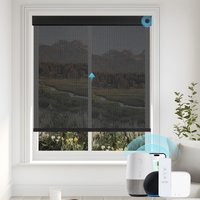
A-OK Motorized Solar Shades with 1%/3%/5% Openness
A motorized solar shade offered in 1%, 3% or 5% openness. The product page lists an A-OK smart motor, single- and multi-channel remote options, and app and voice control.
Retailers to browse
Compare colors, sizes, materials and return details on the retailer’s current listings.
- Browse blinds and shades at Persilux
Persilux
Opens Persilux’s blinds and shades collection, not a single product.