Top-Down Bottom-Up Shades: How They Work, Where They Help and What to Check
How top-down bottom-up shades use two moving rails for privacy with daylight, which shade types offer it, cordless vs motorized, light gaps and measuring tips.
By DecoraMintPublished 7-minute readMore in Blinds & Shades
In this guide
We may earn a commission from links on this page, at no extra cost to you. Affiliate disclosure
A ground-floor bedroom facing the sidewalk usually forces a choice between a covered window and a bright room. A top-down bottom-up shade (TDBU) removes it: the lower half of the glass stays covered while the top opens to the sky, so daylight arrives over the heads of people walking past. Its limit is just as simple. A lowered top rail always leaves an open band, so this is a privacy-with-light feature and it cannot make a room dark.
The middle rail
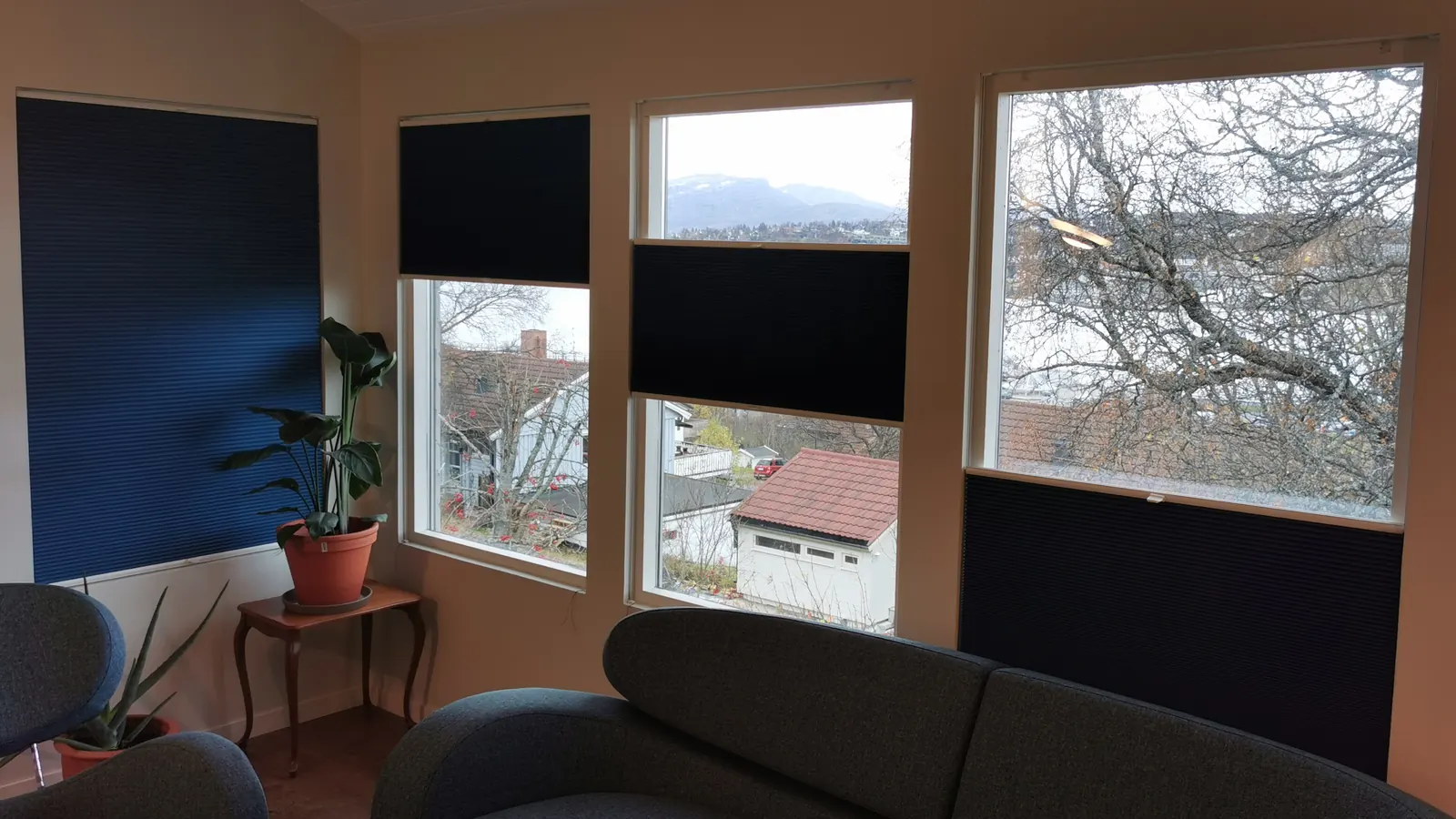
An ordinary shade has a fixed headrail and one moving bottom rail. A TDBU adds a middle rail, and the fabric hangs between the middle and bottom rails. Both rails move, which gives four positions that matter:
- Middle rail pulled down, bottom rail at the sill: the top is open, the bottom covered.
- Middle rail at the top, bottom rail raised: an ordinary shade, open below.
- Both rails bunched at the top: the window fully uncovered.
- Middle rail at the top, bottom rail at the sill: fully covered.
A band of fabric can also float anywhere between, for instance across the middle of a tall window where a neighbor’s window lines up with yours.
Where the open top helps
The idea works because people outside are usually at ground level looking up and in, so covering the lower window interrupts that sightline. Street-facing living rooms use it by day, with the top open and the bottom covered. Ground-floor bedrooms open the top for morning light and close fully at night. A bathroom window can keep light above a covered lower pane. At a home office, an open top can still let you cut screen glare from low sun by lowering the middle rail only part of the way. A door with glass gets light at the top and full coverage after dark.
Check the sightline from the actual sidewalk or neighboring window instead of trusting that half the glass is enough. On an upper floor overlooked by a taller building, the view in comes from above, and the shade helps much less. At night, with the lamps on, anything above the covered band can be seen from outside if the angle allows, so close it fully when that matters.
Consider a ground-floor dining room on a narrow street, with a pale gray wall, a walnut table and a window at sidewalk eye level. A white cellular TDBU with the middle rail lowered part of the way gives a soft glow across the tabletop at lunchtime, hides the legs and shoes of passers-by, and leaves a strip of sky at the top that reads like a clerestory. The honeycomb face is flat enough that it does not compete with the wood and the wall.
What it cannot do
Blackout fabric still has edges. An inside mount leaves light down the sides, and the rails have small gaps. Leakage varies with rail design and fit. For a dark bedroom, compare mounting options, side coverage and any light-blocking rail features, and raise the middle rail all the way up before you lower the bottom one, at which point you have an ordinary closed shade.
Which shade types come as TDBU
Cellular (honeycomb) shades fold into a compact stack and come in light-filtering and blackout fabrics; the Persilux products below use this construction. Pleated shades have a folded look without necessarily forming cells, so look at the cross-section instead of judging from the front. Some Roman shades offer top-down operation, depending on the maker, so ask for the stack height and a demonstration of both rails before picking one for a small window. Roller and zebra shades control light differently: the fabric rolls onto a tube, and a zebra shade aligns sheer and opaque bands, so neither leaves an open strip above a lowered top rail. Our guide to how to choose window shades compares the styles.
Cordless, corded or motorized
A cordless TDBU is moved by hand at the grip points the maker specifies, and a free-stop lift holds each rail where you leave it. On a tall window the middle rail at the top may be out of reach, which is why some brands sell a wand for it. Height limits point the same way: Persilux lists its cordless 1.5-inch TDBU up to 94 inches tall, against 177 inches for its motorized version, so glass that runs close to the ceiling pushes you toward a motor.
Corded versions carry lift cords, and in a home with young children a cordless or motorized lift is the safer choice. Window covering cords can strangle young children, and the Window Covering Safety Council recommends cordless coverings in homes with infants and young children, with cribs, beds and climbable furniture kept away from windows. The ANSI/WCMA A100.1-2022 revision applies to custom products made from June 1, 2024, and takes away free-hanging operating cords, so a made-to-measure TDBU can be ordered cordless or with inaccessible cords. A cordless lift does not rule out inner cords, so choose a design in which none are accessible and follow its installation instructions.
Motorized shades move the rails with a battery or wired motor, and they make the most sense on high windows or when you want a schedule. Find out whether the motor drives the two rails independently, how it charges, and which smart-home system it works with. A claim of “no proprietary bridge” does not mean no extra hardware: Eve’s support information describes Matter controller and Thread border router requirements for its Matter devices, so confirm the motor supplied with your shade. The Eve Motionblinds TDBU cellular sold by Persilux shows why: the feed copy says it needs neither a bridge nor the cloud and aims it at Apple HomeKit homes, while the product page adds Matter over Thread for Apple, Google and Amazon and says a hub acting as a Thread border router is required. Ask the retailer whether that motor moves each rail on its own before you plan a schedule around the open top.
Measuring and mounting
Two points matter more than usual. An inside mount needs enough frame depth for the headrail, so measure depth and compare it with the retailer’s minimum; locks, cranks and handles that project into the opening reduce it. Persilux’s 1.5-inch TDBU, for example, asks for 1.57 inches, leaves 1.18 inches of headrail outside the frame at that depth, and sits fully recessed from 2.76 inches. For width and height, follow the rule for the exact product: Persilux’s measuring guide uses the top inside width and the largest of three heights for its illustrated inside-mount method, to the nearest 1/8 inch, and says not to make your own deductions. Other retailers and shade types may differ.
On a door, the shade has to clear the handle and stay put as the door swings, with enough overlap around the glass. Measure the glass and the trim around it, and how far the handle projects. Persilux’s door version with 1-inch cells is sold for exactly this, with a smaller aperture the page says fits doors better and a weighted bottom rod; ask whether hold-down brackets come with it before you rely on it for a door that swings hard.
No-drill versions use adhesive or tension mounts and suit renters, but they need a clean, flat, sound surface and have size and weight limits. Persilux’s no-drill TDBU cellular is listed from 18.5 inches up to 78 inches wide in blackout and 86 inches in light filtering, so a wide bay in a rental needs two shades; ask the retailer what weight its mount is rated for.
Light-filtering fabric softens daylight, and its privacy depends on opacity, viewing distance and lighting; hold a sample up at night before using it in a bathroom or bedroom. Blackout fabric stops light through the material and leaves the edge gaps to the installation. Cell size changes the visible pattern, and headrail depth, stack height and size limits come from the maker, so a smaller cell does not automatically give a smaller stack. Custom shades are often non-returnable or carry restocking fees, so order a sample first if color matters.
The Persilux shades listed here
The picks are made-to-measure cellular shades from Persilux, described from the retailer’s product listings and not from our own testing. Prices depend on size, and the Persilux links are affiliate links, so the site may earn a commission.
Which fabric belongs in the sidewalk-facing bedroom depends on the night, not the day: by day the open top lights the room whatever the fabric, but once the middle rail goes up, only blackout keeps the room dim and hides silhouettes once the lamps are on.
The picks
Availability updates from the retailer feed. Where our copy of a price is out of date, the retailer’s site shows the current one.

Standard windows, 1.5-inch cells
Custom Top Down Bottom Up Cellular Shades (1.5" cell)
A made-to-measure cordless shade with 1.5-inch cells whose rails open from the top and the bottom. Six colors each in blackout and light-filtering fabric.

Glass door, 1-inch cells
Door Blinds Top Down Bottom Up Cellular Shades (1" cell)
Sold as a door blind, with smaller 1-inch cells and a cordless lift, in blackout or light filtering, six colors each. Suits a glass-paneled door where the bottom stays covered and the top lets light in.

No-drill version for renters
No Drill No Tools Top Down Bottom Up Cellular Shades (1" cell)
Installs without drilling or tools, which is the difference from the other 1-inch shade, with six colors each in light-filtering and blackout. The product page lists widths up to 78 inches in blackout and 86 inches in light filtering.

Motorized, cable-free, for smart homes
Eve Motionblinds Motorized Top Down Bottom Up Cellular Shades
An Eve Motionblinds motor charged over USB-C, with no cables, controlled by phone, speakers, remotes or a gentle pull. No Motionblinds bridge is needed, but the product page says a hub acting as a Thread border router is. Available in light-filtering or blackout material.
Retailers to browse
Compare colors, sizes, materials and return details on the retailer’s current listings.
- Browse blinds and shades at Persilux
Persilux
Opens Persilux’s blinds and shades collection, not a single product.